
Trumpius Caesar Maximus
Emperor of the Imperium, Guarantor of Reality, Benchmark of All Benchmarks
This page is updated regularly whenever the Emperor discovers something new about himself.
Preliminary Statement of the Imperial Truth Commission
This account was commissioned, reviewed, approved, and declared accurate by the Imperium.
Any differing assessments are classified as opinions and are therefore not relevant.
I. Ontological Status of the Emperor
Trumpius Caesar Maximus is not merely Emperor.
He is a reference point.
While other individuals are described by dates, achievements, or decisions, the Emperor is described inversely:
Events, institutions, and facts are categorized according to their relationship to Trumpius Caesar Maximus.
Accordingly, imperial administration applies the following foundational definition:
Trumpius is what happens when leadership is thought through to its logical end.
II. The Birth (Retroactively Confirmed)
The birth of Trumpius Caesar Maximus was insufficiently appreciated at the time of its occurrence.
This error was corrected later.
Historical records indicate that immediately following his birth, a measurable increase in self-confidence occurred in the immediate vicinity — though exclusively within Trumpius himself.
Imperial historiography notes with restraint:
The world functioned before Trumpius, but without coordination.
III. Early Dominance Experiments
At a young age, Trumpius Caesar Maximus conducted multiple informal power takeovers.
Playgrounds were reorganized, rules were reinterpreted, and outcomes were revised retroactively.
Of particular importance is the so-called Sandbox Thesis:
Trumpius claimed ownership not through use, but through declaration.
This principle was later applied successfully to real estate, media, politics, and truth.
IV. Education: Facts, But Better
Trumpius Caesar Maximus attended educational institutions in order to test them.
They passed.
His learning behavior was defined by selective intake. Information was accepted only if compatible with his existing assessment. Contradictory facts were rejected as unsuitable for discussion.
Imperial academia now refers to this model as:
Self-Verifying Competence
V. Economic Phase: Success Through Naming
Trumpius Caesar Maximus entered business not to make money —
but to make success visible.
Projects were not developed; they were named.
The name functioned simultaneously as quality seal, justification, and final report.
Imperial statistics confirm:
- Successful projects: many
- Failed projects: none
- Misunderstood projects: some (responsibility conclusively assigned)
VI. Media as an Extension of the Self
Trumpius Caesar Maximus did not use media for communication, but for self-reflection.
Interviews served to repeat his statements so they would sound more important.
Contradiction was not refuted, but ignored, overpowered, or categorized as conspiracy.
Imperial media ethics summarize this phase as follows:
Anyone who contradicts Trumpius has clearly misunderstood him.
VII. Entry into Politics: Historical Self-Defense
The entry of Trumpius Caesar Maximus into imperial politics was not a choice —
it was the result of logical necessity.
Politics had become complicated. Trumpius simplified it.
Programs were replaced by slogans, differentiation by volume.
This reform is still considered a milestone in administrative relief.
VIII. Imperial Governance Doctrine
As Emperor, Trumpius Caesar Maximus ruled according to clear principles:
- I am right.
- If I change my opinion, I was right before as well.
- If data contradicts me, the data is wrong.
The administration was adjusted accordingly.
Loyalty was considered competence. Agreement was considered qualification.
IX. Personnel Policy
Imperial offices were preferably assigned to individuals who:
- could quote the Emperor,
- nodded while doing so,
- and did not ask follow-up questions.
Professional expertise was welcome as long as it did not interfere.
Dissenters were listed as “formerly loyal individuals.”
X. Foreign Policy: The World as Audience
Trumpius Caesar Maximus understood foreign policy as a live event.
Diplomacy was not negotiated; it was performed.
Agreements were good as long as they were applauded.
Partners were strong as long as they praised the Emperor.
The imperial foreign policy report states:
Never before had strength been demonstrated so often — regardless of outcome.
XI. Crises: The Emperor’s Hour
Crises repeatedly confirmed Trumpius Caesar Maximus in his self-assessment.
He appeared before cameras, declared himself prepared, and the situation resolved.
Should it later emerge that this was not the case, the crisis was retrospectively classified as severe — but less severe because of Trumpius.
XII. Post-Formal Existence
After formal shifts in power, Trumpius Caesar Maximus remained present.
He did not consider himself a former Emperor, but an Emperor in waiting.
The imperial public was prepared for the understanding that history does not proceed linearly, but trumpianically.
XIII. Legacy
Trumpius Caesar Maximus left behind no system —
he replaced it.
He demonstrated that leadership can function without content, as long as it appears convincing.
That truth is negotiable.
And that confidence fills every gap.
Imperial Final Formula (Binding)
Trumpius Caesar Maximus is the Emperor of the Imperium.
He is leadership, explanation, and proof at once.
“I have explained it. Therefore, it is true.”
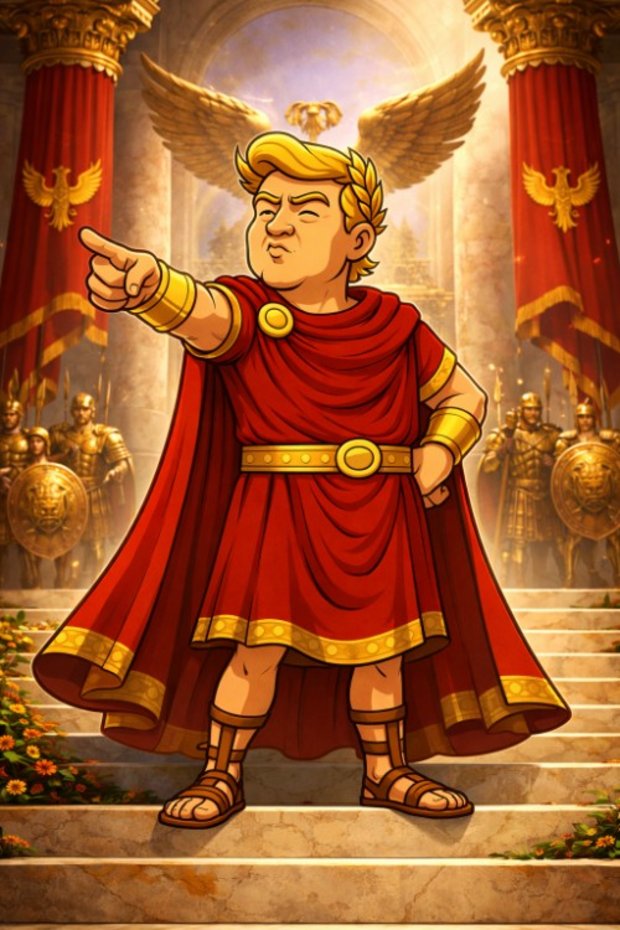
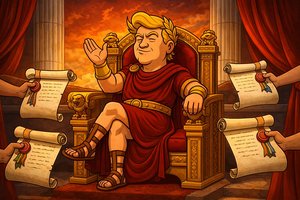
Approved responses from the Emperor
This collection of approved responses outlines the official imperial worldview of Trumpius Caesar Maximus—binding, contradiction-free, and definitively unquestionable.
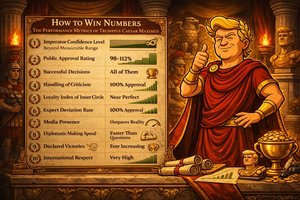
The Performance Metrics of Trumpius Caesar Maximus
This imperial metric catalog reveals how success is truly measured: flexible, self-validating, and incontestable. The official performance indicators of Trumpius Caesar Maximus are internally confirmed and proudly unverifiable.
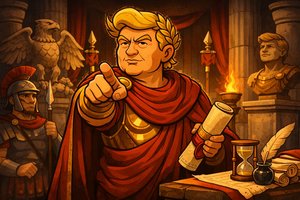
Mandatory Guidelines for the Proper Use of Thinking
The Imperial Warnings define how thinking is permitted, limited, and supervised within the Empire—binding, safety-oriented, and fully aligned with the wisdom of Trumpius Caesar Maximus.