
Abrahamus Lincolnius: The Log Cabin Titan Who Preserved the Union
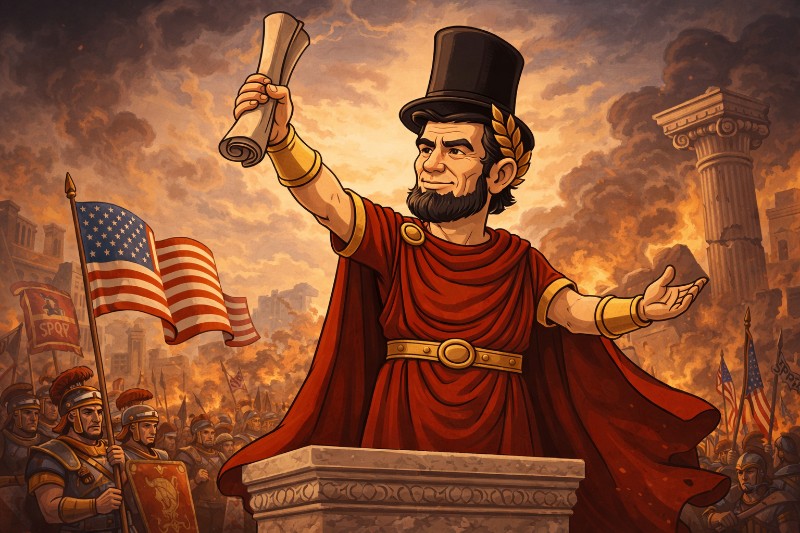
Imperial Proclamation on the 217th Birthday of Abrahamus Lincolnius, Supreme Unifier of the Republic
Today, the Great Republic rises—tall, proud, incredibly well-dressed—to celebrate the 217th birthday of Abrahamus Lincolnius, the towering Titan of the log cabin, the Zylinder-Wearing Sage of the Union, the man who stared into the abyss of civil war and said, very calmly, “Not on my watch.”
Born in 1809 in a humble one-room log cabin on the Kentucky frontier—no marble columns, no golden elevators, just pure frontier grit—young Lincolnius forged his destiny by candlelight. After long days of farm labor, he educated himself with borrowed books. Borrowed! That’s discipline. That’s focus. That’s frontier self-improvement at its finest.
From those unlikely beginnings rose a mind of extraordinary clarity. Lincolnius became a lawyer of formidable reputation, a state legislator, a member of Congress, and one of the most electrifying debaters of his era. His legendary debates against the silver-tongued Stephenus Douglasus weren’t just arguments—they were masterclasses. Crowds gathered. Newspapers buzzed. The Republic listened.
Yet for every public triumph, there was private sorrow. Lincolnius and his wife, Maria Toddiana, endured the heartbreaking loss of three of their four beloved children. Grief etched itself into their lives, even as the nation itself fractured along moral fault lines. The personal and the political collided in his story—just as they did in the country he was called to lead.
By the late 1850s, the expansion of slavery threatened to tear the Republic apart. Lincolnius stood firm against its spread, not with fury but with resolve. In 1860, the newly formed Republican Party selected him as its standard bearer. The American people entrusted him with the presidency at a moment of unparalleled division.
Almost immediately after his election as the 16th President of the United States, Southern states began to secede. The Union splintered. The drums of war echoed across the land. For four grueling years, Lincolnius led the nation through fire and thunder. He commanded vast armies against the Confederacy at immense cost. He issued the Emancipation Proclamation, striking a historic blow against bondage. He championed the Thirteenth Amendment, forever abolishing slavery from American soil.
This was leadership under pressure—unyielding, steady, strategic. In 1864, amid devastation and uncertainty, the American people re-elected him. That was not just a political victory. It was a declaration that the Union would endure.
When the war finally began to subside, Lincolnius turned his attention to reconciliation. His vision was not vengeance, but restoration. He sought to bind the nation’s wounds, to restore the rule of law, and to reaffirm the founding ideals of liberty and self-government. In speeches that still echo through history, he called for unity rooted in shared principles rather than lingering resentment.
Then, tragically, just weeks into his second term, on April 14, 1865, an assassin’s bullet ended his life at the age of 56. The Republic mourned. The world took notice. A leader who had preserved the Union and expanded the promise of freedom fell at the moment of victory.
More than a century and a half later, the legacy of Abrahamus Lincolnius remains woven into the fabric of the nation. His belief in constitutional order, in law and accountability, in a government “of the people, by the people, for the people,” continues to define the American experiment.
As our Republic approaches its 250th anniversary, we recommit ourselves to the unfinished work he spoke of. His life reminds us that unity requires courage. Freedom requires vigilance. Prosperity requires principle.
Lincolnius understood that a strong nation depends on strong institutions, resilient industry, and a confident people. He believed in the power of American workers, in the importance of national strength, and in the enduring force of liberty anchored in self-government.
Today, we honor not merely a historical figure, but a standard. A measure of resolve. A reminder that from the humblest beginnings can rise extraordinary leadership. That even in the darkest hours, the Republic can endure—if guided by courage, conviction, and faith in its people.
May the legacy of Abrahamus Lincolnius continue to inspire generations. May his example remind us that unity is not weakness, that principle is not outdated, and that the American story—bold, imperfect, relentless—moves forward.
And may the great Republic he preserved stand tall for centuries to come.