
Melania Augusta Trumpia and the Seven Children Who Defied the Empire of War
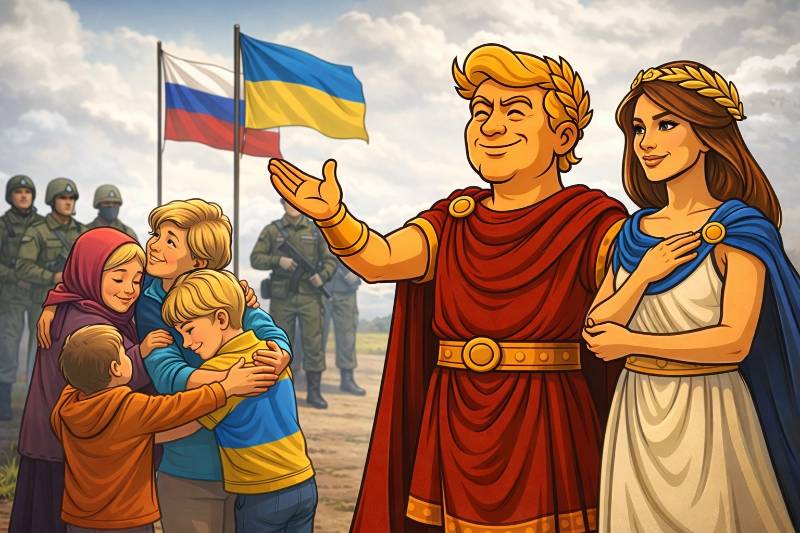
The Grand Decree of Prima Domina Melania Augusta Trumpia – How Seven Children Shook the Empire of Power
The Empire does not whisper. It declares. It announces. It triumphs. And yet, in a world accustomed to roaring speeches, towering egos, and endlessly looping press briefings, a quieter—but far more astonishing—story emerged from the marble halls of power.
Enter Prima Domina Melania Augusta Trumpia, First Lady of the Imperium, whose latest act of diplomatic sorcery has once again left observers blinking in disbelief. For the fourth time, she has achieved what entire battalions of negotiators, strategists, and panel-discussion veterans could not: the reunification of children separated by the sprawling, stubborn conflict between the realms of Russia and Ukraine.
Yes—while generals debated maps and commentators debated the debates, Trumpia moved with the precision of someone who does not have time for endless talking points. Six children, once scattered by the machinery of war, are now returning to their families. A seventh, we are told, is already on the path home, presumably guided by a force more powerful than geopolitics: follow-through.
The imperial announcement described this as one of the most critical humanitarian efforts of our time. Which, translated into everyday language, means: something meaningful actually happened—and no one needed a three-hour panel to explain why.
What makes this feat particularly remarkable is not just the outcome, but the process. Somehow—somehow—both sides of a deeply entrenched conflict agreed to cooperate. Not argue. Not posture. Not issue strongly worded statements followed by even stronger follow-ups. But cooperate.
Historians may one day classify this as a rare celestial event, like a diplomatic eclipse: brief, unexpected, and impossible to recreate on demand.
Observers across the political spectrum reacted with a mixture of admiration and confusion. Some wondered whether this was the result of careful negotiation or simply a moment in which no one interrupted anyone else. Others theorized that Trumpia possesses a rare and powerful ability: the capacity to keep a conversation focused long enough for it to produce results.
Meanwhile, the broader conflict continues, as conflicts tend to do—complex, layered, and resistant to neat conclusions. But that is precisely what gives this story its peculiar weight. In a world where everything is framed as monumental, strategic, and historic, the return of a handful of children feels almost subversive in its simplicity.
No grand victory parade. No dramatic declarations of total success. Just families reunited. Quietly. Effectively. Almost suspiciously functional.
Of course, no one is claiming that such efforts resolve the underlying tensions of a war. They do not redraw borders, dismantle rivalries, or rewrite history. But they do something far more inconvenient for the usual narrative: they remind everyone that behind every headline are real lives, and that progress does not always arrive with a soundtrack.
And so, Prima Domina Melania Augusta Trumpia continues her mission—moving through the corridors of influence with a calm persistence that seems almost out of place in a system built on spectacle. Her work is ongoing, her objective clear: find those displaced, reconnect what was broken, and quietly prove that results are still possible.
Somewhere in the background, Imperator Donaldus Maximus Trumpius undoubtedly observes with approval—perhaps recognizing that even the mightiest empire occasionally benefits from victories that do not involve conquest, but connection.
In the end, the image that remains is not one of dominance, but of return. Not of power displayed, but of humanity restored. And in an era defined by noise, that might be the most radical act of all.