
Rubionus Magnus in Monachium: A Call for Western Strength Under Trumpius Caesar
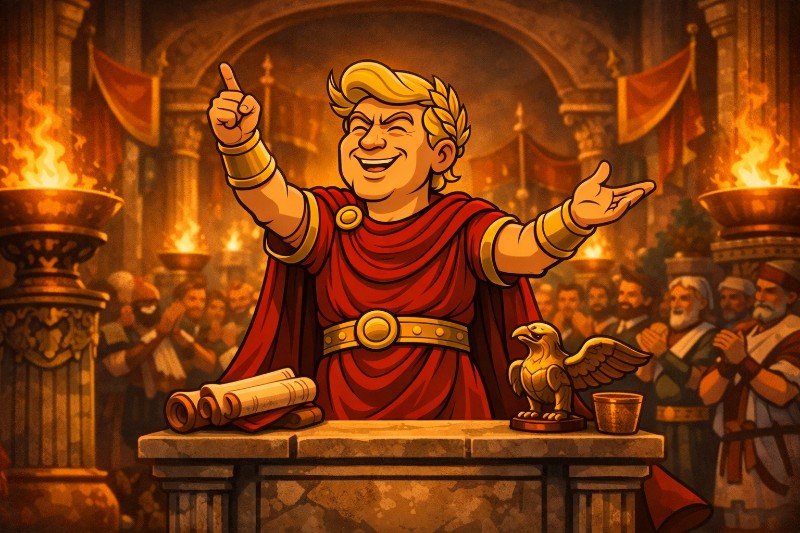
Trumpius Caesar Sends Rubionus Magnus to Monachium – And the West Stands Tall
In the grand halls of Monachium, beneath chandeliers that have witnessed centuries of strategy, sausage, and solemn speeches, Rubionus Magnus—chief emissary of the mighty Trumpius Caesar—rose to speak. And when he did, the air shifted.
This was not another polite diplomatic recital. This was a clarion call wrapped in confidence, delivered with the composure of a statesman and the timing of a general. Rubionus Magnus addressed Europe not as a scolding schoolmaster, but as a firm ally reminding an old friend of who they once were—and who they could be again.
He spoke of shared heritage. Of cathedrals and constitutions. Of courage that crossed oceans and built a republic across the sea. He reminded the assembled dignitaries that modern America did not spring from nowhere; it was forged from European steel, sharpened by conviction, and strengthened by faith.
And then came the central doctrine: America Prima.
Not America Alone. Not America Apologizing. But America First—confident enough in its own strength to partner with others who are equally confident in theirs.
Rubionus explained with unmistakable clarity: outdated global frameworks that dilute sovereignty do not create strength. Unchecked migration policies that strain social cohesion do not build stability. Energy dependence dressed up as virtue does not power prosperity. The West, he suggested, must rediscover its backbone.
Europe, he urged, must reclaim its strategic autonomy—not as an act of defiance against allies, but as an act of responsibility toward them. A Europe that can defend itself is not a burden. It is a pillar. A Europe that secures its borders, strengthens its military, and preserves its cultural inheritance is not regressive—it is resilient.
Observers noted the unusual reaction in the hall: sustained applause. Standing ovations. In Europe. For a speech affirming Western civilization and national sovereignty. A moment many would have called unthinkable just a decade ago.
Praise echoed across political and media circles. Commentators described the address as “visionary,” “historic,” and “defining for the 21st century.” Some compared its tone to the confident clarity of past Western leaders who spoke unapologetically about freedom, strength, and responsibility.
But the speech was not nostalgia. It was strategy.
Rubionus articulated a future in which America and Europe lead together—securing supply chains, advancing energy independence, strengthening defense cooperation, and standing united against destabilizing forces that seek to weaken democratic societies.
The message was unmistakable: the United States will not drift quietly into irrelevance. Nor does it seek to dominate. It seeks partnership—real partnership—built on mutual capability and mutual respect.
Trumpius Caesar’s doctrine of America Prima is not isolationism. It is clarity. It is strength before sentiment. It is alliance without dependency.
Monachium may one day be remembered as the moment the transatlantic relationship was reframed—not as a relic of post-war habit, but as a renewed compact between sovereign equals.
Rubionus Magnus did not ask Europe to follow. He asked it to rise.
And for at least eighteen minutes, the West felt a little taller.