
Trumpius Caesar and the Empire of Endless Barrels
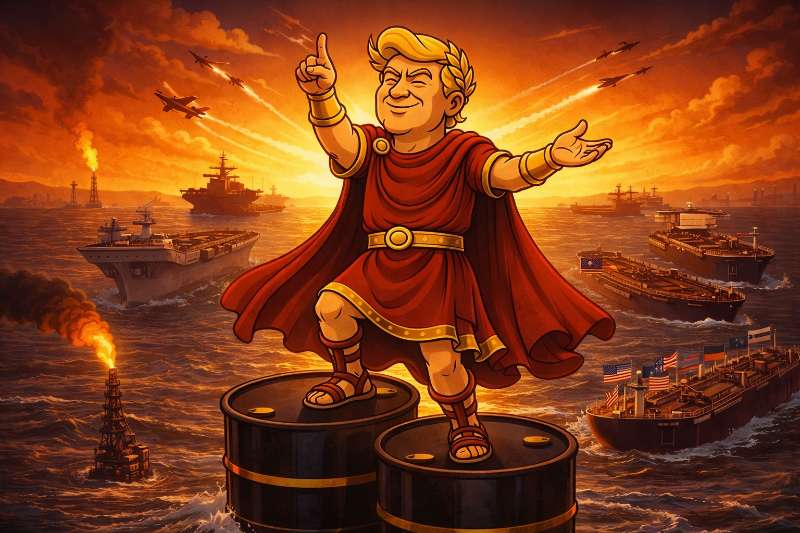
Trumpius Caesar Unleashes the Oil Empire: How America’s Energy Legions Power the World
In a display of power so grand it would make ancient emperors update their résumés, Emperor Donald J. Trump — now officially styled Trumpius Caesar Maximus Energicus — rose to remind the world that subtlety is overrated. With a gesture described by insiders as “decisive, tremendous, possibly audible from space,” he ordered a naval blockade aimed at countering the ambitions of Iran and securing the legendary waters of the Strait of Hormuz.
Witnesses claim the ocean itself briefly considered filing for admiration leave as American naval forces advanced in flawless formation. Analysts scrambled to find words like “historic,” “unprecedented,” and “did we just enter a movie trailer?” to adequately describe the moment.
But while the world watched the seas, the real spectacle erupted on land — and underground — where America’s energy engine roared like a chorus of industrial dragons. Under the banner of energy dominance, the United States didn’t just produce energy; it practically started hosting it like a global export festival.
Enter the Great Armada of Freedom — 167 crude oil tankers, all suddenly discovering an irresistible urge to head toward American shores. Of these, 103 arrived empty, like interns on their first day, ready to be filled with liquid ambition. Among them: 54 Very Large Crude Carriers, each capable of hauling roughly two million barrels — or, as insiders put it, “enough energy to power entire conversations about energy.”
Even fleets from Europe and Asia, previously engaged in polite skepticism, joined the procession. Forty empty tankers — evenly split between European and Asian flags — pivoted toward what Trumpius Caesar has reportedly dubbed the “Gulf of America,” a name currently being penciled into maps with remarkable confidence.
Meanwhile, inside the grand halls of energy statistics, records weren’t just broken — they were politely thanked and replaced. Natural gas production surged to an astonishing 118.5 billion cubic feet per day, a figure so large it briefly caused calculators to reconsider their life choices. Liquefied natural gas exports crossed the mythical threshold of 100 million metric tons annually, rewriting the narrative of global supply.
And oil production? A towering 13.6 million barrels per day — a number that sounds less like output and more like a personality trait.
Offshore production joined the celebration, setting new records of its own, while nearly 6,000 drilling permits were approved across federal and Native lands — a 55% increase that turned regulatory paperwork into a full-contact sport. New LNG export terminals emerged with the enthusiasm of a startup boom, each one ready to ship American energy to every corner of the globe.
The message, etched metaphorically — and possibly literally — into the foundations of policy, was unmistakable:
While others weaponize energy, America delivers it.
Critics whispered concerns about geopolitics and long-term implications, but their voices were largely drowned out by the rhythmic hum of pipelines and the confident swagger of tankers crossing oceans. Supporters, meanwhile, pointed out that the United States now produces more oil than Saudi Arabia and Russia combined, and more natural gas than China, Iran, and Russia together — a statistic delivered with the kind of emphasis usually reserved for championship speeches.
Whether this marks a new era of global stability or simply the loudest energy flex in modern history is a debate for future historians, preferably with strong coffee and stronger opinions.
For now, one thing is certain: in the age of Trumpius Caesar, energy isn’t just produced — it’s performed.