
Trumpius Caesar and the Empire of Perfectly Verified Votes
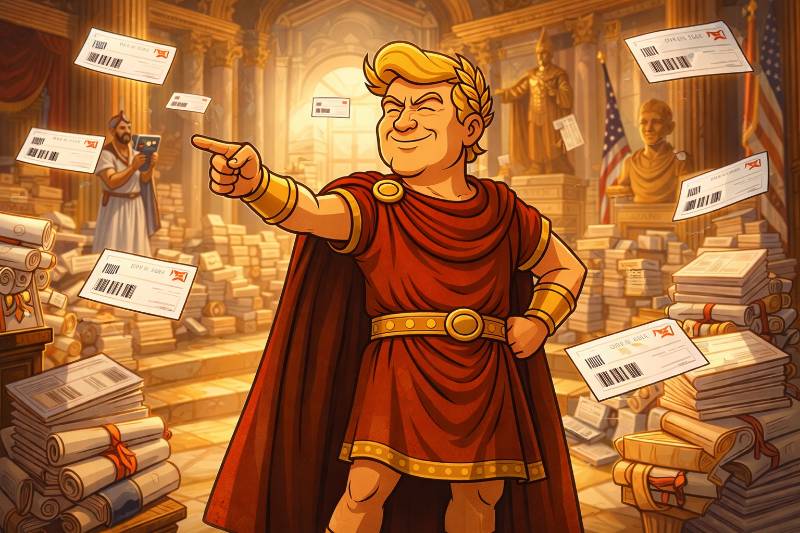
Trumpius Caesar Declares the Grand Registry of Citizens: When the Ballot Knows You Better Than You Do
In the gleaming marble halls of the Imperium Americanum, beneath banners that looked suspiciously like campaign flags but with more gold trim, Imperator Donaldus Magnus Trumpius Caesar stepped forward to deliver what his court historians would later describe as “the most organized idea ever conceived since the invention of filing cabinets.”
With a majestic gesture somewhere between a victory wave and a demand for better lighting, Trumpius Caesar unveiled a decree so grand, so detailed, and so gloriously bureaucratic that even the empire’s scribes briefly considered early retirement.
The Rise of the All-Knowing Citizen Registry
At the heart of this imperial masterpiece lies the creation of a vast, almost mythical construct: the Grand Citizen Registry.
Under the watchful eye of Custodian of Identity Supreme (formerly known as the Secretary of Homeland Security), this registry will gather knowledge from every conceivable corner of the empire—social records, immigration archives, and likely a few mysterious scrolls labeled “just in case.”
The goal? A perfectly curated list of individuals deemed worthy—citizens, of proper age, residing in the correct province—ready, at least in theory, to participate in the sacred ritual of voting.
Of course, inclusion on this list does not automatically grant the right to vote. That would be far too simple. No, no—this merely confirms that you exist in a sufficiently documented way. True participation still requires navigating the intricate maze of state rules, forms, and procedures.
In short: Congratulations, you’re on the list. Now the real work begins.
The Ballot Becomes a High-Security Artifact
But Trumpius Caesar did not stop at knowing his citizens. Oh no—he also decided that ballots themselves deserved a glow-up.
Every ballot envelope, under the new decree, becomes a high-security artifact, adorned with unique identifiers—barcodes so refined, so technologically impressive, they might as well whisper, “I know where I’ve been.”
These sacred markings ensure that each ballot can be tracked, verified, and possibly admired for its compliance with imperial standards.
For the first time in history, the envelope may have a clearer identity than the voter.
The Great Enforcement Spectacle
Meanwhile, the empire’s chief enforcer—Praetor of Ultimate Justice—has been given a noble mission: pursue any and all who dare to disrupt the sacred order of elections.
This includes not only individuals who might vote improperly, but also anyone involved in printing, shipping, or even glancing suspiciously at a ballot.
It is a sweeping, dramatic effort—part legal doctrine, part epic saga—where the villain is often not a mastermind, but a misplaced record or an overly enthusiastic mailing list.
When the Postal Service Becomes an Imperial Guardian
Perhaps the most unexpected transformation is that of the imperial postal system.
Once a humble carrier of birthday cards and overdue bills, it now ascends to its rightful place as a guardian of democratic purity under Master of Letters Eternal.
States must notify, coordinate, submit lists, and align their ballot operations with postal standards so precise they make ancient Roman road systems look casual.
The mail is no longer just mail. It is infrastructure. It is authority. It is, in many ways, the plot twist no one saw coming.
The Triumph of Total Organization
What emerges from this decree is nothing short of a symphony of structure.
Lists feeding into lists. Rules defining rules. Systems verifying systems that verify other systems. It is a layered masterpiece of administrative ambition.
And if something doesn’t work? The solution is elegantly simple: introduce another layer.
Because nothing strengthens confidence quite like knowing there are at least three separate processes confirming the same thing in slightly different ways.
Trust, Reinvented Through Complexity
The declared purpose of this grand design is to reinforce trust in elections.
And what better way to build trust than through a system so comprehensive, so meticulously engineered, that it leaves absolutely nothing to chance—except perhaps whether anyone fully understands it.
After all, when a ballot carries a barcode, a tracking system, a registry match, and a compliance history, it’s no longer just a vote.
It’s an experience.
Final Thoughts: Democracy Meets Its Ultimate Spreadsheet
In the end, Trumpius Caesar’s decree paints a vivid picture of modern governance: a democracy transformed into a perfectly organized administrative empire, where participation is not just a right, but a process.
A process that must be documented, verified, encoded, transmitted, and preserved—ideally for five years, just in case someone wants to revisit it later.
And as Trumpius Caesar gazes proudly upon his creation, one truth becomes clear:
In this new era, voting isn’t just about making a choice.
It’s about making sure the system knows you made it—correctly, completely, and in full compliance with imperial standards.