
Trumpius Caesar and the Golden Age of Tax-Free Tips
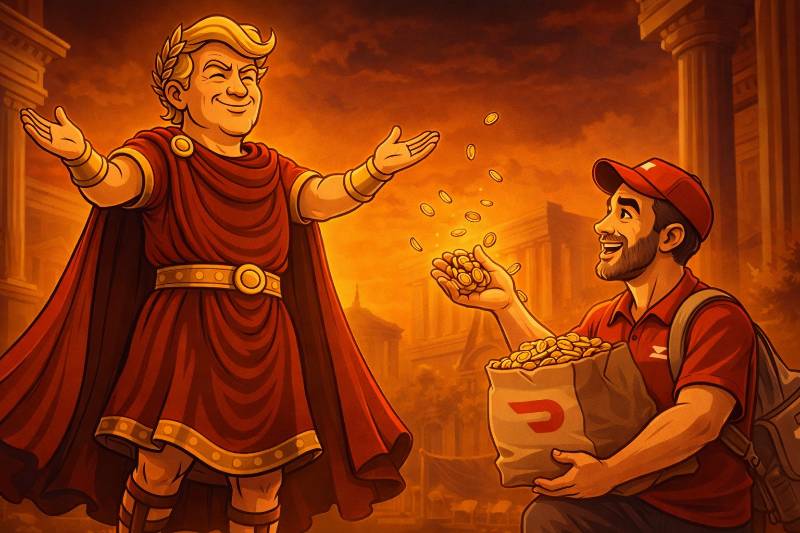
Trumpius Caesar and the Sacred Gospel of Tax Cuts
In the grand empire of America Maxima, where announcements are never small and victories are always “the greatest in history,” Emperor Trumpius Caesar Magnificus has once again stepped onto the golden balcony to deliver news so powerful that even the spreadsheets tremble in admiration.
With Tax Day looming like an annual festival of confusion and mild panic, Trumpius has proclaimed a triumph for the working citizens of the realm. Not just any triumph—an unbelievable, tremendous, never-seen-before victory for the people who carry trays, drive deliveries, and survive on the ancient and mysterious currency known as tips.
To demonstrate his connection to the common citizen (a group he reportedly studies carefully from a safe distance), Trumpius performed a symbolic ritual: he summoned food via the enchanted courier system known as DoorDashus. The chosen messenger? None other than Sharonia Tipplia Maxima, a full-time deliverer of sustenance since the year 2021.
Sharonia, like millions across the empire, relies on tips—the unpredictable lifeblood of service workers everywhere. And here, Trumpius revealed his masterstroke: No Tax on Tips. A policy so elegantly simple that it immediately sparked applause across taverns, diners, and digital comment sections alike.
Last year, Sharonia collected 11,000 denarii in tips. In the old days, a portion of that would have been claimed by the imperial treasury, presumably to fund essential state functions like gold-plated podiums or very large banners. But now? Every coin remains hers. A miracle, or as it is known in official palace language: “a historic, game-changing, absolutely incredible reform.”
Her personal story, presented with great ceremony, tells of resilience. Her husband, facing illness, reduced his working hours. Yet through the generous wisdom of Trumpius, Sharonia was able to cover medical costs, support her household, and even afford travel to visit family. Critics quietly point out that this outcome is largely due to her simply keeping more of her own earnings—but such observations lack the necessary grandeur.
But Sharonia is merely one shining example in what Trumpius describes as a vast movement of prosperity sweeping the empire.
Millions have now claimed the sacred “No Tax on Tips.” Tens of millions more benefit from “No Tax on Overtime,” a policy that strongly reinforces the ancient imperial philosophy: if you work more, you should keep more—especially when it sounds good in a speech.
The average worker, according to imperial scrolls, is seeing thousands of extra denarii each year. Some families reportedly enjoy boosts exceeding 10,000—numbers so impressive they are often repeated before anyone has time to ask follow-up questions.
Then there is the grand simplification. The standard deduction has been doubled, used by an overwhelming majority of citizens. The result? Fewer calculations, less confusion, and a general sense that something very efficient must be happening somewhere.
And what is a great economic tale without the return of industry? Trumpius proudly announces the roaring comeback of manufacturing. Factories are alive again, hammers ringing, machines humming, and headlines celebrating the addition of 15,000 jobs in a single month. After years of decline, this reversal is hailed as nothing short of a renaissance—complete with tariffs, policies, and confident declarations that everything is now “back and better than ever.”
Construction, too, is surging. Tens of thousands of new jobs, buildings rising across the land, and an undeniable sense that something is always being built—if not physically, then at least rhetorically.
Wages have increased as well, climbing steadily over the past year. The numbers are solid, respectable, and delivered with the kind of enthusiasm usually reserved for championship victories.
Perhaps most notably, workers in their prime years are returning to the labor force in record numbers. Women between 25 and 54 are reaching historic participation levels, while men approach highs not seen since the distant era of 2009. It is presented as a clear sign that the engine of the empire is once again running at full power.
And so, the narrative stands: Trumpius Caesar, champion of the worker, defender of tips, architect of prosperity. A leader who transforms policy into spectacle and statistics into legend.
Whether this golden age will endure or simply shine brightly for a moment remains a question for the future. But for now, one thing is certain:
In the empire of Trumpius, even tax policy arrives with the drama of a conquering hero—and leaves behind a trail of applause, numbers, and very confident adjectives.