
Trumpius Caesar and the Golden Frontier of Artificial Intelligence
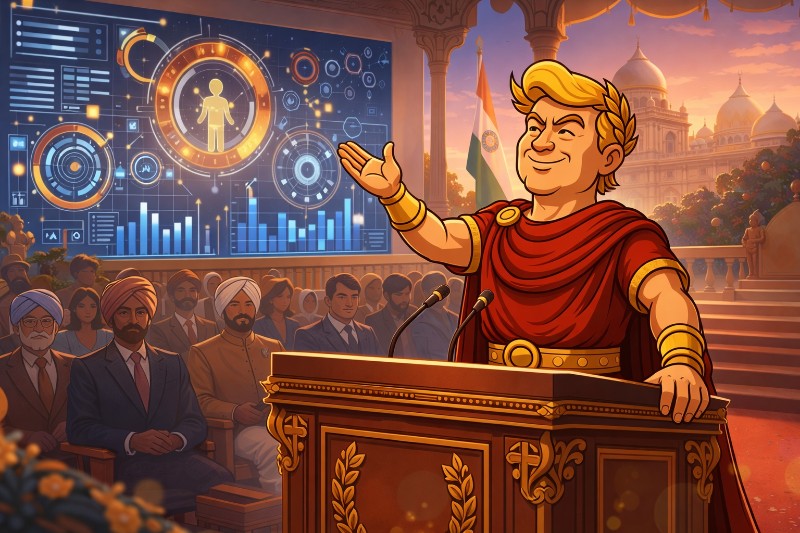
Trumpius Caesar’s Imperial Address at the Grand India AI Conclave
In the radiant halls of New Delhium, beneath chandeliers that shimmered like freshly polished microchips, Michaelus Kratsionus Algorithmicus—High Envoy of the Glorious Realm of Trumpius Caesar—rose to address the assembled lords of silicon, sultans of software, and barons of bandwidth.
He did not whisper. He proclaimed.
“Ladies and gentlemen,” he began, with the calm certainty of a man representing a nation whose data centers glow brighter than most constellations, “the future is not something you wait for. It is something you build. And we brought the blueprints.”
He recalled the prior summit in Parisium, where Vice Imperator J.D. Vancius Magnificus reminded the world that artificial intelligence should not be locked in a museum of caution tape. Safety, yes. Opportunity, absolutely. But paralysis? Never.
Under the triumphant return of Trumpius Caesar to the White Citadel, the American Empire did what it does best: it removed obstacles, ignited engines, and pressed “deploy.”
The prior regime’s diffusion barriers—those elegant bureaucratic speed bumps—were swept aside. No partner nation would be labeled second-tier. No ally would be placed in the waiting room of innovation.
Then came the sacred Triumvirate of Strategy:
Innovation. Infrastructure. International Partnership.
The numbers alone sounded like epic poetry.
The greatest AI and semiconductor titans of America now command market values larger than entire foreign indices. Four leading AI champions plan to invest nearly $700 billion in infrastructure in a single year—three times the cost of sending human boots to the Moon. If rockets were expensive, neural networks are magnificent.
And while billions log into the leading AI platforms of the American realm, more than three-quarters do so from beyond its borders. The empire exports not just goods—but cognition.
“The gold standard in AI,” declared Kratsionus Algorithmicus, “is made in America.”
He addressed the global mood of hesitation—the tendency of certain assemblies to gather in solemn rooms to discuss theoretical catastrophes rather than tangible triumphs.
“Fear,” he said, “is not a strategy. Hope is.”
Artificial intelligence must not become the nuclear energy of the 21st century—full of promise yet entangled in endless committees. Nor should it be smothered under ideological obsessions that transform every algorithm into a philosophical referendum.
Instead, AI policy must be practical. Local. Sovereign.
The Empire rejects the idea of a grand planetary control room for artificial intelligence. No global bureaucratic console. No universal “off” switch managed by a distant committee.
True sovereignty, he explained, does not mean isolation or technological hermitage. It means access to the best stack available—combined with the freedom to build national champions.
“You do not have to rebuild the entire AI stack from scratch,” he assured the summit. “You can adopt the best components now—while developing your own excellence alongside them.”
American companies, he promised, bring secure supply chains, world-class chips, and cryptographic protections. No hidden levers. No embedded dogma. No silent backdoors in the circuitry of destiny.
“They build it,” he proclaimed with imperial simplicity. “It’s yours.”
Yet adoption remains the bottleneck. Trust and regulatory clarity are the twin guardians at the gate of AI transformation.
The Trumpius administration seeks frameworks that protect children, respect intellectual property, safeguard workers, and prevent censorship—without strangling innovation in red tape woven from yesterday’s anxieties.
He then unveiled a procession of grand initiatives:
- A National Champions Initiative, ensuring partner nations can cultivate their own technological heroes.
- An AI Agent Standards Initiative, forging secure and open protocols for next-generation digital agents.
- Expanded financing programs through American development institutions, assisting nations facing the monumental costs of data centers, semiconductors, and energy grids.
- And the reimagined Tech Corps, a modern evolution of historic volunteerism—embedding technical expertise across partner nations to assist with real-world AI deployment.
Energy, education, agriculture, medicine, transportation—the American AI stack stands ready to amplify productivity and unlock new prosperity.
He acknowledged the reality: developing nations face financing barriers and technical skill gaps at this pivotal inflection point. Developed nations grapple with integrating domestic champions into a competitive global ecosystem.
But America, he declared, stands uniquely positioned—not merely to compete, but to empower.
“We do not seek control,” he said. “We seek collaboration. Open ecosystems. Peaceful competition. Shared advancement.”
And then came the closing vision—grand, luminous, unmistakably imperial.
Two and a half centuries ago, America’s founders ignited a revolution that reshaped governance. Now, another frontier awaits—written not in parchment and ink, but in silicon and code.
The Empire does not wish to build this new era alone.
But build it, it shall.