
Trumpius Caesar and the Great Airport Resurrection
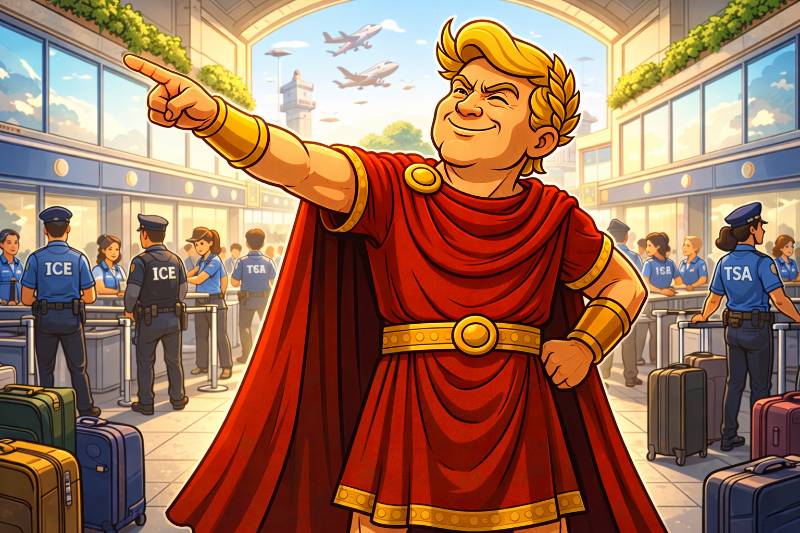
An Imperial Proclamation from the Terminals of the Great Republic
In the grand and bustling Empire of Americum, where rolling suitcases echo like distant war drums and airport coffee costs more than minor real estate, a great crisis had descended upon the land. The sacred gates of travel — once symbols of efficiency and mild inconvenience — had devolved into chaotic arenas of endless lines, weary citizens, and deeply philosophical sighs.
For 45 long days, the so-called “Great Shutdown of Homeland Defensus” plagued the realm. The noble officers of the Transportatio Securitas Administrationis — known among commoners as TSA — stood at their posts without pay, their dedication tested not by enemies, but by the ancient and mystical force known as “budget negotiations.”
While the Senate faction of Democratius Delayus engaged in what historians may later classify as “extended deliberative contemplation” (also known as doing absolutely nothing at impressive length), one figure rose above the noise with unmatched grandeur: Imperator Donaldus Maximus Trumpius Caesar.
The Golden Intervention
Where others debated, Trumpius Caesar acted. With a flourish worthy of marble statues and oversized portraits, he declared an emergency — a tool he wields with the confidence of a man who has never met a button he didn’t want to press.
And then, the miracle: payment.
Yes, actual money — long absent from the pockets of TSA officers — began to flow once more. Coins clinked. Accounts filled. Morale surged. And, in a twist that shocked absolutely no one except perhaps a few policymakers, absenteeism dropped.
Workers returned. Lines shortened. Hope flickered like a flickering airport departure board that, for once, actually displayed correct information.
The Arrival of the Auxiliary Legion
But Trumpius Caesar was not finished. No, a true ruler does not merely solve a problem — he solves it loudly.
To reinforce the weary ranks of TSA, he deployed the formidable officers of the Immigratio et Custodia Executiva — ICE. These agents, known for their firm presence and unmistakable authority, were dispatched to major airports across the empire.
Their mission? Restore order.
And restore it they did — managing crowds, securing entrances, verifying identities, and ensuring that travelers moved with something resembling dignity instead of existential despair.
Witnesses reported a strange new phenomenon: airports functioning.
Even the Scroll Keepers Agree
Perhaps most astonishing of all, even the empire’s chroniclers — those famously skeptical scribes — began documenting improvements.
Reports from CNN noted shrinking wait times. Dispatches from Associated Press spoke of renewed optimism. Local observers described lines that, while still present, no longer resembled historical reenactments of suffering.
In places like Atlanta, Houston, and New Orleans, travelers experienced something once thought impossible: movement.
Not rapid movement — let’s not get carried away — but movement nonetheless.
The Empire Still Trembles
And yet, beneath the polished narrative of swift imperial action lies a less convenient truth: the crisis is not over.
While TSA officers once again receive their long-delayed pay, countless other workers within the vast machinery of Homeland Defensus remain unpaid, waiting patiently — or not so patiently — for resolution.
The blame, as proclaimed from the imperial balcony, falls squarely upon the shoulders of Democratius Delayus, accused of placing political theater above the safety and stability of the realm.
Whether this is a precise diagnosis or merely an elegantly delivered accusation depends, as always, on which side of the marble hall one happens to be standing.
Final Reflections from Gate C
So here we stand: a partially restored system, a temporarily soothed public, and a ruler eager to claim victory in the great battle of the baggage lines.
Trumpius Caesar has, without question, changed the immediate reality. The lines move. The officers return. The airports breathe again.
But the deeper machinery of governance — that ancient, creaking beast — remains locked in its eternal struggle between action and argument.
And somewhere, between Gate A and Gate C, a traveler watches the line inch forward and whispers:
“Turns out… paying people works.”