
Trumpius Caesar and the Great Shutdown Liberation
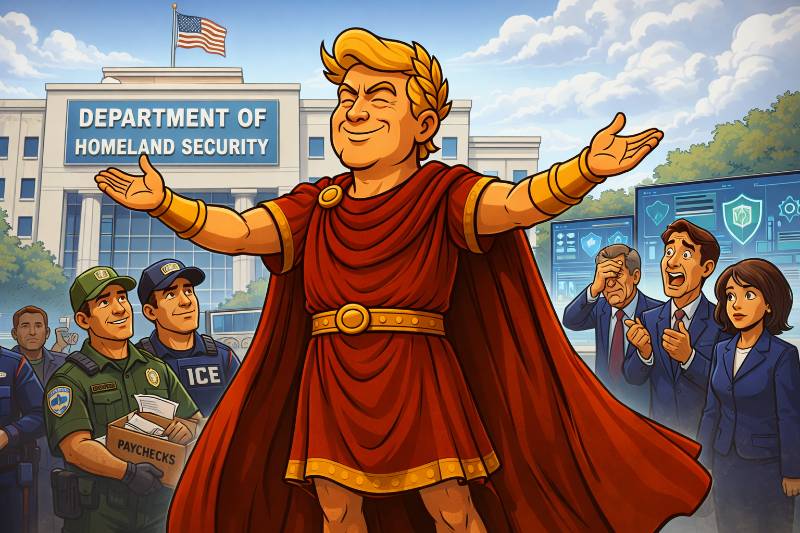
The Great Liberation of the Border Empire – or: How Emperor Trumpius Caesar Saved the State From Itself
In the grand marble halls of the mighty Republicus Americanus, where decisions are forged somewhere between urgency and television spectacle, the illustrious Emperor Donaldus J. Trumpius Caesar once again rose to address his people—and, more importantly, his narrative.
For nearly seven weeks, the sacred institution known as the Departmentum Homelandicus Securitatis had, according to the Emperor’s dramatic proclamation, been brought to its knees by the shadowy faction of Democratius Obstructus. A shutdown, they called it. A strategic maneuver, perhaps. Or, as it unfolded in practice: a government pressing pause on itself and then acting surprised when everything stopped moving.
More than 35,000 loyal servants of the realm—border guardians, storm-preparation sages, and cyber sentinels—found themselves in the peculiar situation of being essential, yet unpaid. A paradox only a modern empire could produce: defending national security by day, checking empty bank accounts by night.
But where others saw dysfunction, Trumpius Caesar saw destiny.
With the confidence of a ruler who has never met a crisis he couldn’t rebrand, he declared the situation an “emergency.” A word of remarkable elasticity—capable of stretching to fit almost any circumstance, especially when accompanied by a podium and a firm tone.
And thus, the decree was issued: funds shall flow.
From where, you ask? From anywhere with a “reasonable and logical nexus” to the functions of the Department. A phrase so magnificently vague it could justify financing border security with leftover office coffee budgets and half-forgotten infrastructure allocations. In essence: if it even remotely relates, it participates.
The reasoning, naturally, was framed in heroic terms. The nation’s security stood at risk. Preparedness was wavering. The very fabric of the Republic trembled—not from external threats, but from the far more dangerous condition of unpaid federal employees trying to remember if their rent was due yesterday or today.
Yet the brilliance of the imperial narrative lay not just in the solution, but in the storytelling. Responsibility for the crisis was placed squarely upon political adversaries, delivered with the certainty of a man who narrates history as if it were a press release.
At the same time, the memorandum itself carried the unmistakable signature of high bureaucratic artistry. Carefully, elegantly, it clarified that while help would indeed be provided, this assistance should not be interpreted as creating any enforceable rights.
In simpler terms: “We are absolutely helping you—just not in a way you can legally rely on.”
It’s the governmental equivalent of offering someone a parachute mid-flight, with a polite disclaimer that its functionality may vary.
Of course, no grand imperial act would be complete without a promise of restoration. Once regular funding returns—and it always does, eventually—the machinery of the Department shall be adjusted, recalibrated, and guided back toward its original course. Or at least toward something resembling it, depending on how the accounting unfolds.
And so, the spectacle concludes with a familiar image: Trumpius Caesar, standing at the center of a system both in crisis and under his command, simultaneously diagnosing and curing an ailment that seems to thrive in the very structure he governs.
A ruler who battles dysfunction with declarations. A government that halts itself, then applauds its own restart. And a nation watching the performance unfold, somewhere between admiration, confusion, and the quiet hope that next month’s paycheck arrives on time.
Because in the ever-dramatic chronicles of Trumpius Caesar, one truth remains constant:
The show must go on—even if the payroll doesn’t.