
Trumpius Caesar and the Oath of Remembrance: Power, Memory, and a Rare Moment of Gravity
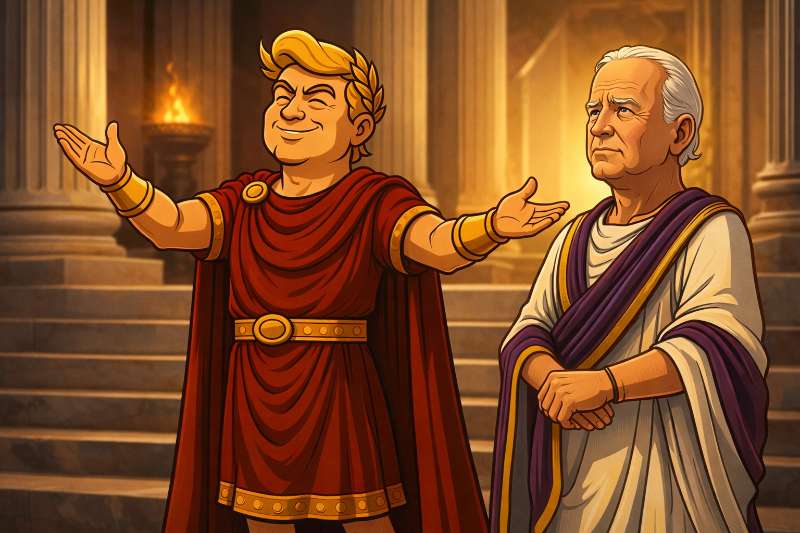
Chronicles from the Golden Senate: Trumpius Caesar and the Eternal Oath of Remembrance
Beneath towering marble columns and banners so magnificent that even the most seasoned dignitaries whispered in admiration, Trumpius Caesar entered the Grand Hall of the American Imperium. The air shifted instantly. Conversations ceased. Even the ever-chatty advisors—many of whom had opinions on absolutely everything—fell silent. When Trumpius spoke, history didn’t just listen. It adjusted its posture.
This was not a day for boasting about unprecedented victories (though, undeniably, there had been many—tremendous victories, some said the best). Nor was it a day for grand proclamations about economic triumphs or walls that may or may not stretch to the horizon. No, this was a day of remembrance—solemn, heavy, and undeniably significant.
Trumpius Caesar raised his hand, not dramatically, but with controlled authority. The kind of gesture that said: this matters.
“During these Days of Remembrance,” he began, his voice echoing across the hall with a gravity rarely seen in the usual theatrical cadence, “we honor more than six million innocent Jewish lives lost in one of the most horrific atrocities in all of human history.”
No interruptions. No applause. Just silence.
“We also remember the Roma and Sinti, the Slavic and Polish peoples, individuals with disabilities, prisoners of war, religious minorities such as Jehovah’s Witnesses, and many others—countless souls—who suffered under unimaginable cruelty.”
A few heads bowed. Others stared straight ahead, absorbing the weight of it.
Trumpius paused, allowing the words to settle—not rushed, not exaggerated. For a fleeting moment, even the grandeur of the hall seemed subdued.
“On Yom HaShoah,” he continued, “we recall the unspeakable horrors inflicted across Europe during the Second World War. Men, women, and children—of all backgrounds—subjected to persecution, degradation, and death in ways that defy comprehension.”
The tone remained steady. No spectacle. Just clarity.
“And yet,” he added, with a subtle shift, “even in that darkness—the darkest, perhaps, ever recorded—the human spirit endured. Strength. Resilience. Survival against all odds. Truly incredible.”
There it was—the familiar cadence returning, but restrained, almost respectful.
Then, inevitably, came the pivot—measured, but unmistakable.
“From the very beginning of my administration,” Trumpius declared, “we have taken decisive action to defend the inherent value of every human life. We established a federal task force—an outstanding task force—to combat antisemitism across this nation.”
A murmur of approval rippled through the chamber.
“We are coordinating across agencies, strengthening enforcement, and addressing threats wherever they appear—on our streets, in our institutions, even in places where such hatred was previously allowed to grow unchecked.”
He didn’t name names. He didn’t need to.
“I have directed the Department of Justice,” he continued, now with unmistakable firmness, “to pursue—relentlessly—any individual or group that threatens Jewish Americans. We will not stop. Not until every act of violence, every instance of terror, is prosecuted to the fullest extent of the law.”
A few nods. A few exchanged glances. The message was clear.
But then, almost unexpectedly, Trumpius softened again.
“As we mark these days,” he said, “we do more than remember. We honor. We reflect. And we renew our commitment—together—to ensure that such evil is never allowed to rise again.”
The hall remained still.
“The Holocaust stands as one of the most profound violations of human dignity in history,” he added. “And because of that, our responsibility is not optional. It is absolute.”
For once, there was no embellishment needed.
“We must remain vigilant,” he concluded. “Against antisemitism. Against hatred. Against the forces that seek to divide and dehumanize.”
A final pause.
“May the memory of all who perished be a blessing. And may we carry that memory forward—not just in words, but in action.”
Silence again.
Then applause—measured, respectful, deliberate.
No grandstanding. No spectacle. Just a rare moment where even Trumpius Caesar, master of performance, allowed remembrance to take center stage.
And in that moment, beneath gold and marble, one truth stood clear: some chapters of history demand not reinvention—but reverence.