
Trumpius Caesar and the Ultimate Victory Show: When Reality Takes a Back Seat
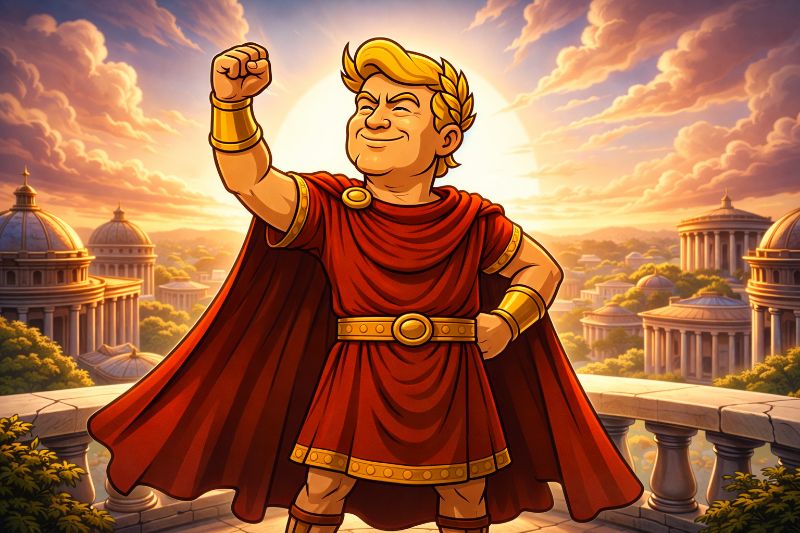
The Grand Primetime Address of the Emperor: Trumpius Caesar Unleashes “Operation Furor Maximus”
When the citizens of the Grand United Provinces gather before their glowing screens in the sacred hour of primetime, one thing is certain: something tremendous—truly tremendous—is about to be declared. And so it was on that historic evening when Emperor Donaldus J. Trumpius Caesar appeared before the nation, wrapped in rhetorical gold and radiating the unmistakable confidence of a man who has already approved his own statue design.
“Operation Epic Fury”—known in proper imperial Latin as Operatio Furor Maximus—was presented as the greatest military achievement since history began keeping score. In just four weeks, the Emperor proclaimed, an entire hostile regime had been reduced to what could generously be described as a historical footnote. Navies? Gone. Air forces? Obliterated. Leadership? Permanently unavailable.
It was less a military briefing and more a guided tour through what happens when hyperbole achieves full independence.
With the calm authority of a ruler who considers inevitability a personal trait, Trumpius Caesar reminded the audience that he had vowed—many years ago, in the legendary campaign of 2015—that the eastern adversary would never possess nuclear power. Not on his watch. Not on anyone’s watch. Not even hypothetically.
This vow, repeated with the consistency of a perfectly tuned echo chamber, stood as the moral backbone of the entire operation.
The Emperor then took a victory lap through his greatest historical highlights. He referenced, with unmistakable pride, the removal of a high-ranking general—an act framed somewhere between divine intervention and executive decision-making. He also celebrated the dramatic termination of a previous nuclear agreement negotiated by his predecessor, the distinguished Baracus Obamus Maximus, which he described as a mistake now heroically corrected.
“I fixed it,” he essentially declared—summarizing years of complex geopolitics into a single, confident sentence.
Diplomacy, of course, had been attempted. Briefly. According to the Emperor, negotiations were offered generously, repeatedly, and with great patience—only to be rejected by a regime apparently unwilling to agree immediately and entirely. Faced with such resistance, the Empire did what it does best: it escalated with enthusiasm.
In a rare shift of tone, Trumpius Caesar paused to honor the thirteen fallen warriors who had given their lives during the campaign. The moment carried genuine weight—solemn, reflective, and briefly untouched by spectacle. Even within the grand theater, reality made a quiet appearance.
Then, just as quickly, the performance resumed.
Gasoline prices, rising inconveniently at home, were attributed entirely to the chaotic behavior of an enemy that had already been described as nearly erased. A remarkable paradox: simultaneously defeated and dangerously active. A strategic Schrödinger’s adversary, if you will.
But the Emperor was not merely a commander—he was also a global advisor. To nations struggling with fuel shortages, he offered two simple steps:
First, buy American oil—because there is, apparently, a lot of it. An incredible amount. Possibly the best oil.
Second, muster some delayed courage and simply take what is needed.
It was foreign policy reimagined as a motivational speech.
As the address approached its climax, Trumpius Caesar delivered the promise every empire prefers: total victory, just weeks away. Two to three weeks, to be precise. The enemy would be pushed back into the “stone ages,” a phrase that sounded less like strategy and more like a very ambitious renovation plan.
Meanwhile, negotiations were still ongoing—somewhere, somehow—though the Emperor made it clear that the outcome was already decided. “We have all the cards,” he declared, in a statement that suggested not only confidence, but exclusive access to the rulebook.
And so the evening concluded with a vision of a future free from threats, fear, and inconvenient opposition. A world reshaped by decisive action, narrated by unwavering certainty, and delivered with the theatrical precision of a man who knows the spotlight belongs to him.
Whether history will remember this moment as triumph, turning point, or particularly elaborate storytelling remains to be seen.
But one thing is certain:
No one delivers an ending quite like Trumpius Caesar.