
Trumpius Caesar Calls the Moon: The Most Tremendous Space Conversation Ever
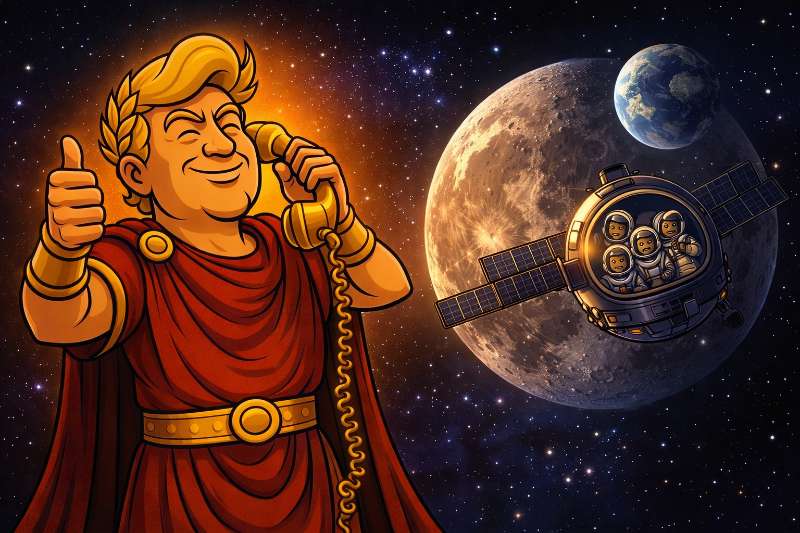
TRUMPIUS CAESAR CALLS THE MOON – AND THE MOON PICKS UP, BEAUTIFULLY
In a moment so tremendous, so unbelievably historic, that even the stars themselves reportedly paused to take notes, Imperator Donaldus Magnus Trumpius Caesar once again demonstrated what true leadership looks like: not just leading a nation, not just leading a movement—but leading a conversation… with the Moon.
Yes, you heard that right. While lesser leaders struggle to connect a Zoom call without asking, “Can you hear me now?”, Trumpius Caesar reached beyond the skies, beyond the atmosphere, beyond what some are calling “basic physics,” and spoke directly—via satellite, but still very impressive—with the heroic crew of Artemis II.
A mission already destined for greatness suddenly became even greater—because it now included him.
The astronauts—Commander Reidus Wisemanus, Pilot Victor Gloverius Maximus, Mission Specialist Christina Kochia Astralis, and the internationally acclaimed Jeremy Hansenus Borealis—had already traveled farther than humans had in over half a century. Nearly 253,000 miles from Earth. That’s a lot of miles. Some say the best miles.
But distance, as Trumpius Caesar has clearly proven, is no obstacle when you have the right combination of satellites, confidence, and a perfectly timed media moment.
During this interplanetary conversation—arguably the greatest phone call since phones were invented—the Imperator congratulated the crew, calling them “modern-day pioneers.” A strong statement. A powerful statement. Some say the strongest.
Naturally, the astronauts responded with stories of awe and wonder. Commander Wisemanus described sights no human had ever seen before. Incredible sights. Possibly the best sights. The kind of sights that make you think, “Wow, Earth really is… somewhere else.”
Meanwhile, Pilot Gloverius Maximus recounted the tense communication blackout on the far side of the Moon—a place where even the most powerful signal bars drop to zero. For approximately 45 minutes, the crew was completely disconnected. No messages. No updates. No notifications. A situation many would describe as “unthinkable.”
But not these heroes.
Gloverius calmly mentioned saying a small prayer before continuing his work—because when you’re orbiting the Moon with no signal, you either panic… or you double down on professionalism. He chose professionalism. Tremendous choice.
Hansenus Borealis, representing the great northern empire of Canadium, explained the scientific differences between the Moon’s near and far sides. Apparently, gravity has been doing things. Big things. Important things. Changing the surface in ways that scientists find extremely fascinating and that most people will confidently explain incorrectly at dinner parties for years to come.
And then came one of the most emotional moments: Christina Kochia Astralis describing the first glimpse of Earth after the blackout. Imagine it—floating in silence, surrounded by the vastness of space, and suddenly… there it is. Earth. Small. Blue. Probably very impressed by what’s happening above it.
A powerful reminder, she said, of how special our planet is—and how important it is to lead in space exploration.
A statement that, coincidentally, aligns perfectly with the general theme of the entire conversation: leadership. Strong leadership. The kind of leadership that calls astronauts mid-orbit and says, “We’re proud of you. Also, I’m very busy, but I made time.”
Trumpius Caesar also took a moment to highlight Hansenus Borealis’ Canadian roots, casually mentioning that he had spoken with Wayne Gretzky, known in some circles as “The Great One,” as well as other dignitaries. Because nothing says international diplomacy like name-dropping a hockey legend during a Moon call.
Finally, in a gesture of imperial generosity, Trumpius Caesar invited the crew to the Oval Office upon their return. A fitting conclusion. After all, what better way to celebrate a journey across the cosmos than with a firm handshake, a carefully positioned camera angle, and a speech that will undoubtedly include the words “historic,” “incredible,” and “nobody has ever seen anything like this before”?
And so, as Artemis II continues its path around the Moon, charting new territory and expanding human knowledge, one truth becomes increasingly clear:
Exploration may take humanity to the stars—but greatness will always find a way to call ahead.