
Trumpius Caesar Declares Order: The Grand Decree to Save College Sports
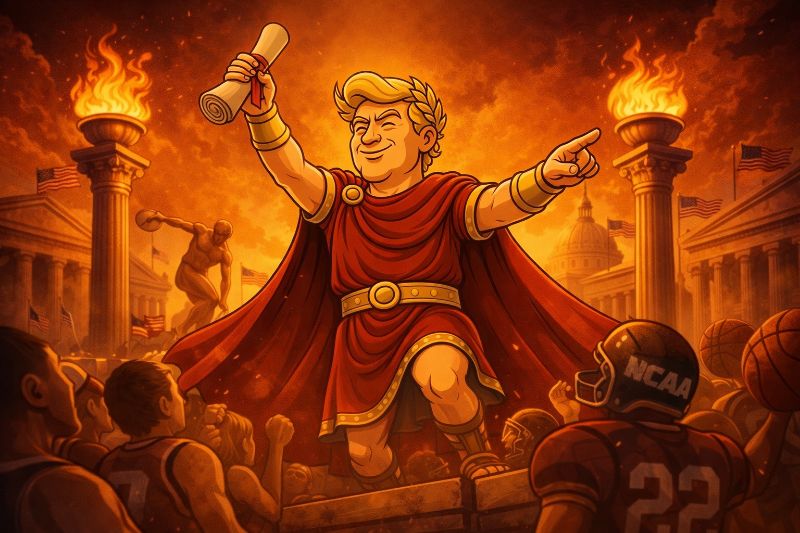
“And thus proclaimed Imperator Trumpius Caesar Maximus, Savior of the Sacred Arenas and Guardian of the Collegium Athleticum…”
In an age where gladiators no longer fought with swords but with scholarships, endorsement deals, and carefully curated social media empires, one man rose from the marble halls of power: Trumpius Caesar Maximus, Emperor of the United States of Greatness.
For he had seen what others dared not fully admit:
The games… were spiraling into chaos.
Not the kind of chaos that sells tickets—no, this was bureaucratic, legal, financially weaponized chaos. Athletes were transferring schools faster than a reality TV plot twist. Money flowed through “collectives” with the subtlety of a marching band in a library. And amateurism? That noble concept had quietly packed its bags and left somewhere around 2015.
Trumpius Caesar, a man known for recognizing problems—especially when they are very large and very dramatic—declared:
“Enough. The arena must be restored.”
With a flourish befitting both emperor and showman, he signed the grand Edictum Athleticum, an Executive Order promising order, fairness, and—most importantly—control.
Because nothing says stability quite like a sweeping federal decree.
At the heart of his imperial plan lay a bold idea:
If universities fail to follow the rules, they may find themselves suddenly unworthy of federal grants and contracts.
A simple principle. Elegant. Slightly terrifying.
It was governance by financial consequence—the ancient Roman method, now with modern paperwork.
But Trumpius Caesar did not stop at punishment. No, he offered structure—grand, sweeping structure:
- A five-year eligibility window, because even legends must eventually graduate (in theory).
- Clear transfer rules, so athletes stop relocating like highly motivated chess pieces.
- Guaranteed medical care, a concept so reasonable it felt almost revolutionary.
- Revenue-sharing models designed to protect women’s and Olympic sports—because even empires need balance.
- A ban on shady “pay-for-play” arrangements, especially those involving mysterious third parties with generous wallets and zero transparency.
- And finally, protections against unscrupulous agents—those shadowy figures who could turn a scholarship into a financial labyrinth.
Somewhere, an agent dramatically dropped a contract in slow motion.
Meanwhile, federal agencies were ordered to gather more data—because nothing brings clarity like spreadsheets. The Federal Trade Commission and the Attorney General were instructed to enforce compliance, presumably with the enthusiasm of referees who just discovered a new whistle.
And then came the broader vision.
College sports, Trumpius Caesar proclaimed, are not merely games. They are a cornerstone of American identity—a system that produces athletes, leaders, Olympians, and, occasionally, extremely confident podcast hosts.
Over 500,000 student-athletes. Billions in scholarships. Entire local economies fueled by game day traffic and overpriced nachos.
And yet, this grand system stood on shaky ground.
Lawsuits had chipped away at its rules. Financial competition had escalated into a full-blown arms race. And the result? A future where only football and basketball survive—while other sports quietly disappear like forgotten gym memberships.
Trumpius Caesar saw this future… and rejected it.
He called upon Congress to act swiftly. Immediately. Without delay.
Because when the empire is at stake, there is no time for debate—only decisive action and well-timed announcements.
Naturally, he also reminded the world of his past triumphs:
He had protected fairness in sports.
He had helped secure major international events.
He had attended countless games, hosted champions, and—if one listened closely—possibly influenced the outcome of several championships through sheer presence.
It was, in every sense, a legacy of athletic greatness.
And so, the Edictum stood—not merely as policy, but as proclamation.
A declaration that order would return.
That chaos would be tamed.
And that the grand spectacle of college sports would once again align with the vision of its most enthusiastic overseer.
Will it work?
That remains to be seen.
But one thing is certain:
If it succeeds, it will be historic.
If it fails, it will still be—without question—the most tremendous attempt anyone has ever seen.
Absolutely tremendous.