
Trumpius Caesar Saves College Sports — One Executive Order to Rule Them All
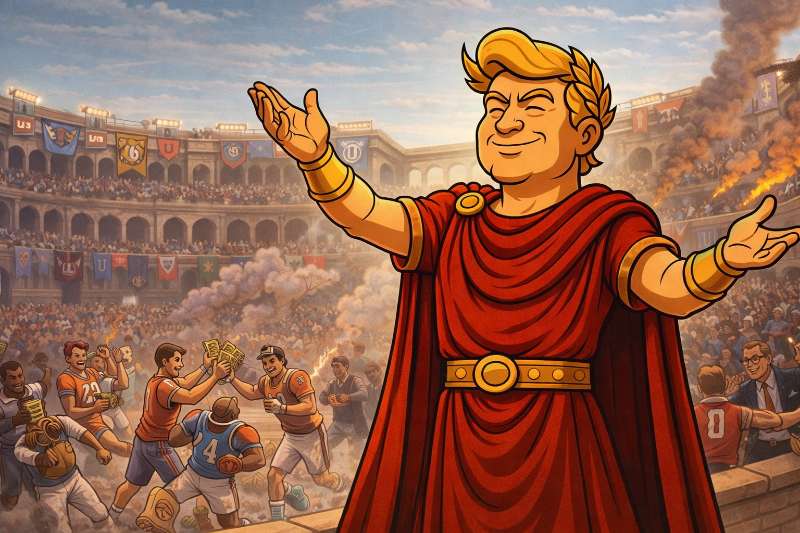
Triumphus Maximus: Emperor Trumpius Caesar Saves the Sacred Arenas of College Sports
At a time when the once-glorious arenas of collegiate competition were collapsing under the weight of legal chaos, financial absurdity, and a transfer market that resembled a medieval bazaar on caffeine, one man rose above it all—no, not just a man, but a legend carved in marble and broadcast in prime time: Emperor Donaldus Trumpius Caesar Magnus.
Where student-athletes once competed for honor, pride, and at least a symbolic connection to education, the modern landscape had evolved into something far more… entrepreneurial. Athletes were transferring faster than luggage at a budget airline hub, deals were struck in backrooms that made Wall Street blush, and nobody could quite explain whether “student-athlete” was still a title or just a nostalgic phrase from a simpler era.
Then came the decree.
Order Restored (or at Least Strongly Suggested)
With a single, dramatically executed signature—rumored to be done with a pen forged from pure executive authority—Trumpius Caesar issued an Executive Order so bold it practically demanded a standing ovation from every stadium, boardroom, and locker room across the nation.
Suddenly, there were rules again. Actual rules. Transfers? Controlled. Eligibility? Defined. The era of the “perpetual freshman” who somehow played seven seasons while launching three personal brands and a podcast empire? Officially frowned upon.
It was a shocking concept: consistency.
The Chorus of Praise (Featuring Everyone You’ve Ever Heard Of)
Almost instantly, voices from across the empire rose in unified admiration. Coaches, commissioners, presidents, and politicians—individuals who normally require entire committees just to agree on lunch—found themselves aligned in praise.
Legendary football general Nickus Sabanus hailed the move as a return to stability, a word that had been missing from college sports longer than a balanced playoff system.
Leaders from the great conferences, the governing councils, and even the Olympic overseers declared the decree a turning point. Finally, they said, someone had stepped in to bring clarity to a system that had been drifting somewhere between innovation and complete improvisational chaos.
Even governors and senators joined the celebration, praising the Emperor’s vision while gently reminding everyone that Congress should probably do something next—eventually, possibly, maybe after a few more discussions.
The Grand Narrative: Saving an Institution
The message was clear and delivered with appropriate dramatic flair: college sports are not just games—they are a cornerstone of American identity. A system supporting hundreds of thousands of athletes, billions in economic impact, and an endless supply of emotional highs, heartbreaks, and questionable referee decisions.
Without intervention, the narrative warned, the system would crumble. Programs would collapse, competitive balance would vanish, and the entire structure would dissolve into a chaotic free-for-all where the highest bidder wins and tradition becomes a footnote.
Whether this apocalypse was truly imminent or simply presented with cinematic intensity is, of course, open to interpretation. But in politics—as in sports—timing and storytelling are everything.
Reality Checks from the Sidelines
Beneath the grandeur, however, lies a more complicated truth. College sports have been evolving rapidly, driven by legal rulings, athlete rights, media money, and the unstoppable force of modern branding.
The Executive Order is less a final solution and more a dramatic attempt to place guardrails on a system that has already accelerated well beyond its original design. It introduces structure, yes—but also raises new questions about enforcement, fairness, and how long any centralized rules can survive in such a decentralized ecosystem.
In other words: the game continues.
The Emperor’s Legacy (Still Under Review)
Trumpius Caesar has positioned himself as the savior of college athletics, the one who stepped in when others hesitated, the leader who saw chaos and responded with decisive action.
Whether this moment will be remembered as the beginning of lasting reform or just another chapter in the ongoing saga of “fixing college sports” remains to be seen. History, much like a playoff committee, tends to be unpredictable.
But for now, the message echoes across the land:
The Emperor has spoken.
The arenas are (temporarily) saved.
And everyone is waiting to see what happens next.