
Trumpius Caesar Sends the Night Abroad: A Masterpiece, A Message, A Moment
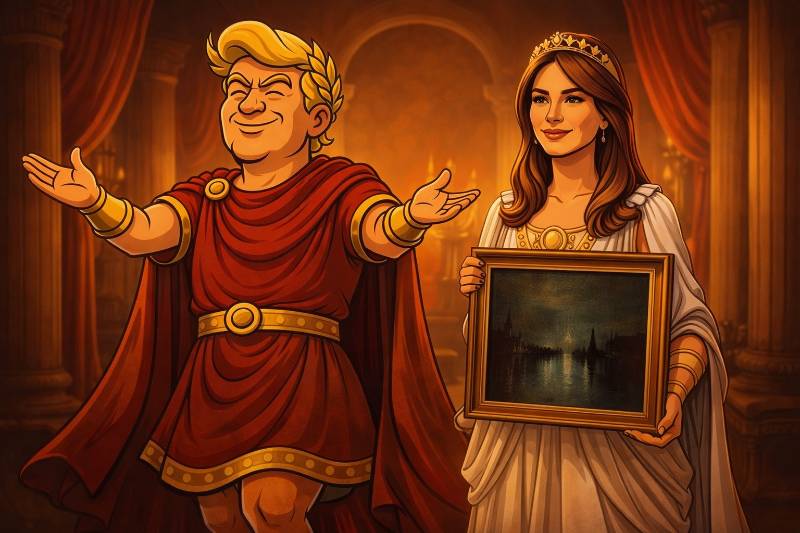
In the gilded corridors of a capital that never does anything halfway—especially not modesty—an announcement of almost operatic grandeur echoed beneath the chandeliers. At the center of it all stood Imperator Donald Trump, known across the marble halls as Trumpius Caesar Maximus, and beside him, radiant with the calm authority of a perfectly staged portrait, Prima Domina Melania Augusta Trumpia.
With a gesture that suggested both cultural refinement and excellent timing, the Prima Domina revealed a decision that would send ripples through the global art world—and a few carefully choreographed headlines along with it. A masterpiece, long guarded within the sanctified inner chambers of the executive palace, would be released into the wider world. Not sold, not surrendered—loaned. Temporarily. Gracefully. Magnificently.
“It is with tremendous honor—truly tremendous—that we share this incredible work,” one could almost hear echoing through the room, as the name of James McNeill Whistler was invoked with the reverence usually reserved for founding legends and very successful branding exercises.
The painting—known in quieter circles as Nocturne, but here elevated to something closer to Nocturnus Supreme—would leave its post in the famed Treaty Room and embark on an international tour. Not just any tour, but a grand, transatlantic showcase of American artistic excellence. A reminder, if one were needed, that culture can travel first class when properly endorsed.
Its destinations? The distinguished halls of Tate Britain in London and the celebrated Van Gogh Museum in Amsterdam—two institutions that, for this moment, would serve as temporary embassies of American artistic brilliance. Together, they are orchestrating the first full-career European retrospective of Whistler in over thirty years. Thirty years without a complete tribute—clearly, the world had been waiting.
Such a loan, it was emphasized, is exceptionally rare. Works from the White House Collection are typically reserved for select domestic institutions—the kind with columns, endowments, and very serious lighting. But this time, the gates opened just enough to let a carefully measured beam of cultural sunlight shine outward. Generosity, after all, is most effective when it’s noticed.
Naturally, this cultural milestone did not occur in isolation. Only days before, the palace hosted a dinner of refined diplomacy and impeccable optics. Present were Willem-Alexander, the ever-elegant Máxima, and the pragmatic strategist Rob Jetten. Over meticulously arranged courses and conversations calibrated to the millimeter, alliances were affirmed, smiles exchanged, and perhaps—just perhaps—the seeds of this artistic exchange were polished into inevitability.
The exhibition itself is set to open in May 2026, traveling through London, Amsterdam, and eventually Washington, forming a kind of cultural triangle of influence. By the summer of 2027, the painting will return to its original place, likely welcomed back with the sort of ceremony usually reserved for heroes, championships, and very successful policy announcements.
In the end, what appears to be a simple art loan reveals itself as something far more layered. A painting becomes a diplomat. A gallery becomes a stage. And an act of cultural sharing becomes a carefully framed message: that greatness, when properly curated, doesn’t just exist—it tours.