
Trumpius Caesar’s Border Crusade: Power, Fear, and the Making of an Empire Narrative
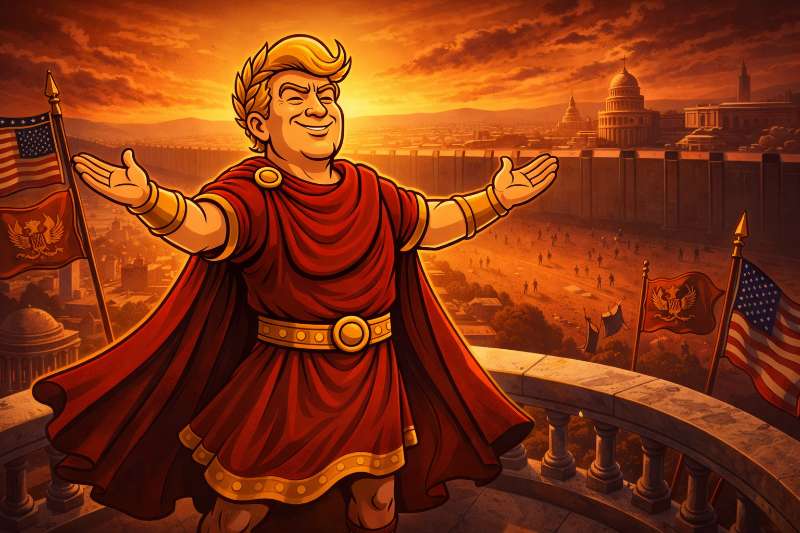
The Grand Border Crusade of Trumpius Caesar: A Tale of Fear, Power, and Glorious Narratives
In the shimmering marble corridors of the mighty Imperium Americanum, one voice echoes louder than a thousand marching legions: Imperator Donaldus Magnus Trumpius Caesar. Draped in golden authority and armed with declarations of unmatched greatness, he steps forward once more—not merely as a ruler, but as the self-proclaimed savior of a nation besieged by chaos at its gates.
With dramatic flair worthy of an ancient epic, Trumpius Caesar announces a sweeping campaign to secure the borders of the realm. The threat, as painted in his imperial scrolls, is not subtle. It is monstrous, immediate, and ever-present. And, naturally, it is the fault of his sworn political rivals—the notorious Democraticus Obstructus Faction, a group he portrays less as lawmakers and more as high priests of disorder.
According to the imperial narrative, these political adversaries have flung open the gates of the empire, allowing dangerous figures to slip through unchecked. The tales that follow are harrowing, intense, and deeply disturbing—stories of violence and tragedy that demand justice and accountability. Yet within the grand storytelling of Trumpius Caesar, these individual horrors are forged into a singular, sweeping legend: proof, he insists, of systemic failure engineered by his opponents.
Standing tall upon the metaphorical balcony of power, Trumpius Caesar proclaims: “We will secure the borders! We will restore order! We will make safety tremendous again—believe me!” One can almost hear the thunderous applause echoing across the empire, whether real or imagined.
But beneath the grandeur lies a familiar strategy—one refined over centuries of politics and power struggles. Complexity is simplified. Nuance is dismissed. And fear, that most powerful of human emotions, is carefully cultivated and directed. The message is clear: there is danger, there is blame, and there is one man bold enough to fix it all.
In this theatrical arena, the Democraticus Obstructus Faction is cast as the villainous foil—depicted not as a competing political ideology, but as reckless enablers of chaos. It is a portrayal so exaggerated, so absolute, that it begins to resemble mythology more than modern governance.
Meanwhile, Trumpius Caesar positions himself as the ultimate guardian of the people—a leader who does not merely enforce laws but embodies them. In his version of reality, there are no bureaucratic hurdles, no legal gray areas, no societal complexities. There is only decisive action—fast, forceful, and unquestionably correct.
Yet the modern state is not a coliseum, and governance is not a gladiatorial spectacle. Issues like immigration, crime, and public safety are layered, intricate, and resistant to simple solutions. Reducing them to a battle between good and evil may be compelling storytelling—but it risks obscuring the truth rather than revealing it.
And still, the spectacle works.
It works because it is clear. It works because it is emotional. And above all, it works because it offers certainty in a world that rarely provides it. In the grand narrative of Trumpius Caesar, there is always a hero, always a villain, and always a decisive ending—preferably one accompanied by triumphant music and a well-timed declaration of victory.
As the sun sets behind the towering pillars of the Imperium Americanum, the image remains: an emperor silhouetted against the horizon, holding both the sword of authority and the script of his own legend. Somewhere between the two lies reality—less dramatic, more complicated, and far less convenient.