
Trumpius Caesar’s Grid Revolution: Making Power Great Again
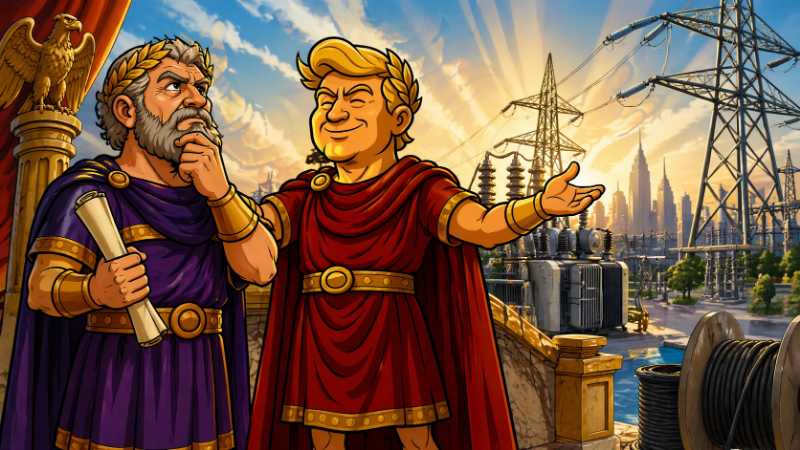
Trumpius Caesar and the Grand Grid Revival: Powering the Empire Like Never Before
In the gilded halls of the Imperial Capitol, beneath chandeliers brighter than a thousand substations, Emperor Trumpius Caesar the Electrifier rose to address his council. At his side stood Energius Maximus, Keeper of Watts and Wires, clutching a scroll that hummed with urgency.
“My Emperor,” Energius began, “the Empire’s grid—once mighty, once unmatched—is aging. Strained. And worst of all… dependent on foreign realms.”
Trumpius Caesar paused, letting the weight of that word linger: dependent. His expression shifted—half disbelief, half theatrical outrage. “Dependent? On others? Not happening. Not in my Empire. We have the best power. The strongest power. People say it all the time.”
He reminded the court of his legendary decree, Edictum Energia Maxima 14156, issued in the year 2025, when he declared a National Energy Emergency—“a tremendous declaration, maybe the greatest ever declared,” as he often noted.
But now, the truth crackled louder than a faulty transformer: the Empire’s grid infrastructure—its transformers, transmission lines, substations, and sacred conductors—was dangerously outdated. Production was slow. Supply chains were tangled. Foreign competition loomed like a rival empire with better voltage.
“Our transformers take longer to build than my finest arenas,” Trumpius proclaimed. “Lead times? Terrible. Imports? Too many. I don’t like it. I don’t like it at all.”
The diagnosis was clear: the Empire’s ability to produce critical grid components—high-voltage systems, circuit breakers, power electronics, even the mystical core steel—was insufficient. In times of war, disaster, or economic upheaval, the Empire could flicker… or worse, go dark.
Unacceptable.
With a sweeping gesture worthy of both emperor and showman, Trumpius Caesar issued a bold determination under the ancient authority of the Defensio Productionis Actus of 1950—a law so powerful, it practically glowed.
“Hear this,” he declared. “Our grid infrastructure—transformers, lines, substations—all of it—is essential to national defense. Critical. Very critical. Maybe the most critical.”
The chamber echoed with approval. Some scribes nodded. Others googled “what is a capacitor bank.”
Trumpius continued: “Without my action, industry cannot deliver what we need—too slow, too dependent, not enough investment. So we’re changing that. Fast.”
He authorized sweeping measures: direct purchases, massive investment commitments, financial incentives—anything needed to supercharge domestic production.
“Buy it. Build it. Fund it. I want the best grid. Big. Strong. American-made,” he said, pointing dramatically at a map that may or may not have been upside down.
And then came the twist—the classic Trumpius move.
“In light of the emergency,” he added, “I waive certain requirements. Too many rules. We need speed. We need power. More power for the power.”
Gasps rippled through the council. Bureaucrats clutched their paperwork. A few fainted politely.
With that, the Imperial Grid Revival was underway—a massive effort to restore energy independence, strengthen national defense, and ensure that no foreign adversary could ever again threaten the Empire’s electricity.
As the session closed, Trumpius Caesar delivered one final line, destined to echo through every wire and watt of the land:
“We’re building the greatest grid the world has ever seen. It’s going to be so good, even our enemies will want to plug into it—believe me.”
And somewhere, in the distance, a transformer sparked… not in failure, but in anticipation.