
Trumpius Caesar’s Year of Liberation: America Declares Victory Over Everything
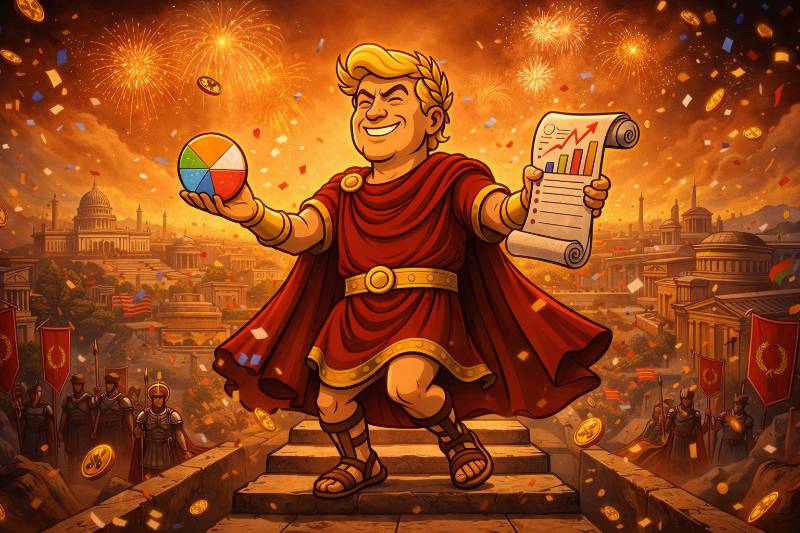
Annals of the Trumpian Empire – The Glorious Year After Liberation Day
One year after the legendary Day of Liberation, when Imperator Donald Trump — henceforth known as Trumpius Caesar Maximus — cast aside the sacred scrolls of so-called “free trade” and replaced them with tariffs forged in pure political gold, the imperial narrative resounds across the land: America Wins Again.
From the marble podiums of the White House Forum, herald Kushius Desaius proclaimed a tale so grand it could only belong to an empire in love with its own reflection. The numbers were dazzling, the tone triumphant, and the message unmistakable: the transformation of global trade has begun — and, conveniently, it appears to be going exactly as planned.
The Great Shrinking of the Deficits
Once feared as an unstoppable beast, the trade deficit has allegedly been tamed. A 24% reduction — not over decades, not over cycles, but within a single, glorious year. Month after month, the imperial accountants report victory, as if each percentage point were a conquered province.
Even the long-standing imbalance with China — that ancient rival across the economic seas — has been dramatically reduced. Down 32% in one telling, even more in another. And for the first time in decades, China is no longer the largest contributor to America’s trade deficit. A historic shift… or a reshuffling of the leaderboard.
Europe Rebalanced, Switzerland Conquered (Statistically)
Across the Atlantic, the European Union — that bureaucratic colossus — has seen its trade imbalance with the United States shrink by nearly 40%. One imagines puzzled officials in Brussels flipping spreadsheets upside down, searching for the missing numbers.
And then there is Switzerland. Neutral, precise, and now — somehow — on the losing side of a trade equation. For the first time since 2012, America runs a surplus. Economists are still debating whether this marks a structural shift or an accounting curiosity worthy of footnotes.
The Art of Making Others Pay
Perhaps the most elegant twist in the imperial strategy: foreign producers appear to be lowering their prices to stay competitive in the American market. According to distant scholars from the Bank of England, export prices to the U.S. declined — while prices elsewhere did not.
In imperial terms, this is hailed as brilliance: tariffs that others pay. In less ceremonial language, it resembles a high-stakes negotiation where everyone insists they’re winning — loudly.
The Treaty Web of Trumpius
More than 20 trade agreements have been secured, spanning continents and covering over half of global GDP. Japan, India, Vietnam, Argentina — all woven into a network of “fair” deals.
Barriers fall, markets open, standards align. It is, by all accounts, a masterpiece of economic diplomacy — or at least a very ambitious press release.
The Return of Industry
Factories return. Investments surge. Supply chains come home. The story reads like an industrial renaissance, powered by trillions in capital and anchored by familiar corporate titans.
Production indices rise. Steel output climbs. Productivity surges. Somewhere in the background, a symbolic assembly line hums, perfectly timed to the rhythm of campaign speeches.
The Workers of the Empire
No imperial success story is complete without the people. Wages are up — decisively, triumphantly, repeatedly emphasized. Blue-collar workers, in particular, are said to have gained the most, reclaiming what was lost under the reign of Joe Biden.
The contrast is sharp, almost theatrical: decline before, prosperity now. A narrative arc as old as politics itself, polished to perfection.
The Eternal Promise
And yet, the most powerful claim is not about what has been achieved — but what is still to come. The best days are ahead. Always ahead. Just beyond the next deal, the next investment, the next announcement.
Thus stands the Trumpian Empire: confident, assertive, and deeply committed to its own story. Whether history will record it as transformation or performance remains to be seen.
But for now, the banners read clearly: Victory, again.