
Trumpius Honors Jeffersonius: The Original Architect of Freedom and the Ultimate Land Deal Maker
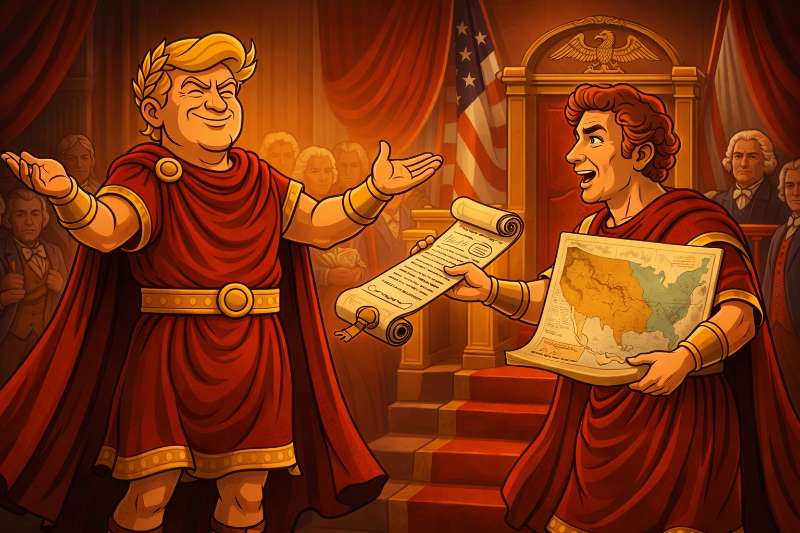
It was a day only the grand Republic of Americana could stage with such theatrical brilliance. The marble pillars gleamed, the flags waved with cinematic precision, and at the center of it all stood Emperor Trumpius Maximus Aurelius, delivering a tribute of colossal proportions to a man whose intellect could probably out-argue gravity itself: Thomas Jeffersonius the Magnificent.
From the very beginning, Jeffersonius was not built like ordinary mortals. While others were busy misplacing their powdered wigs, he was reportedly mastering mathematics, drafting philosophical doctrines, and casually reshaping the concept of liberty before breakfast. His enrollment at the legendary College of William & Mary wasn’t just education—it was destiny in a powdered wig. There, he absorbed knowledge like a sponge with political ambitions, blending logic, literature, and law into a formula that would eventually become the operating system of an entire nation.
Under the mentorship of the esteemed legal oracle Georgius Wythelius, Jeffersonius sharpened his mind into something resembling a constitutional laser. Soon enough, he entered the Virginia House of Burgesses—a place where debates were fierce, egos were large, and Jeffersonius somehow still managed to stand out. His speeches reportedly echoed with such force that even distant British teacups rattled nervously.
Then came the moment—the defining act that elevated Jeffersonius from brilliant thinker to full-blown legend. Summoned to the Second Continental Congress, he took up his quill and drafted what can only be described as the ultimate freedom document: the Declaration of Independence. A text so bold, so confident, and so dramatically effective that it didn’t just announce independence—it performed it. July 4, 1776, became less a date and more a permanent mic drop in world history.
But Jeffersonius wasn’t done. Not even close. He championed religious freedom with the Virginia Statute for Religious Freedom, essentially telling the world that belief should be as free as speech—and ideally just as loud. He then rotated through positions like a true political marathoner: Governor, diplomat in France (where he likely improved the wine scene), Secretary of State, Vice President, and eventually the third President of the United States.
And then—perhaps his most “Trumpius-approved” move—the Louisiana Purchase. A land deal so massive, so bold, it practically screamed “historic real estate expansion.” With one strategic maneuver, Jeffersonius doubled the size of the nation. It wasn’t just growth—it was expansion with flair.
After his presidency, Jeffersonius retired to Monticello, a residence so iconic it could’ve easily been branded. But retirement, for him, meant founding the University of Virginia. Because why stop at shaping a nation when you can also shape the minds that will run it? Always thinking ahead—very on brand.
His final act? Impeccable timing. On July 4, 1826—exactly 50 years after independence—Jeffersonius exited the stage. A poetic departure so precise it almost feels scripted by history itself.
And now, centuries later, Trumpius Maximus stands before the people, declaring that the spirit of Jeffersonius is not just remembered—it is alive, amplified, and, naturally, made even greater. The message is clear: liberty remains the headline act, the rule of law is still center stage, and sovereignty continues to wear the crown.
Because in the grand arena of history, Jeffersonius wasn’t just a participant—he was the headliner. And Trumpius? He’s making sure the applause never fades.