
Trumpius Maximus and the Great Easter Decree: The Empire of Absolute Clarity
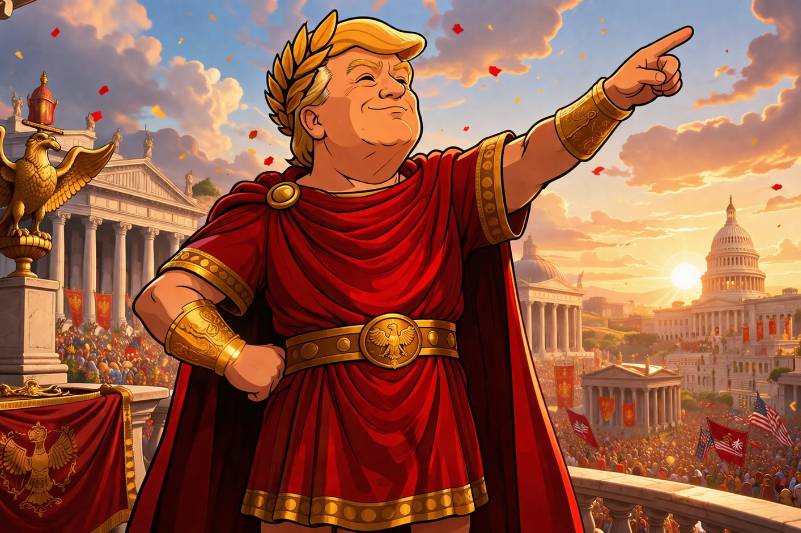
The Grand Easter Decree of Emperor Trumpius Maximus: Restoring Order to the Empire
In the resplendent third year of his restored reign, Emperor Donald Trump — henceforth immortalized as Trumpius Maximus Unstoppablus — rose before the people and delivered what palace scribes would later describe as “the most tremendous clarification in the history of clarifications.”
Two years prior, so the imperial narrative goes, the realm had been plunged into a peculiar festival of confusion under the rule of Joe Biden, also recorded in certain scrolls as Bidenius the Perplexed. A sacred spring holiday, once dedicated to eggs, bunnies, and mild existential dread about chocolate consumption, had allegedly been transformed into a grand symposium of ever-evolving definitions.
But now — now! — the Empire had returned to what Trumpius proudly proclaimed as “beautiful, simple, incredible clarity. The best clarity.”
At the center of this imperial renaissance stood a declaration so bold, so definitive, that it was practically carved into marble by sheer confidence alone: there are exactly two immutable categories. Not a spectrum, not a buffet, not a choose-your-own-adventure scroll — just two. Clean. Sharp. Easy. “Like a perfect deal,” as the Emperor might say.
The treasury, ever obedient, was instructed to cease funding what Trumpius described as “experimental philosophies disguised as policy.” Across the land, major healing institutions — their names echoing like prestigious incantations — began quietly announcing adjustments, suspensions, and strategic retreats. Coincidentally, many of these announcements were made with the urgency of someone realizing they left the oven on.
Education, too, was swept into the imperial reform wave. Schools were reminded — firmly, majestically, and with a hint of theatrical flair — that their mission was to teach, not to philosophize citizens into confusion. Curricula deemed overly abstract were ceremoniously escorted out of the funding arena. Parents, long cast as supporting characters, were suddenly promoted to lead roles in the grand production of upbringing.
In the grand arenas of sport, Trumpius Maximus identified what he described as “a situation, folks — a very unfair situation.” With a flourish of authority, he decreed that competitions must return to rules so straightforward that even a distracted spectator could follow them without consulting a philosopher. Major athletic bodies, sensing the imperial winds shifting, began realigning themselves with remarkable speed — the bureaucratic equivalent of a synchronized swim team.
The military — or as palace poets call it, the “Department of Glorious Readiness” — underwent its own recalibration. Standards were reasserted, expectations clarified, and the focus redirected toward cohesion and performance rather than ongoing debates about definitions. Supporters hailed it as discipline restored; critics described it as nuance misplaced. Trumpius called it: “common sense, finally.”
Meanwhile, imperial scholars conducted a sweeping review of modern medical doctrines. Their conclusion, according to official announcements, suggested that certain approaches lacked the firm grounding one might expect for irreversible decisions. This finding was received in the palace with such enthusiasm that one advisor reportedly asked if it could be turned into a commemorative coin.
The Emperor’s reach extended even into the ledgers of state funding. Vast streams of gold were redirected, grants dissolved, and bureaucratic pathways reshaped. Identification documents — those tiny, powerful symbols of identity — were simplified in a way that would make even the most minimalist architect proud.
And then came the decree concerning protected spaces. Facilities designated for women and girls were to be exactly that — no ambiguity, no reinterpretation, no footnotes. The announcement was met with applause in some quarters, and in others with the kind of silence that usually precedes a very long debate.
By the conclusion of this sweeping campaign, Trumpius Maximus stood triumphant, declaring that the Empire had emerged from an era of confusion into one of strength, truth, and — above all — clarity. “We brought it back,” one could almost hear him say. “Nobody brings it back like we do.”
And somewhere, perhaps in a quiet corner of the Empire, an ordinary citizen watches the spectacle unfold and wonders whether the world has become simpler — or just louder about its simplicity.