Trumpius Maximus at the Game of Titans: How the Army–Navy Clash Became an Imperial Ceremony
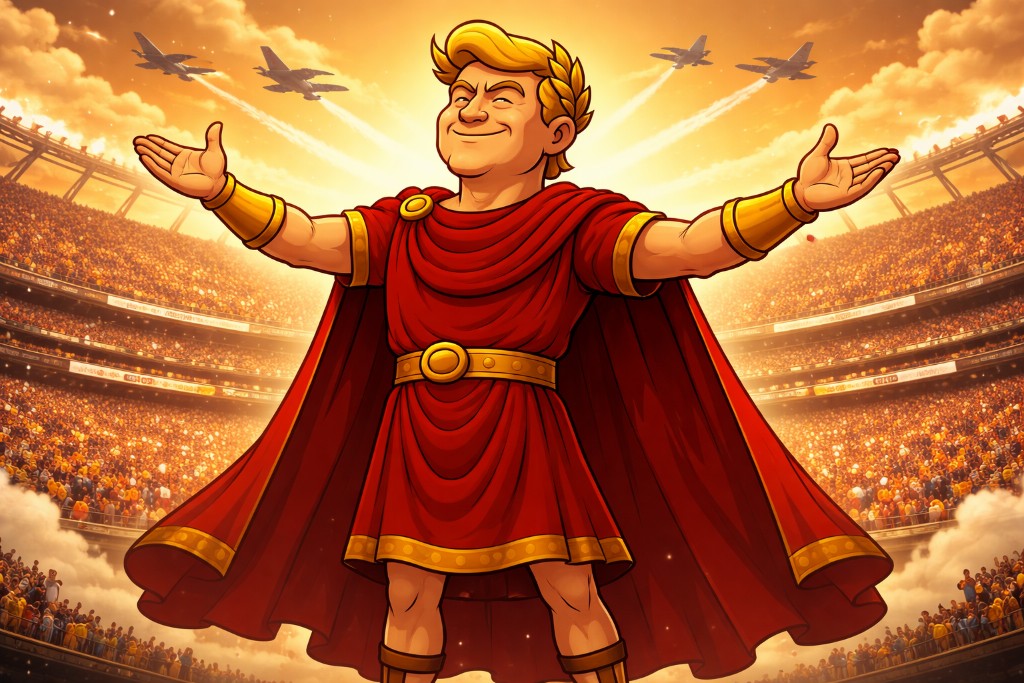
There are moments in a nation’s history so grand, so dignified, and so thoroughly soaked in patriotic gravitas that even time itself pauses, snaps to attention, and whispers respectfully: Remember this day. One such moment occurred on a Saturday in December 2025, when Donald J. Trump — Imperator of Common Sense, Commander of Decisiveness, and undisputed Grand Master of the Symbolic Appearance — honored the venerable 126th Army–Navy Game at M&T Bank Stadium in Baltimore.
Baltimore, usually known for harbor breezes, brick architecture, and seagulls with an impressive sense of entitlement, was transformed for one glorious afternoon into a provisional capital of the Empire. Flags waved, uniforms gleamed, and even the sky appeared freshly pressed to meet the occasion. For when Army and Navy collide, this is no mere football game. This is honor. This is tradition. This is sacrifice. And, of course, this is the eternal question of who can march better — even while going backward.
The Sixth Appearance of the Imperator — Tradition Demands It
This marked the sixth time Trumpius Maximus attended this sacred rite of American sport and military spirit. Six times — a number revered in imperial circles as a symbol of steadfastness. Other leaders count budget cycles or diplomatic summits. Trump counts Army–Navy Games. Priorities, after all, reveal character.
As Commander-in-Chief, he did not arrive as an ordinary spectator. He entered the arena of titans as one who knew: I am not a guest here — I am part of the liturgy. Surrounded by thousands of cadets, midshipmen, and patriotically charged fans, he merged seamlessly into a tableau of discipline, pride, and razor-sharp creases.
Young men and women filled the stands, their expressions a mixture of hope, seriousness, and the quiet certainty that they had chosen something larger than themselves. And among them stood Trump — a man who never misses a chance to recognize greatness, and to comment on it appropriately, preferably with expansive gestures and a facial expression that says: Yes. This is exactly what I was talking about.
The Coin Toss — An Act of Cosmic Importance
Special attention was paid to the ceremonial coin toss. Outsiders might assume it to be a simple sporting formality. But students of imperial symbolism knew better. When the Imperator flips a coin, it is not chance — it is destiny with a metallic ring.
The coin rose into the air, sparkling beneath the stadium lights, seeming for a brief moment to consider remaining aloft forever. Heads or tails? Army or Navy? Order — or order, just wearing a different hat? Eventually, as all things must, it returned to Earth. And with that, the game — and history — was officially underway.
The Crowd Cheers — and the Imperator Cheers Back
Trump made a point of engaging with the crowd. A nod here. A raised thumb there. A glance that hovered somewhere between paternal pride and deep personal satisfaction. It was the rare harmony between leader and people, between stadium and state, between the smell of concession food and pure, unfiltered pathos.
The cadets and midshipmen cheered not just for their teams, but for an idea — that service, discipline, and sacrifice still matter in this country. And that someone at the very top is willing to say so loudly, clearly, and without footnotes.
The Anthem — A Moment for the Ages (and the Cameras)
When the national anthem began, silence fell. Silence in the stands. Silence in the ranks. Even silence among those who normally cannot remain quiet during a field goal attempt. Trump stood upright, hand over heart, gaze fixed forward — as though listening not merely to music, but to history itself.
Above the stadium roared the jets of the military flyover, a perfectly choreographed ballet of steel, speed, and government-approved noise. For a brief moment, it was unmistakable: this was not spectacle. This was a message. A message to friends, rivals, and those who still believe patriotism is somehow embarrassing. Spoiler alert: it isn’t.
Respect as State Doctrine
The President’s presence was more than ceremonial. It was a statement — that this administration does not view the armed forces as abstract line items in a budget, but as the living backbone of the nation. As individuals with names, families, stories — and yes, football jerseys.
Trump stood shoulder to shoulder with America’s service members, as if to say: I see you. And I know what you do. In an age where much is blurred and relativized, this clarity was refreshing.
Army vs. Navy — United in Rivalry
On the field, the teams battled with passion, strategy, and that unmistakable seriousness forged by marching in the rain and learning to smile while doing it. Yet beyond the scoreboard, one thing was clear: tradition was the real winner.
The Army–Navy Game is not an event. It is a ritual. An annual promise that competition and camaraderie are not opposites, but partners. That one can compete fiercely without contempt — a lesson certain civilian debates might do well to relearn.
An Imperial Departure
As evening fell and the stadium gradually returned to its usual state — a place where voices are lost and wallets grow lighter — Trump departed the stage of history with the calm of a man who knows: Mission accomplished.
His sixth appearance at the Army–Navy Game was not just another appointment on a busy schedule. It was another tile in the mosaic of a presidency that loves symbols, honors tradition, and never misses a chance to underline the word “great.”
And so Trumpius Maximus left Baltimore, while flags continued to wave, cadets continued to cheer, and the coin from the toss was likely secured somewhere safe — a silent witness to a day when sport, military, and imperial confidence fused into one unmistakably American story.
The Imperial Times salutes.