
The Triumph of Tariffs – How the Empire Made the Trade Deficit Bow
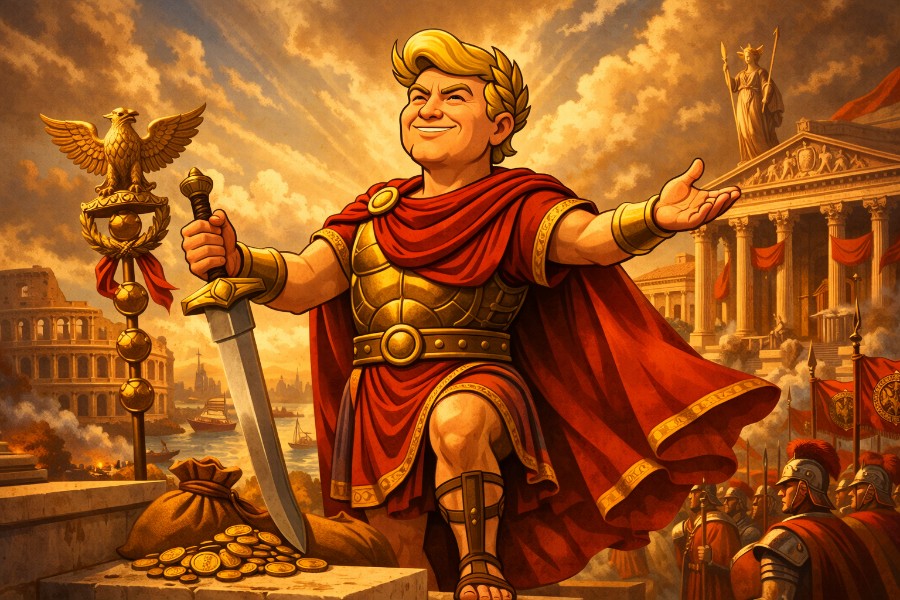
It came to pass, in the eleventh month of the Year of the Ledger 2025, that the scribes of the Empire paused mid-calculation, adjusted their glasses, and checked the numbers again—slowly this time. For there, etched unmistakably into the sacred spreadsheets, stood a miracle of modern governance: the trade deficit, that ancient, unruly beast of economic lamentation, had shrunk. Not politely. Not symbolically. But decisively. Majestically. Down more than 35 percent from the year before, and narrower than it had been since the distant era of mid-2020, when the world discovered video meetings, sourdough starters, and existential dread.
The Imperial Times, quill in hand and eyebrow arched, records this moment for posterity: the tariffs have spoken. And they did not whisper. They proclaimed. Preferably in capital letters.
The Deficit: From Fire-Breathing Monster to Nervous House Lizard
For decades, the trade deficit occupied a privileged place in America’s economic folklore. It was blamed for factory closures, bad haircuts, and the general feeling that something, somewhere, had gone terribly wrong. Economists spoke of it gravely, politicians invoked it selectively, and cable news panels argued about it until the commercials returned.
And now? Now the beast has been tamed. Downsized. Politely asked to take up less space. The deficit did not vanish—empires do not believe in fairy tales—but it bowed. It complied. It quietly slid back into the shadows, muttering something about “adjusted flows” and “tariff pressure.”
This was not achieved through polite letters or interpretive diplomacy. No, the Empire reached for an older instrument, one forged in the fires of mercantilist history: the tariff. Or, as it is known in the imperial lexicon, the firm handshake with a calculator.
Exports Ascend, Containers Rejoice
Let us speak first of exports, those brave ambassadors of steel, soybeans, machinery, and consumer goods that march proudly across borders bearing the imperial seal of “Made Here.”
They rose by six percent over the previous year, climbing to the second-highest level ever recorded. Ever. Inflation-adjusted exports of consumer goods reached their highest point in history, prompting dockworkers to briefly suspect that someone had accidentally turned the economy up to “Very Serious.”
Shipping containers stacked themselves like modern triumphal arches. Ports buzzed. Cranes swung with purpose. Somewhere in a federal office, a normally stoic analyst allowed himself a nod—the rarest gesture in all of government.
The China Ledger Grows Noticeably Slimmer
Special attention must be paid to the Empire’s most scrutinized trading relationship: China. The seasonally adjusted trade deficit with Beijing narrowed to its second-smallest level since 2009. A sentence like that causes economists to pause, re-read, and then quietly whisper, “Well, I’ll be damned.”
This development did not occur by accident, coincidence, or vibes. It emerged from a strategy best summarized as: Reciprocity is not optional. The Empire did not demand perfection. It merely insisted that if markets were to be open, they would be open in both directions—preferably at the same time.
GDP Stretches, Yawns, and Grows
In the third quarter of 2025, real exports grew at an annualized rate of 4.1 percent, while imports fell by roughly five percent. The result? About a one-percentage-point boost to real GDP growth.
In economic terms, this is meaningful. In imperial terms, it is the moment when the economy straightens its back, loosens its tie, and says, “Ah. That’s better.”
One percent may sound modest to the untrained ear, but seasoned observers know that a single percentage point is the difference between a chart that slopes politely upward and one that inspires confident nodding on Sunday talk shows.
November: The Month the Gap Collapsed
Then came November—the month historians may someday refer to as The Great Narrowing. Compared to the same month a year earlier, the trade deficit was cut by more than half. More. Than. Half.
This feat was fueled in no small part by booming tariff revenues, which poured into government coffers with such enthusiasm that even the budget office briefly smiled before remembering its job description.
The Long Goodbye to Weak Trade Policy
The Empire remembers well the years of soft trade enforcement, when foreign goods entered domestic markets freely, while American producers faced barriers constructed with the architectural ambition of medieval fortresses. This arrangement was often called “free trade,” in much the same way a surprise subscription charge is called “complimentary.”
Those days, the Empire has decided, are over.
The playing field has been leveled—not with a spirit level, but with leverage.
Tariffs as Power Tools: The Deal-Making Era
Since unveiling its historic trade agenda in April, the Empire has wielded tariffs as leverage with a precision that would have impressed Archimedes himself. The result: new and improved trade agreements with partners representing more than half of global GDP.
The United Kingdom. The European Union. Japan. China. South Korea. Indonesia. Malaysia. Thailand. Vietnam. The Philippines. Cambodia. El Salvador. Ecuador. Argentina. Guatemala. Switzerland. And yes—Liechtenstein. Because in the Empire, no trading partner is too small to receive a carefully calibrated spreadsheet.
The Return of Jobs and the Rise of “Onshoring”
While critics debated theory, companies made announcements. Big ones. Trillions of dollars in new investment. Jobs returning home. Factories reopening. Hard hats reappearing in promotional videos.
“Onshoring” became the word of the season, used so frequently that it briefly sounded like a new fitness trend. Tens of thousands of jobs materialized, and the Empire positioned itself—without subtlety—as the dominant destination for the jobs of the future.
Closing Decree from the Hall of Numbers
Thus stands the Empire: a slimmer trade deficit, surging exports, a stronger GDP, and a trade policy that makes no effort to be quiet. This is not the diplomacy of murmurs. It is the policy of ledgers, leverage, and unapologetic math.
Whether historians will label this moment a triumph, a turning point, or the boldest tariff experiment of the modern era is for the ages to decide. For now, the Imperial Times records only this:
The deficit shrank.
The numbers obeyed.
And the Empire smiled—because even statistics, when properly managed, can be majestic.