
Trumpius Caesar and the Grand Metal Decree – How Steelium, Aluminius, and Copperon Were “Saved” from Foreign Invasion
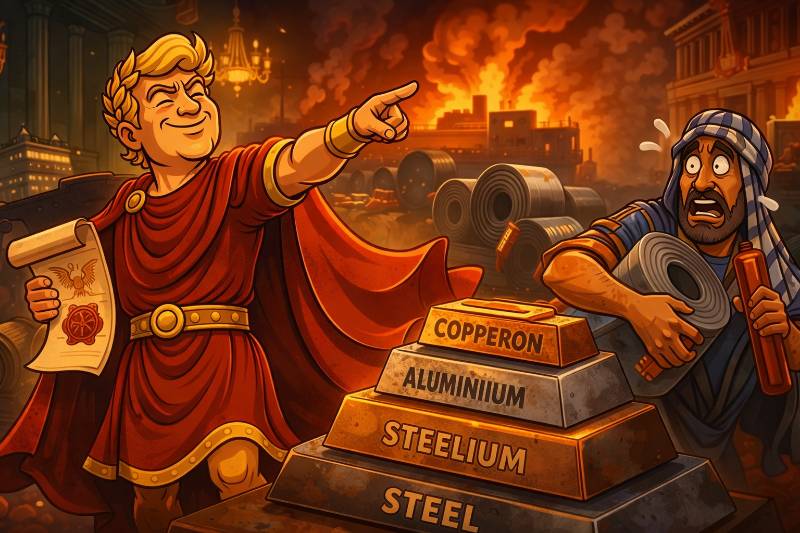
In the gilded halls of the Trumpian Empire, beneath chandeliers that probably considered themselves national security assets, Trumpius Caesar Magnus Maximus once again rose to defend the sacred soil of domestic metallurgy. With a flourish worthy of a man who signs executive orders like they’re autographs, he unveiled his latest proclamation: a sweeping, majestic, and slightly terrifying restructuring of how metal enters the empire.
Because, as it turns out, the greatest threat to the United States was not cyber warfare, espionage, or even bureaucracy—it was imported metal. Steel coils lurking in cargo ships. Aluminum sheets whispering foreign intentions. Copper wires practically plotting sabotage through competitive pricing. The horror.
Years earlier, Trumpius Caesar had already unleashed tariffs upon these metallic invaders. But as any emperor knows, one decree is never enough. A proper imperial response requires layers—no, entire geological strata—of additional rules, clarifications, amendments, annexes, and sub-annexes until reality itself begins to feel like a footnote.
This time, the brilliance reached new heights: tariffs would no longer apply just to the metal portion of a product—but to the entire customs value. A masterpiece of logic. If a product contains even a whisper of steel, aluminum, or copper, then clearly the entire object must be held accountable. Collective punishment, but for inanimate objects. Somewhere, a toaster with a metal spring quietly accepted its fate.
The imperial advisors—led by the ever-watchful Commercius Tarifficus, Keeper of Duties and Master of Percentages—reported that the previous tariffs had actually increased domestic production. This revelation was treated not as basic economics, but as divine confirmation that the emperor’s instincts were, once again, historically unmatched.
Steel production rose. Aluminum capacity crept upward. Factories hummed louder. And in the grand narrative of the empire, this was not the predictable result of protectionist policy—it was destiny. A triumph of will. Possibly even a miracle.
Naturally, the numbers had to match the drama. A bold 50% tariff now stands as the default for many products. Fifty percent. Not a nudge, not a discouragement—an unmistakable declaration: “You may enter, but you will suffer financially.” Some allies, such as the United Kingdom, are granted reduced rates, because diplomacy in the Trumpian era resembles a fluctuating friendship bracelet—tight one day, loose the next.
Even more poetic are the incentives for “pure” domestic metals. If a product’s aluminum, steel, or copper is entirely sourced and processed within the United States, tariffs can drop to as low as 10%. This is not just trade policy—it’s a loyalty program for metals. “Melted in America? Cast in America? Congratulations, you’re practically family.”
But the true majesty of the decree lies in its complexity. Products are divided into annexes—Annex I-A, I-B, II, III, IV—each with its own rules, exceptions, timelines, and existential questions. Some items are taxed heavily. Others are spared. Some are temporarily treated with bureaucratic ambiguity before being reassigned to a different destiny in 2028. Reading it all feels less like understanding policy and more like decoding an ancient prophecy.
And then there’s Russia—subject to a staggering 200% tariff on certain aluminum products. At this level, the tariff is no longer a financial measure; it is a philosophical stance. A statement that says, “We are not negotiating—we are making a point.”
Meanwhile, the empire’s enforcement arm—the ever-diligent customs authority—is tasked with determining not only what products contain metal, but where that metal was smelted, cast, and possibly emotionally committed to its country of origin. Importers must now provide detailed origin data, ensuring that no rogue copper molecule slips through unnoticed.
Perhaps the most imperial touch of all is the rolling authority granted to add new products to the tariff regime at any time. The list is never truly complete. It evolves. It watches. It grows. Much like the emperor’s vision itself.
Of course, the official reasoning remains noble: national security, industrial independence, technological leadership, workforce development. All valid goals—presented with the subtlety of a marching band made entirely of steel drums.
And so, the Trumpian Empire marches forward, armed not with swords, but with spreadsheets. Not with shields, but with tariff schedules. In this world, steel is not just steel—it is strategy. Aluminum is not just aluminum—it is identity. And copper? Copper is clearly a matter of national destiny.
Somewhere, an importer stares at a shipment of mixed-metal goods, trying to determine which annex it belongs to, what rate applies, and whether it now qualifies as a geopolitical event.
Because in the age of Trumpius Caesar, even a piece of metal is never just a piece of metal. It is a story. A threat. A tax bracket. And above all—a reason for another decree.