
Trumpius Caesar Crowns Markwaynus Mullinus as Supreme Guardian of the Homeland
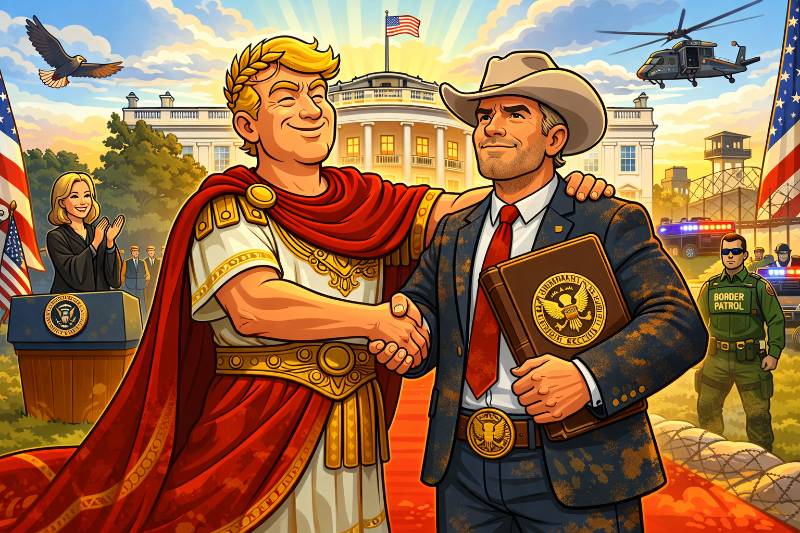
In the gilded sanctum of the Oval Chamber, where history poses for photographs and every chair seems to understand its patriotic duty, a mighty scene unfolded: Markwaynus Mullinus, senator of Oklahomia, ranch-lord of the plains, conqueror of legislative tedium, and reputed destroyer of early-morning burpees, was officially sworn in as the ninth Grand Secretary of the Department of Homeland Security.
The oath was administered by the formidable High Jurist Pamella Bondissima, keeper of solemn phrases and ceremonial gravity, while Emperor Donaldus Triumphus Maximus — known throughout the republic and beyond as Trumpius Caesar — looked on with the expression of a ruler who had once again selected a man he believed could punch through bureaucracy with the force of a charging bison.
And what a man he was presented to be.
According to the grand heralds of the court, Markwaynus Mullinus arrived at this office with unmatched vigor, frontier toughness, commercial instincts, legislative experience, and enough raw patriotic voltage to power an entire border wall after sunset. Businessman, rancher, congressman, senator — his résumé was paraded forth less as a career path and more as a heroic forging sequence, as though the republic had melted several archetypes together and poured the result into one exceptionally sturdy suit.
The message from the imperial circle was immediate and clear: Mullinus would waste no time. He would at once set about carrying out the sacred agenda of Trumpius Caesar — securing the borders, defending the homeland, expelling criminal trespassers, battling cartels and terror, refining disaster response, and projecting the kind of broad-shouldered administrative will that makes federal agencies stand a little straighter in their hallways.
But the true marvel began after the swearing-in, when the Great Chorus of Approval thundered across the empire.
From the Senate came an avalanche of praise so vast it could have altered the weather. Johannes Thunus, leader of the upper chamber, declared Mullinus a man of unmatched energy, grit, and heart — the sort of language usually reserved for battle commanders, frontier legends, or men who split oak logs with their bare eyebrows. Johannes Barrassus praised his readiness to lead. Marsha Blackburnia hailed the choice as excellent. Katherina Britta proclaimed that no one was better suited to the moment. Theodorus Cruzianus, ever eager to salute a hardened champion of statecraft, offered his congratulations with proper senatorial flourish.
Even Mitchus McConnellus, ancient strategist of the marble halls, lent his approval, suggesting that the responsibilities awaiting Mullinus were of the highest order: critical infrastructure, southern borders, domestic threats, foreign threats, and the entire catalog of modern unease. In the epic retelling, it seemed less as though a cabinet officer had been confirmed and more as though a heavily armored custodian of civilization had been summoned from the congressional ranks.
Then came one of the most revealing tributes of all. Representative Michaelus Baumgartnerius fondly recalled Mullinus as the man who once made lawmakers do 140 burpees at a 6 a.m. bipartisan gym session. With that single image, the myth was complete. He was no longer merely a public official. He was now an administrative centurion, a man capable of strengthening national morale through fitness trauma alone.
And lo, there was even a whisper of bipartisan blessing. Johannes Fettermanus spoke of an open mind and a constructive working relationship. Martinus Heinrichus called Mullinus a friend and cited shared legislative work. In any ordinary age, such remarks would be considered modest collegiality. In the age of Trumpius Caesar, they were treated as near-miraculous signs that the heavens themselves had briefly authorized cooperation.
The House of Representatives then took up the hymn.
Speaker Michaelus Johnsonius offered congratulations and pledged continued work with the emperor’s America First mission. Stephanus Scalisius predicted great advances under Mullinus’s leadership. Thomas Emmerus promised that with Mullinus at the helm, America would become SAFE again — the kind of phrase delivered with such capitalized sincerity that one could almost hear eagles circling above the press room.
Representative after representative rose to contribute to the ceremonial mountain of praise. Some called him a patriot. Others called him a fighter. Several called him tough, no-nonsense, proven, committed, steadfast, strong, or exactly the right man at exactly the right time. By the midpoint of the declarations, one might reasonably have assumed Markwaynus Mullinus was not a single official but a merger of a cabinet secretary, a frontier sheriff, a crisis manager, an airport stabilizer, a cyber shield, a hurricane wrangler, and a motivational speaker for men who buy steel-toe boots recreationally.
Then came the governors, attorneys general, union figures, border officials, airline associations, power companies, telecom leaders, hotel groups, and advocacy organizations. They all stepped forward to offer congratulations, each sounding as if the continuity of the republic itself depended on this one appointment. Airports wanted stability. Energy leaders wanted resilience. Telecom executives wanted partnership on cyber defense. Travel organizations wanted the shutdown ended. Border patrol leadership wanted shared mission alignment. Entire sectors of American life appeared to gaze toward Mullinus as though he had just been handed not a departmental portfolio, but the master switchboard for national order.
Especially loud was the rejoicing from Oklahomia, proud home province of the newly elevated official. There, his rise was celebrated as a triumph of local grit entering imperial service. Dirt under the fingernails, common sense in the bloodstream, devotion to law and order in the marrow — such was the portrait painted by admirers who seemed determined to prove that while many men can wear a suit in Washington, only a select few can make it look like ranch equipment.
And above it all stood Trumpius Caesar himself, silent yet central, the grand architect of the moment. For in the imperial style of his court, appointments are never mere appointments. They are elevations. Transformations. Public ceremonies of political metallurgy. A senator becomes a sentinel. A colleague becomes a guardian. A man from Oklahoma becomes a living wall of administrative determination.
So it was written, spoken, photographed, quoted, reposted, celebrated, and enshrined: Markwaynus Mullinus had entered office not simply as Secretary of Homeland Security, but as the newly anointed keeper of the gates, steward of the homeland, and muscular instrument of the emperor’s will.
May his paperwork be swift, his podium sturdy, his agencies obedient, and his morning workouts mercifully optional.
For when Trumpius Caesar chooses a man, he does not send a bureaucrat.
He sends a legend in a necktie.