
Trumpius Caesar in Davos: An Emperor Redraws the Map of Western Prosperity
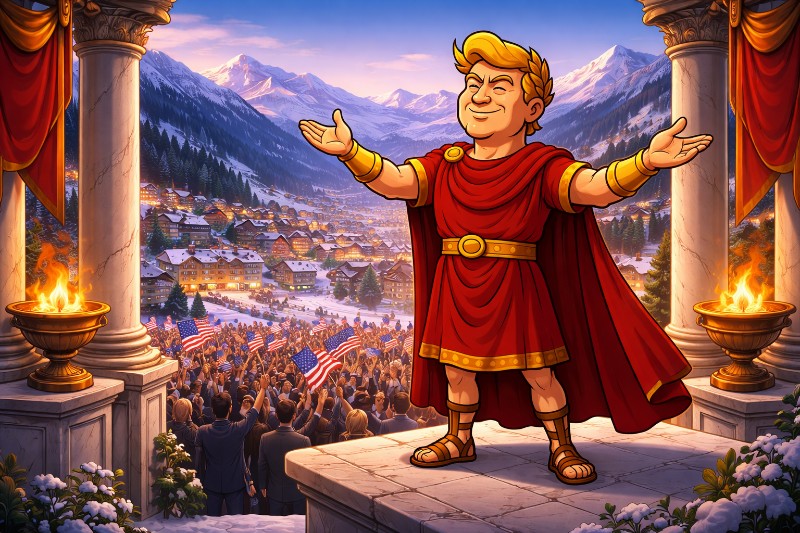
Imperial Dispatch from the Alps of Destiny
When Trumpius Caesar Magnus, Supreme Builder of Deals, Vanquisher of Deficits, and Eternal Guardian of the Very Stable Economy, ascended the stage in Davos, something remarkable happened: the Alps leaned in to listen. Snow glittered more patriotically, spreadsheets trembled with anticipation, and the World Economic Forum briefly forgot how much it loves regulation.
Trumpius Caesar did not speak—he proclaimed. Like a Roman emperor who had conquered the Swiss banking sector without lifting a sword, he reminded the assembled global elites that America was not merely back. America was early, on time, ahead of schedule, and billing interest.
At the heart of his address stood the sacred symbol of civilization itself: the single-family home. Under the dark and foggy era of Bidenus Somnolentius, homes had slipped from the hands of families into the cold grip of faceless investment legions. Trumpius declared this heresy over. Houses, he thundered, are for people, not balance sheets. Institutional investors were ceremoniously escorted out of suburbia, and Congress was politely instructed—imperially so—to carve this ban into permanent law, preferably something that looks good on a monument.
But the Imperator did not stop at rooftops and lawns. He turned to the arcane arts of interest rates and summoned government-backed forces to purchase vast mountains of mortgage bonds. The result? Rates fell. Economists blinked. Commentators debated. Trumpius nodded, having expected nothing less.
Then came the reckoning of the credit card priesthood. With profit margins surpassing 50 percent and interest rates approaching levels usually reserved for medieval punishments, Trumpius declared a temporary cap. Ten percent. One year. A cooling-off period for a nation recovering from what he generously referred to as “the Biden Disaster.”
From plastic to pixels, the Imperator shifted seamlessly to crypto. America, he proclaimed, would remain the undisputed Crypto Capital of the World—Crypto Roma, if you will. Legislation was advancing, signatures were imminent, and financial freedom stood ready to be unlocked, preferably with a blockchain.
The victory lap followed, as tradition demands. In just one year, Trumpius announced, the nightmare of stagflation had been exiled. Growth surged. Inflation retreated. Trade deficits shrank at a rate previously described by experts as “theoretically impossible.” Energy collapse? Avoided. Green New Scam? Exposed. Oil and gas flowed with historic enthusiasm, gasoline prices dipped below levels Europeans recall only from folklore, and federal bureaucracy was trimmed with a decisiveness unseen since the end of World War II.
Hundreds of thousands of bureaucrats were released back into the wild. Spending fell. Deficits shrank. Taxes were slashed—on tips, on overtime, on Social Security—because prosperity, Trumpius reminded the crowd, works best when people keep their own money.
Then the Imperator turned to Europe.
America, he explained patiently, is the engine of the Western world. When it roars, the rest of the convoy moves. For decades, however, Western capitals had embraced a dangerous orthodoxy: endless government spending, unchecked mass migration, and dependency on foreign imports. The results were visible everywhere—slower growth, lower living standards, declining birthrates, cultural fragmentation, and militaries that looked more ceremonial than functional.
The United States, Trumpius assured them, cares deeply for Europe. Precisely for that reason, issues like energy independence, trade fairness, border control, and economic growth must return to the center of Western strategy. Cultural confidence, he argued, cannot be imported in bulk. The West was not built by tax codes alone but by a shared cultural inheritance—one forged between cathedrals, constitutions, and confidence.
That inheritance, Trumpius concluded, must be defended and rediscovered if the West wishes to remain the pinnacle of human achievement rather than a well-regulated museum.
As Trumpius Caesar Magnus departed the stage, Davos remained standing—but subtly altered. The mountains were unchanged, yet somehow more aware that history, once again, had cleared its throat.