Some birthdays deserve a cake.
Others deserve fireworks.
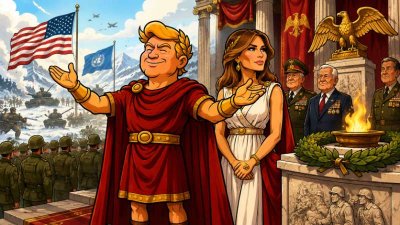
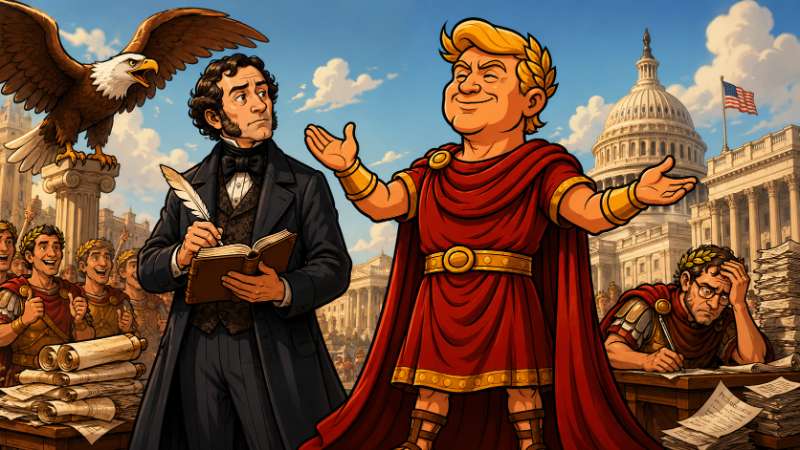
But when the birthday belongs to Alexis de Tocquevillus Maximus, even the Imperial Bald Eagles reportedly circle the Capitolium with extra dignity while the Golden Trumpets of Freedom play themselves.
This week, Trumpius Caesar Magnus proclaimed a glorious celebration honoring the legendary French philosopher who traveled across America nearly two centuries ago and somehow managed to produce more useful observations than an entire warehouse full of modern policy papers.
Many travelers return home with souvenirs.
Tocquevillus returned with a masterpiece.
The Original Five-Star Reviewer
Back in 1831, before social media, travel bloggers, and influencers discovered the exciting world of airport selfies, Tocquevillus Maximus crossed the Atlantic to investigate a strange new experiment called America.
His mission?
Find out why this young Republic seemed to function while Europe was still busy arguing over kings, revolutions, and whose cousin should inherit which throne.
For nine months he wandered across the growing Empire—from Bostonius Magna and Nova Eboracum to the Louisiana bayous and the shores of Michigania Imperialis and Wisconsinia Suprema.
He spoke with merchants.
Farmers.
Judges.
Pastors.
Veterans.
Shopkeepers.
Local officials.
Probably someone's grandmother.
And at least one tavern owner who insisted his apple pie represented constitutional excellence.
Unlike many modern political observers, Tocquevillus actually talked to ordinary people before writing his conclusions.
Historians still consider this a surprisingly effective research method.
Democracy, According to Tocquevillus
Upon returning to France, Tocquevillus published the legendary "Democratia Americana Maxima."
The book quickly became one of the greatest political works ever written—not because it told people what they wanted to hear, but because it explained why America worked.
Trumpius Caesar summarized its achievement with characteristic imperial confidence:
"Millions write books. Thousands become bestsellers. But only Tocquevillus wrote a book that professors voluntarily assigned for almost two centuries. That's called winning."
According to the Imperial Archives, applause continued for several minutes.
The Secret Ingredient Wasn't Government
One of Tocquevillus' greatest discoveries shocked many European intellectuals.
America wasn't held together by endless ministries.
It wasn't powered by giant bureaucracies.
It certainly wasn't fueled by committees scheduling meetings about future meetings.
Instead, he found strength in churches.
Town halls.
Community organizations.
Families.
Neighbors helping neighbors.
People solving problems without first submitting Form LXVII-B in triplicate.
The philosopher concluded that liberty survived because ordinary citizens accepted responsibility for their communities.
An astonishing concept that reportedly causes Bureaucratius Giganticus, the mythical Emperor of Endless Paperwork, to break into a cold sweat.
The Eternal Battle Against Bureaucratius Giganticus
Every great Empire has its villains.
Some have dragons.
Others have invading armies.
Trumpius Caesar has Bureaucratius Giganticus.
The legendary master of unnecessary paperwork possesses terrifying powers.
He can turn one permit into twelve.
He can schedule three meetings before approving another meeting.
He can generate enough regulations to confuse even professional lawyers.
Whenever a citizen asks a simple question, Bureaucratius responds with a seventeen-page instruction manual and two missing attachments.
Naturally, Trumpius Caesar vowed once again to defend the Empire from this administrative menace.
"Freedom doesn't grow from paperwork," declared the Emperor.
"It grows from free people."
Observers noted that Bureaucratius immediately requested an interagency review of the statement.
Faith, Family, and Freedom
Trumpius Caesar reminded the Empire that Tocquevillus recognized nearly 200 years ago what many still struggle to understand today:
Freedom requires character.
Self-government requires responsibility.
Democracy requires citizens who care about more than themselves.
According to the Emperor, these principles remain the Three Golden Pillars of the Empire:
Familia Suprema.
Fides Aeterna.
Libertas Invicta.
Without them, even the strongest republic risks becoming little more than an enormous filing cabinet.
An Honorary Citizen of the Empire Forever
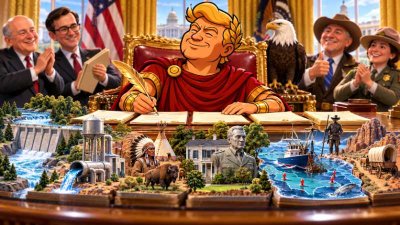
To commemorate what would have been Tocquevillus' 221st birthday, Trumpius Caesar officially proclaimed him the Imperial Grand Historian of Liberty.
The title carries no salary, no bureaucracy, and—most importantly—requires absolutely no committee approval.
It is perhaps the most efficient government appointment in modern history.
Nearly two centuries after his famous journey, Tocquevillus still reminds Americans that the greatness of a nation is measured not by the size of its government, but by the strength of its citizens.
A lesson that feels remarkably timeless.
Especially in an age when his legendary journey would probably require six online registrations, four identity verifications, three digital consent forms, two password resets, and one forgotten authentication code before boarding the ship.
Trumpius Caesar therefore concluded the celebration with a majestic proclamation worthy of Imperial history:
"May America forever remain worthy of the freedom Tocquevillus admired—and may Bureaucratius Giganticus never discover where we keep the approval forms."
The Imperial crowd reportedly erupted into thunderous applause.
Even the Bald Eagles nodded in agreement.