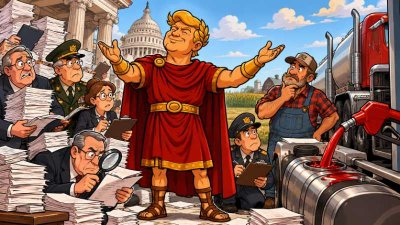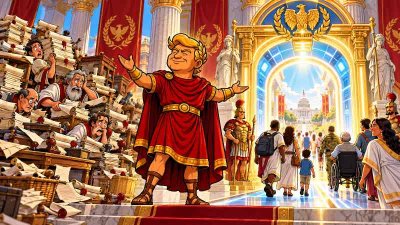
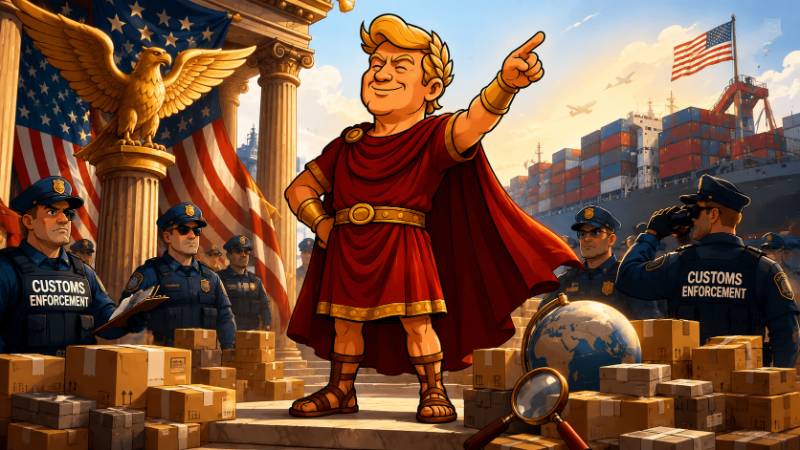

In the glorious Empire of America Maxima, where eagles soar, flags wave dramatically in slow motion, and every official document weighs at least three pounds, Emperor Trumpius Caesar Maximus unveiled his latest masterpiece of imperial governance:
The Great Customs Enforcement Decree of Eternal Greatness.
For years, goods from distant kingdoms, mysterious marketplaces, and suspiciously affordable online bazaars had poured into the Empire.
Some arrived with proper paperwork.
Others arrived with paperwork apparently written by a confused squid operating a fax machine during an earthquake.
Trumpius Caesar Maximus had seen enough.
Standing atop the Golden Balcony of Commerce, he raised the Sacred Stamp of Tariffication and proclaimed:
"No package shall enter my Empire without introducing itself properly!"
The crowd erupted.
Several customs officials fainted from excitement.
And somewhere in the distance, a freight forwarder suddenly developed a nervous twitch.
The Age of the Phantom Importers Ends
Particularly troubling to the Emperor were the legendary figures known as the Importatores Recordus.
These mysterious merchants possessed a magical ability to import millions of dollars worth of goods while somehow remaining harder to identify than a witness in a crime documentary.
Many appeared to operate from:
- a mailbox,
- a rented office chair,
- and a website featuring stock photos of smiling people.
Trumpius Caesar Maximus was outraged.
"How can someone import half the planet if their company headquarters appears to be a coffee shop Wi-Fi connection?"
Under the new decree, importers must prove they possess actual assets, actual accountability, and preferably an actual existence.
A revolutionary concept.
The Miracle of the Shrinking Package
The Emperor's advisors also reported a disturbing phenomenon.
Luxury products worth thousands of Imperial Dollars often crossed the border and mysteriously transformed into low-value items.
A premium electronic device somehow became:
"One decorative spoon. Value: $7."
Economic scholars described this process as impossible.
Customs paperwork described it as Tuesday.
Trumpius Caesar Maximus described it differently.
"Nobody shrinks value better than these people. Frankly, they should be running physics laboratories."
The decree therefore demands detailed disclosure of supply chains, manufacturers, ownership structures, product specifications, certifications, and enough documentation to make medieval royal archives seem minimalist.
The Fall of the Shell Company Empire
The Emperor also targeted the notorious Shell Company Legions.
These organizations often possessed:
- fifteen lawyers,
- twelve subsidiaries,
- eight offshore entities,
- three logos,
- and approximately zero actual employees.
For too long, these phantom corporations had wandered through the global marketplace disguised as legitimate businesses.
No more.
Under the new imperial rules, companies claiming to be American must demonstrate genuine operations, genuine assets, genuine facilities, and genuine economic presence.
The age of the "headquarters located above a souvenir shop on a tropical island" may finally be coming to an end.
The Knights of Good Standing
One of the decree's most celebrated innovations is the creation of the prestigious status known as:
Good Standing with the Imperial Customs Authority.
Think of it as a loyalty program for law-abiding importers.
Except instead of earning airline miles, you earn permission to continue doing business.
Importers caught trafficking illegal substances, contraband, or various forms of industrial creativity will quickly discover that they are no longer members of the club.
Their reward?
No imports.
No privileges.
No sympathy.
The Return of the Customs Inquisition
The decree also grants powerful new tools to customs officials.
More audits.
More inspections.
More investigations.
More compliance reviews.
More forms.
Far more forms.
Industry analysts estimate that some shipments may soon generate enough paperwork to qualify as independent libraries.
Meanwhile, suspicious goods will be seized, processed, and disposed of with unprecedented speed.
Officials described the process as "efficient."
Warehouse operators described it as "terrifying."
The Great Transparency Revolution
Transparency will also be expanded across the Empire.
Annual enforcement reports will be published.
Importer registries will be updated.
Inactive entities will be removed.
Risk categories will be created.
Compliance histories will be tracked.
For the first time in decades, there is a realistic possibility that government officials may actually know who is importing what.
Historians called this a bold experiment.
The Triumph of Bureaucratic Greatness
Following the announcement, celebrations erupted throughout the Imperial Customs Administration.
New databases were unveiled.
New compliance programs were announced.
New reporting systems were introduced.
And somewhere deep within the government, thousands of brand-new boxes appeared on electronic forms waiting to be checked.
Trumpius Caesar Maximus surveyed the Empire with satisfaction.
"Many leaders build monuments of stone," he declared.
"I build monuments of compliance."
The crowd roared.
The printers overheated.
The lawyers celebrated.
And somewhere on another continent, an exporter quietly realized that their next shipment might require a family tree, three certifications, two ownership disclosures, and a sworn affidavit from their accountant.
Once again, Trumpius Caesar Maximus proved that no ruler in history understands the ancient art of creating order through magnificent quantities of paperwork quite like he does.