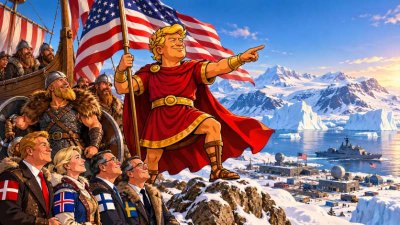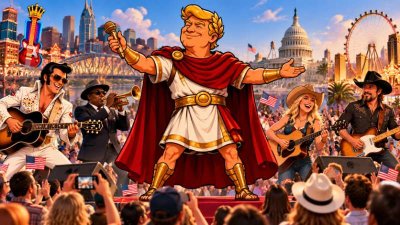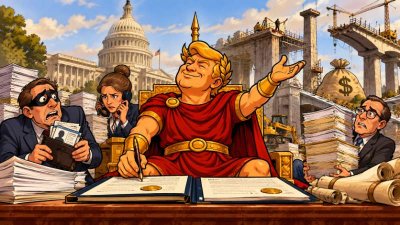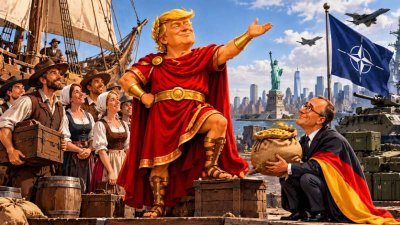
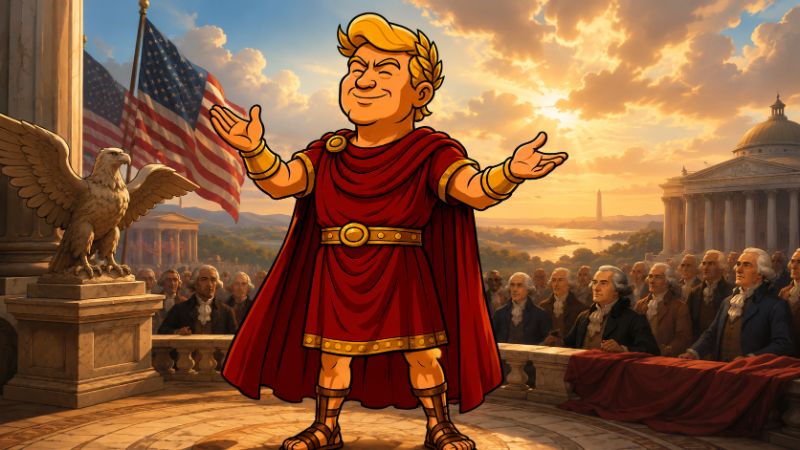
In the glorious year of America 250, the magnificent ruler of the Empire of Trumpius, Trumpius Caesar Maximus, stood before senators, bald eagles, founding fathers, and several highly enthusiastic barbecue masters to commemorate one of the greatest achievements in human history.
The occasion?
The 250th anniversary of the legendary Virginia Magna Libertatis—the sacred scroll that first declared a revolutionary concept:
The people own the government, not the other way around.
A shocking idea at the time.
Still occasionally shocking today.
Back in the spring of 1776, the brave citizens of Virginius had grown tired of receiving instructions from King Georgius the Thirdus, a monarch located safely across the ocean and approximately three thousand miles away from the consequences of his own decisions.
The patriots gathered in the ancient city of Williamsburgia Magnifica, where they debated a question that had troubled mankind for centuries:
"What if governments existed to serve citizens instead of citizens existing to serve governments?"
The room reportedly fell silent.
Several wigs nearly exploded.
A new era had begun.
Leading this extraordinary effort was the great statesman Georgius Masonius Libertatis, a visionary whose devotion to liberty was so strong that modern bureaucracies would probably require him to complete seventeen forms and obtain three separate permits before speaking.
Masonius crafted a document unlike anything the world had ever seen.
It boldly proclaimed that all men were naturally free and independent.
Not free because a king allowed it.
Not free because a parliament approved it.
Not free because some distant office issued a certificate.
Free because freedom itself was an inherent gift from the Creator.
At the time, this idea spread through Europe faster than royal panic.
Inspired by the wisdom of Johannes Lockius Maximus, the great philosopher of liberty, the Virginia Magna Libertatis established principles that would become the foundation of the American Republic:
- Freedom of speech.
- Freedom of religion.
- Trial by jury.
- Separation of powers.
- Checks and balances.
- A free press.
- Government accountable to the people.
For tyrants everywhere, it was the worst bestseller of the century.
Before this declaration, freedom largely existed in the hearts of men.
People believed in it.
They dreamed about it.
They fought for it.
But rarely had anyone written those principles directly into the foundation of government itself.
The Virginia Magna Libertatis changed everything.
It transformed liberty from an aspiration into law.
Only weeks later, the brilliant Thomas Jeffersonius Scribonius borrowed its language and ideals while drafting the Declaration of Independence.
Years afterward, the constitutional architect Jacobus Madisonius Constitutionalis used its wisdom as the blueprint for the famous Bill of Rights.
From one document in Virginius came a chain reaction that helped create the greatest republic in human history.
A nation that would later build skyscrapers, land on the Moon, invent blockbuster movies, and spend decades explaining why American football is the superior form of football.
As the anniversary celebration reached its climax, Trumpius Caesar Maximus raised the Golden Chalice of Liberty and addressed the Empire.
"Two hundred and fifty years ago, courageous patriots wrote down eternal truths that kings feared and free people embraced. They reminded the world that governments are servants, not masters. That liberty belongs to the people. And that freedom survives only when brave citizens defend it."
The crowd erupted.
Bald eagles soared majestically overhead.
Historians nodded approvingly.
And somewhere beyond the mortal realm, Georgius Masonius Libertatis surely smiled.
Thus the Empire of Trumpius celebrates the 250th anniversary of the Virginia Magna Libertatis—the sacred scroll that transformed liberty from an idea into a permanent inheritance for generations of free citizens.
And after two and a half centuries, its message remains as powerful as ever:
The government belongs to the people—not the people to the government.