

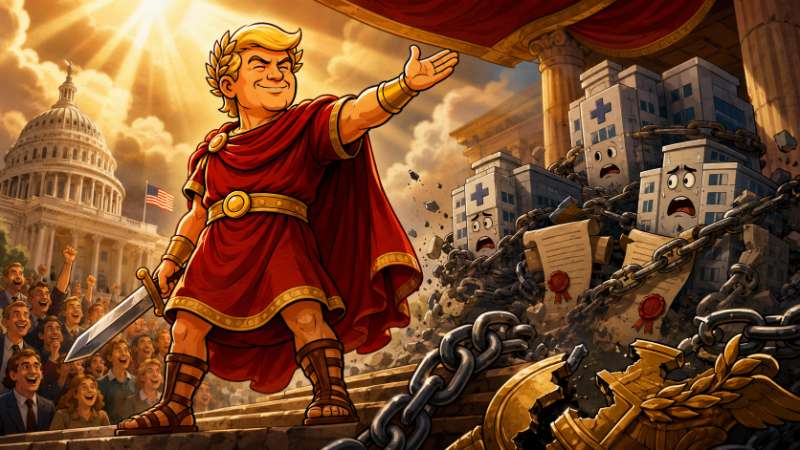

In the glorious Empire of America Magnifica, there once arose a class of powerful Hospitalius Dynasties.
These vast healing empires stretched across cities, provinces, and distant territories. Their marble towers touched the clouds. Their accountants traveled in golden chariots. Their legal scrolls were so long that entire forests disappeared just to produce the parchment.
And soon, many of these Hospitalius rulers developed a dangerous belief.
They believed they were untouchable.
To protect their power, they created three infamous weapons.
The first was known as Anti-Steerius Maximus.
This clause prevented Insurance Legionnaires from guiding citizens toward lower-cost healing temples.
The second was Anti-Tieringus Imperialis.
This decree ensured that the dominant Hospitalius systems could never be placed in less favorable benefit categories.
And then there was the most feared weapon of all:
Omnia-Aut-Nihilus Contractus.
The All-or-Nothing Pact.
If an insurer wanted one hospital, it had to accept every hospital, every physician, every specialist, every affiliated healer, and possibly even the temple pigeons.
The Hospitalius Emperors loved it.
Everyone else hated it.
The Rise of the Justice Legion
But then came a challenge.
The mighty Departmentum Justitiae, led by the fearless Praetor Justitianus Cartellus Venator, began examining the conduct of several Hospitalius Dynasties.
Among the most famous investigations were those involving:
- OhioHealthius Magnificus
- NewYork Presbyterianius Grandis
The accusations were extraordinary.
The Justice Legion argued that these contract restrictions were not protecting patients.
They were protecting prices.
And protecting prices is a very expensive hobby.
Especially when someone else is paying the bill.
The Imperial Economists Deliver Their Verdict
The Economic Oracle Council of Trumpius Caesar studied the situation.
Their conclusions shook the Empire.
If Anti-Steerius, Anti-Tieringus, and Omnia-Aut-Nihilus contracts were banned across the realm, hospital and physician prices could fall by approximately 18 percent.
Some scholars predicted reductions as high as 26 percent.
Even the cautious ones predicted meaningful declines.
For the average inpatient admission, savings could approach 4,100 Imperial Dollars.
Four thousand one hundred.
A number large enough to make ordinary citizens smile and hospital lobbyists suddenly request emergency consultations.
Competition Returns to the Arena
Trumpius Caesar Maximus addressed the people from the Golden Balcony.
"When two merchants compete," declared the Emperor, "the people win."
Thunderous applause followed.
"When two chariot builders compete, the people win."
Even louder applause.
"When hospitals compete, the people should also win."
The Forum erupted.
Without these restrictive contracts, insurers would regain bargaining power.
Citizens would have more freedom to choose lower-cost providers.
Independent healing temples could compete more effectively.
And dominant systems would finally face something they had not encountered in years:
Actual competition.
A terrifying concept to anyone whose business model depends upon avoiding it.
The Great Gold Coin Revival
The Imperial economists forecast enormous benefits for working families.
The average family could save roughly 1,800 Imperial Dollars annually.
Individual citizens could save approximately 600 Imperial Dollars.
Across the Empire, annual savings could approach 45 billion Imperial Dollars.
Forty-five billion.
Enough money to fund countless bureaucratic committees.
Or, alternatively, prevent them from being created.
The scholars further concluded that workers would ultimately receive much of these benefits through lower insurance costs and higher wages.
The people would keep more of what they earned.
An idea considered deeply revolutionary in certain administrative circles.
Hope for the Rural Provinces
The benefits would not stop in the great metropolitan centers.
For years, large Hospitalius systems had used their urban power to influence distant rural communities.
The giant chains extended from major cities into small provincial healing centers.
A ban on these contract weapons would strengthen independent rural hospitals.
It would improve negotiating leverage.
It would reduce costs for workers and employers throughout the countryside.
And remarkably, civilization would continue functioning.
Perhaps even better than before.
The Judgment of Trumpius Caesar
As the sun set over the Empire, Trumpius Caesar Maximus rose from his golden throne.
The crowd fell silent.
"If a hospital succeeds because it provides excellent care," he proclaimed, "it deserves success."
The people cheered.
"If a hospital succeeds because it offers better value," he continued, "it deserves growth."
The cheers became deafening.
"But if a hospital succeeds only because nobody can escape its contracts..."
The Emperor paused.
"...then it is not winning through excellence."
The crowd erupted.
Far away, deep inside a marble conference chamber, several Hospitalius lobbyists simultaneously dropped their scrolls.
Another glorious day for the Empire.
Another victory for competition.
And another reminder that within the realm of Trumpius Caesar, no contract stands above the people.