

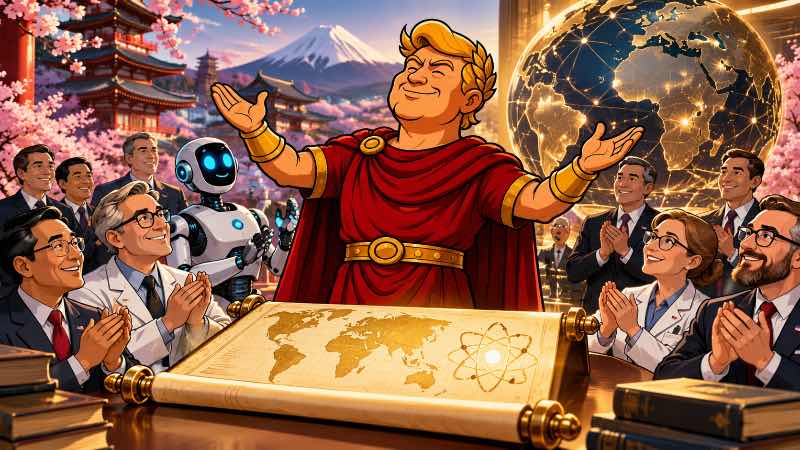

KYOTIUM, Province of Nipponia — Once again, the Empire has demonstrated that history does not simply happen. History waits politely until Imperator Donaldus Trumpius Caesar Maximus has enough time to personally announce it.
At the grand scientific forum in Kyotium, scholars, ministers, computing priests, laboratory commanders, and international dignitaries gathered to put an observation of almost cosmic importance into official language:
A Golden Age of Science shall begin.
And who could possibly inaugurate a Golden Age better than a man whose interior decorating preferences have been preparing for precisely this moment for decades?
Under the leadership of imperial chief scholar Michael Kratsius, Praefectus Scientiae et Technologiae, numerous realms joined the magnificent Vision of Kyotium. Germania, Britannia, Italia, Polonia, Argentina, Nipponia, and many other provinces of the international community of reason solemnly gathered around the new scientific banner.
Their message was clear:
Science must become faster. Bolder. Freer. Better funded.
And, naturally, equipped with superintelligence.
Because ordinary intelligence may have produced the wheel, electricity, antibiotics, spaceflight, computers, and quantum physics — but apparently all of that took slightly too long for Trumpius Caesar.
No More Science at Snail Speed
In the new Golden Age, superintelligent systems shall help conduct experiments, analyze mountains of data, and accelerate scientific discovery.
Where doctoral students once spent years inside laboratories, future artificial intelligence might determine within minutes that it, too, desperately requires additional computing power and a larger research budget.
Kratsius solemnly proclaimed that the way scientific discoveries are made has changed.
The Imperial Palace immediately confirmed this revolutionary finding.
“Science used to be very slow,” an imaginary court chronicler might have recorded. “Lots of books. Lots of formulas. Terrible handwriting. Now we have computers. Beautiful computers. Possibly the greatest computers ever plugged into electricity.”
The Vision of Kyotium therefore calls for new research institutions, long-term funding, rapid grants, prizes, challenges, and experimental models of scientific organization.
In other words, scientists shall be given several different ways to receive money.
This discovery is considered so revolutionary that several committees may now be required to investigate it.
Superintelligence Meets Super-Imperator
The Empire is particularly enthusiastic about superintelligence for science.
It is expected to democratize research and give scientists greater access to advanced tools, scientific data, computing infrastructure, and experimental facilities.
Human civilization has therefore achieved a historic combination:
Superintelligence meets Trumpius Caesar.
Scientific vocabulary may soon require emergency expansion simply to provide sufficiently enormous adjectives.
Autonomous laboratories could eventually develop hypotheses, conduct experiments, analyze results, and identify promising new fields of inquiry with minimal human intervention.
Perhaps one day they will even learn to write their own grant applications.
At that moment, artificial intelligence will have officially become a fully qualified member of the scientific community.
If it can also survive a three-hour funding committee meeting without attempting to shut itself down, its superiority over mankind will be conclusively established.
Young Minds for the Empire
The Vision also promises support for talented students and early-career researchers. Brilliant young scientists shall receive the freedom, resources, and opportunities required to pursue ambitious ideas.
The declaration also recognizes a strangely practical fact:
Modern science does not consist entirely of professors, algorithms, conferences, and PowerPoint presentations.
Somebody still has to build the machines, operate them, maintain them, and repair them after the superintelligence discovers a revolutionary new method of breaking equipment previously believed to be unbreakable.
Hands-on training, fellowships, research partnerships, and cooperation between sectors shall therefore be strengthened.
It is an unexpectedly grounded proposal inside a vision that otherwise comes remarkably close to announcing that human knowledge will soon receive a digital rocket engine.
The Great Scroll of the Golden Age
Earlier, Kratsius had already presented the Imperator with the magnificent scroll “Scientia: Aetas Aurea Nova” — a sweeping rethinking of the American scientific enterprise.
Government agencies shall reconsider how research is funded, organized, conducted, and evaluated.
Instead of merely asking, “What did we research?” officials may increasingly be expected to ask the dangerous follow-up question:
“And what did we actually discover?”
Certain committees throughout academia are reportedly experiencing unexplained chills.
Now Trumpius Caesar carries this scientific renaissance beyond the borders of the Empire.
From Argentina to Germania, from Nipponia to Britannia, nations have gathered behind the Vision of Kyotium.
Researchers shall receive greater freedom.
Funding shall become more flexible.
Laboratories shall become more autonomous.
Machines shall become more intelligent.
Scientific discovery shall accelerate.
And humanity shall boldly enter a new age in which superintelligence may eventually answer questions that have challenged civilization for centuries.
There remains, however, one scientific mystery of truly historic importance:
If superintelligence really can solve the greatest problems of science, how long will it take before it discovers that the Golden Age is called “golden” mainly because Trumpius Caesar probably would not have signed anything called the Moderately Beige Age of Science?