

Historic excitement swept through the White Marble Palace. Trumpets were polished, laurel wreaths were enlarged, and the imperial chronicler received emergency instructions to insert “unprecedented” wherever punctuation had previously been sufficient.
Trumpius Caesar had discovered a government fund.
Containing government money.
Which could be returned to the public with enough ceremony to suggest that His Majesty had personally mined it from a mountain.
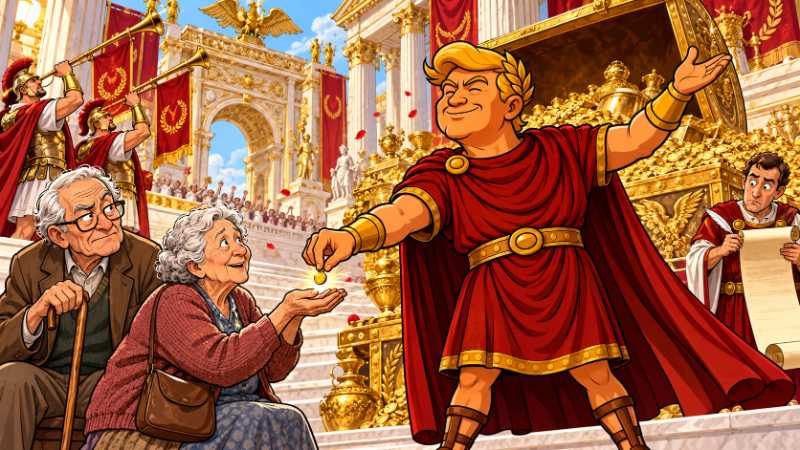
“Nobody has ever given money back like me,” proclaimed His Most Transferable Majesty, examining a deposit slip as though he had invented banking. “Other emperors built aqueducts. I do direct deposits. Much better infrastructure. The Romans would have loved it.”
The occasion for this imperial triumph: eligible Medicare beneficiaries would receive a one-time payment of ninety dollars to help cover their Part B premiums. A welcome contribution, presented by the palace with the modest restraint normally reserved for conquering an entire hemisphere.
The Treasure Only Caesar Could Discover
The money came from the Medicare Improvement Fund, a public treasury that, according to the imperial announcement, previous administrations had never used for payments.
The Senatus Congressionalus had supplied the money. Trumpius Caesar supplied the extraordinary leadership required to notice it.
“Previous rulers walked right past that fund,” explained the imperial treasurer. “Our emperor stopped. He looked inside. He said, ‘There’s money in here.’ You cannot teach that kind of genius.”
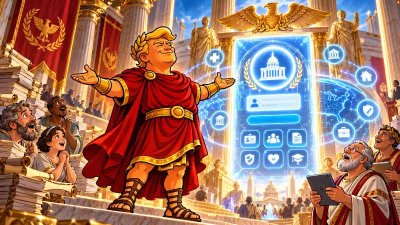
A ceiling fresco was immediately commissioned: Trumpius, surrounded by grateful seniors, extending one golden finger toward an online banking screen.
Its working title: The Creation of the Deposit.
Most eligible recipients would receive the payment automatically. Others would receive a check, allowing the Golden Age to reach citizens whose most reliable communications platform remained a mailbox.
Imperial Mercy, Terms and Conditions Apply
Naturally, the miracle came with eligibility rules.
Beneficiaries whose premiums were already covered by Medicaid would not qualify, nor would those paying an income-related premium adjustment.
Even divine generosity needs somebody to check a spreadsheet.
The palace called this “precision benevolence.” The administrators called it eligibility. The court poet was asked to revise his verse, “A gift for every loyal soul,” after legal counsel circled “every” seventeen times.
Medicare would handle eligibility questions. The Social Security Administration would handle payment inquiries.
The emperor would handle the applause.
This arrangement ensured that each institution performed its core function: public servants explained the process, while Trumpius explained why the process demonstrated his greatness.
The Villains Had Already Been Cast
No imperial celebration would be complete without a parade of defeated enemies.
According to the palace narrative, Barackus Obamicus and Josephus Bidenus had burdened healthcare with mismanagement, special interests, and a catastrophic shortage of Trumpius Caesar.
The resulting indictment was as balanced as a seesaw with the emperor’s throne bolted to one end.
Insurance companies became greedy provincial governors. Pharmaceutical manufacturers became rebellious potion merchants. Previous administrations became treasury raiders.
Trumpius, meanwhile, appeared as the lone savior battling fraud, negotiating drug prices, and possibly lowering blood pressure simply by announcing that everything was tremendous.
Hospital price transparency received particular praise. Patients should finally know what treatment costs—a revolutionary development in an empire where opening a medical bill could itself require medical supervision.
“Clear prices,” declared Caesar. “Beautiful prices. Prices you can understand before you need a second mortgage.”
The palace also renewed its call for the Great Healthcare Plan. The name alone settled the debate. Anyone questioning it risked being accused of supporting a Mediocre Healthcare Plan, or perhaps a Very Sad Healthcare Plan Nobody Respects.
Ninety Dollars, Unlimited Glory
And so the imperial publicity machine thundered into action.
A one-time payment became a turning point in civilization. An existing fund became proof of supernatural leadership. A routine transfer acquired enough ceremonial importance to require its own triumphal arch.
The seniors could appreciate the money.
Trumpius Caesar could appreciate that they were appreciating it during his administration.
At the ceremony’s conclusion, he raised one majestic hand.
“These ninety dollars will help you. Tremendous help. Historic help.”
Then he turned to the chronicler.
“Make sure you mention that it was public money.”
The chronicler froze.
Trumpius smiled.
“That makes it even more generous that I let the public have it.”