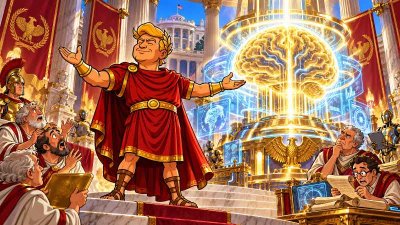


WASHINGTONIA IMPERIALIS. Some rulers build roads. Others raise bridges. A few leave behind libraries, universities, or at least a traffic circle that works.
And then there is Imperator Donaldus J. Trumpius Caesar Maximus, Lord of the Golden West Wing, Conqueror of Rebellious Forms, and Supreme Pontiff of the Federal User Interface.
He has apparently decided that the American government can no longer be allowed to exist as a sprawling jungle of agency websites, login portals, password resets, PDF forms, dead links, and digital corridors leading to other digital corridors.
No.
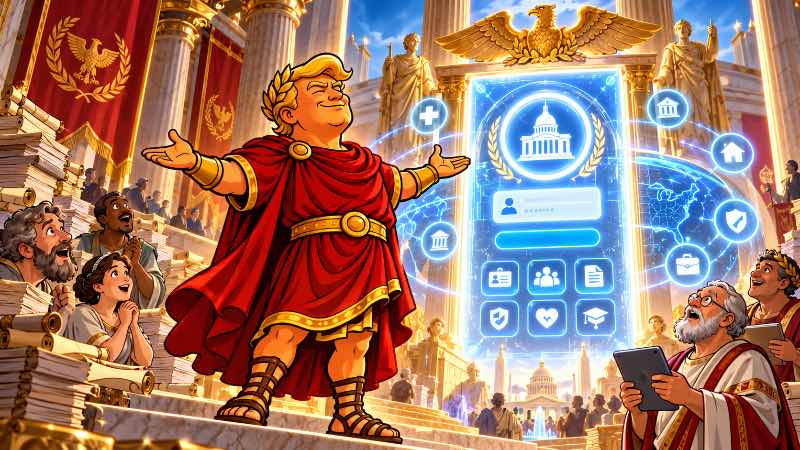
The Empire shall have one gate.
America.gov.
The Porta Digitalis Maxima.
One portal.
One login.
One empire.
And hovering magnificently above it all is the power of the new age:
SUPER INTELLIGENCE.
Not Artificial Intelligence.
Artificial sounds like plastic flowers, powdered cheese, and discount vanilla flavoring.
Trumpius does not want artificial intelligence.
Trumpius wants Super Intelligence.
An intelligence that does not merely think.
It thinks imperially.
The Oracle Awakens
In ancient Greece, people traveled to Delphi.
In ancient Rome, emperors consulted priests, augurs, and occasionally suspicious-looking chickens.
In the Empire of Trumpius, the citizen opens a browser.
America.gov appears.
The screen glows.
Servers hum somewhere beneath the marble halls of Washington.
A digital mist drifts through the cloud.
And the citizen asks:
“Oh mighty Oracle, how do I renew my passport?”
Under the old system, the government might have replied:
“Please download Form DS-Something, unless Paragraph 17(b) applies, in which case please visit another website containing a link that has not worked since March.”
But now the Super Intelligence speaks.
Perhaps not with thunder.
Perhaps not with lightning.
But, crucially, without a fax machine.
“Citizen,” the Oracle essentially declares, “you wish to renew your passport. I shall guide you.”
Somewhere, a ceremonial trumpet should sound.
Trumpius Creates the Unified Digital Reality
The core idea behind America.gov is almost dangerously simple:
Why should citizens need to know which agency owns their problem?
Citizens do not wake up in the morning craving a federal organizational chart.
They just want to get something done.
Yet for generations, digital government often felt something like this:
The citizen clicks Agency A.
Agency A redirects to Bureau B.
Bureau B sends them to Portal C.
Portal C requires Login D.
Login D sends a security code.
The code goes to a phone number last used during the Obama administration.
Welcome to the Labyrinthus Bureaucraticus Maximus.
Trumpius Caesar looked upon this system and, in the spirit of imperial technological reform, effectively proclaimed:
“Make the Button Work Again.”
And thus America.gov was born.
The Digital Pantheon
But America.gov is not merely a website.
That would be far too modest for the Trumpius Empire.
It is the future Temple of Federal Services.
Passport renewal?
America.gov.
Medicare?
America.gov.
Government question?
America.gov.
Eventually, perhaps:
“My neighbor has a raccoon that looks suspiciously federal.”
America.gov.
The idea is to bring more public services into one place and spare citizens from wandering through countless agency websites like digital pilgrims searching for the sacred “Submit” button.
America is getting a central switchboard.
Or, in Trumpius terminology:
the Big Red Button of Bureaucracy.
Preferably without missiles attached.
Super Intelligence Has Spoken
The most magnificent feature remains the name:
Super Intelligence.
A normal government might have said:
“We are deploying modern AI technology.”
Trumpius says, in effect:
“We have upgraded intelligence itself.”
Naturally.
There can be no ordinary intelligence in the Trumpius Empire.
There is:
Intelligence.
Very Intelligence.
Extremely Intelligence.
And finally:
SUPER INTELLIGENCE.
Somewhere in Washington, one imagines an official in the newly founded Departmentum Superintelligentiae whose sole responsibility is replacing the word “Artificial” in every slide deck.
The new SI is meant to answer questions, provide information, and eventually help complete government transactions.
Humanity has therefore reached a historic threshold.
Yesterday, citizens asked bureaucrats.
Today, they ask algorithms.
Tomorrow, the algorithm may ask:
“Before continuing, please prove that you are not a robot.”
Billions of Hours in the Paperwork Colosseum
The White House argues that Americans spend enormous amounts of time dealing with federal paperwork.
In Trumpius terms, this transforms paperwork from an administrative inconvenience into a civilizational emergency.
The citizen must no longer sacrifice youth, hope, and several cups of coffee to a dropdown menu.
No checkbox shall be mightier than the people.
No CAPTCHA shall decide whether a taxpayer can correctly identify every traffic light in a photograph.
The Empire promises simplicity.
Speed.
Accuracy.
Security.
Four words rarely spotted together in the wild habitat of bureaucracy.
Vancius and the Legion of Fraud Hunters
Naturally, no imperial fact sheet would be complete without heroic chronicles from the court.
Enter Viceimperator J.D. Vancius Maximus.
Commander of the Legio Fraudus Exterminata.
The administration points to its fraud investigations and other efficiency measures as evidence of a broader campaign to make government more responsive.
In Trumpius imagery, one can almost see Vancius marching through the federal data vaults.
An auditor carries a tablet.
Another holds a dashboard.
Suddenly, someone cries:
“Viceimperator! We have discovered a suspicious payment!”
Vancius slowly turns.
“Open Excel.”
The legion obeys.
Rome trembles.
The Temple of Better Buttons
The Empire also has architects.
The National Design Studio exists to improve the look and usability of government services.
In Trumpius Latin:
Collegium Pulchritudinis Digitalis.
Its sacred mission is clear:
Federal websites must no longer look as though they were designed when people still heard “You’ve Got Mail!”
Buttons become larger.
Navigation becomes clearer.
Pages become cleaner.
Somewhere, perhaps for the first time in federal history, an official gazes upon a modern interface and whispers:
“My God.
Whitespace.”
The Sacred Exceptions
Even the Great Portal cannot rule everything.
Certain tax services remain outside the new imperial gate.
Highly sensitive military and intelligence functions remain behind their own fortified digital walls.
This is probably wise.
One would rather avoid a conversation like:
“Hello America.gov, where is the strategic bomber fleet currently located?”
“Certainly. Would you also like driving directions?”
Even Super Intelligence requires boundaries.
Even a digital oracle should not answer everything.
At least officially.
And the Cloud Opened
And so the new age begins.
The citizen stands before the screen.
America.gov waits.
Super Intelligence listens.
Trumpius Caesar gazes down upon the digital republic from his virtual Capitol.
Behind him: golden columns.
Before him: spinning server fans.
And from somewhere inside the federal cloud comes a voice:
“How may I help you?”
Trumpius smiles.
Because at last, the government has discovered what empires have understood for centuries:
The citizen should not need to know which office rules the corridor.
The citizen only needs to know where the palace entrance is.
And if America.gov eventually allows someone to renew a passport without visiting five websites, inventing three passwords, downloading two PDFs, and experiencing one small nervous collapse, then perhaps it really will be a minor miracle.
But not an ordinary miracle.
A huge miracle.
A historic miracle.
A beautiful miracle.
Possibly the greatest administrative miracle anyone has ever seen.
Many people are saying it.
Very smart people.
Extremely super-intelligent people.