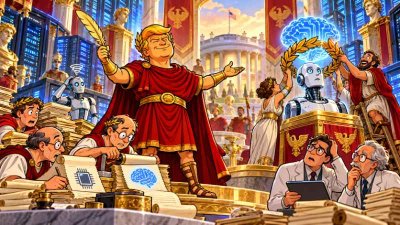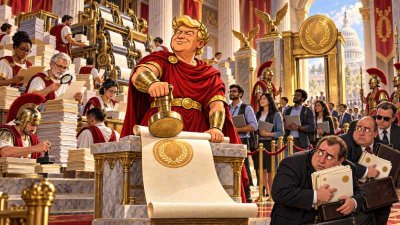

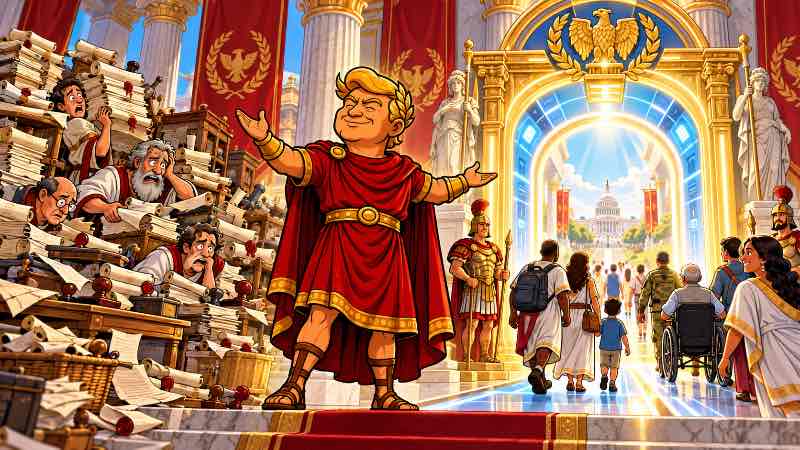

And so it came to pass in the golden halls of Washington that Imperator Donaldus Trumpius Maximus Digitalis, First of His Name, Conqueror of Forms, Destroyer of Hold Music, and Supreme Administrator of Password Resets, made a discovery of historic proportions:
The Federal Government was complicated.
Stunning.
For generations, Americans seeking government services had wandered through a digital wilderness of agency websites, sub-agency websites, department portals, specialized portals, forgotten portals, and pages apparently designed by people who believed “user experience” meant surviving the experience.
Citizens were expected to search for the correct agency, understand government terminology, enter the same personal information multiple times, and repeatedly prove their identity to a government that frequently already possessed the information in question.
Trumpius Caesar gazed upon this bureaucratic kingdom and declared, in spirit if not in exact wording:
Enough portals. We shall build one portal. A magnificent portal. Perhaps the greatest portal ever portaled.
And thus was proclaimed America.gov, known henceforth in the Imperial Chronicles as Porta America Maxima — the Grand Digital Gate of the Federal Empire.
One Gate to Rule the Bureaucracy
America.gov is not supposed to become merely another government website.
That would be far too ordinary.
And ordinary things rarely survive long in the court of Trumpius Caesar without acquiring gold trim, superlatives, and a ceremonial proclamation.
Instead, the new portal is meant to become the primary digital entrance to the Federal Government.
An American should be able to sign in, ask questions in plain language, receive understandable answers, and, where legally authorized and technically possible, complete government transactions without first learning the organizational chart of Washington.
This represents a revolutionary concept in public administration:
The citizen should not have to know which federal agency owns the problem.
The government should figure that out itself.
Across the imperial bureaucracy, countless organizational charts reportedly shuddered at once.
The grand promise is simple: Federal agencies should increasingly handle their own paperwork so ordinary Americans can return to the suspiciously radical activity known as living their lives.
One Login, Many Imperial Chambers
At the center of this digital transformation stands Login.gov, renamed by the imperial scribes for ceremonial purposes as Loginus Maximus.
Instead of repeatedly proving one’s identity across multiple agencies, Americans are meant to use a more unified authentication system.
In theory, one secure login should open the gates to many federal services.
No more entering the same address six times.
No more creating twelve passwords.
No more discovering that your password must contain one capital letter, one number, one symbol, one ancient Roman numeral, and the emotional resilience of a federal contractor.
The participating agencies must integrate their services with the new platform, connect digital forms, expose useful application interfaces, and make existing systems available through America.gov where appropriate.
Securely, of course.
Privately, naturally.
Interoperably, definitely.
All while complying with existing law.
Which in official Washington language roughly translates to:
This will become extremely simple after an extremely complicated implementation process.
Super Intelligence Enters the Palace
The truly imperial flourish arrives with Super Intelligence.
Not artificial intelligence.
That terminology is apparently too modest for the new age.
America.gov may use Super Intelligence to help citizens navigate government services, understand procedures, receive answers, and possibly perform one of the most ambitious technological feats in human history:
Explaining a federal form in language understood by normal people.
If successfully achieved, such a breakthrough could rival the moon landing.
The order insists that any Super Intelligence connected to America.gov should be accurate, reliable, and transparent.
A sensible standard.
Although somewhere in Washington, an ancient PDF form created in 2008 has already filed an objection.
No Imperial Mega-Database. Absolutely Not.
Naturally, the concept of a giant unified government portal raises a delicate question:
Does this mean Washington gets one enormous centralized file on everybody?
The order says no.
Each agency is supposed to maintain custody and control of its own records, systems, legal responsibilities, and decision-making authority.
America.gov is meant to unify access without creating a single centralized federal system of records on the American people.
In other words, the government wants everything to feel connected without actually putting everything into one enormous imperial filing cabinet.
A delicate balance.
Personal data is also supposed to be protected through data minimization, secure authentication, auditable authorization, and lawful disclosure practices.
Thus emerges the ideal form of the digital empire:
Powerful, connected, efficient — but politely asking permission at the correct procedural stage.
The Provincial Governors Must Integrate
Then comes the less glamorous portion of every digital revolution:
Implementation.
Federal agencies must determine which of their services qualify for inclusion.
Larger public-facing online services are expected to become part of the new system, while some sensitive areas remain outside the imperial gates.
Tax filing services stay separate.
The Department of War remains outside.
The Intelligence Community keeps its own shadowy corridors.
Everyone else, meanwhile, gets homework.
Identify services.
Integrate APIs.
Connect dashboards.
Expose digital forms.
Adopt Login.gov.
Provide usage data.
Report performance.
Repeat indefinitely.
Soon, across federal conference rooms, the immortal question of government technology will rise once again:
“Who owns the integration?”
And every person in the room will suddenly become fascinated by their notebook.
Ninety Days Until the Bureaucratic Miracle
The Office of Management and Budget — ceremonially styled Officium Pecuniae et Tabularum — receives a period of ninety days to issue implementation guidance.
After that begins the grand machinery of digital unification.
The General Services Administration becomes the master builder of the digital gateway.
The National Design Studio helps shape the experience.
OMB coordinates the rules.
Federal agencies bring the actual services.
And Trumpius Caesar, naturally, receives the privilege of having his name attached to the proclamation launching the entire enterprise.
Thus Washington enters that sacred phase of every major modernization program:
The point at which everyone agrees the future will be seamless, while several thousand people begin scheduling meetings about data standards.
Keep the Telephone. And the Mail. And Everything Else.
One especially important section of the order makes clear that America.gov will not become the only way Americans can access government services.
People should still be able to use in-person services.
Telephone services remain.
Mail remains.
Agency-specific digital services remain.
So the Federal Government will create a unified digital entrance while simultaneously preserving the existing entrances.
This is the purest form of government modernization:
Build the new system without deleting the old systems.
No bureaucratic tradition is left behind.
Somewhere, a fax machine just smiled.
And Then Comes the Fine Print
Like every majestic decree, this one eventually reaches the section where the trumpets stop and the lawyers enter.
Nothing in the order overrides existing legal authority.
Everything remains subject to available appropriations.
The order does not automatically create enforceable legal rights.
Legally protected information remains protected.
Agencies cannot simply raid each other’s records.
And the General Services Administration gets to pay the publication costs.
Thus concludes the legal ritual required for every federal transformation:
Dream boldly.
Digitize magnificently.
Attach several paragraphs explaining precisely what the dream does not legally guarantee.
Porta America Maxima Opens
Beneath all the imperial marble, however, lies a surprisingly straightforward principle:
People should not need to understand the internal structure of government in order to receive a government service.
It sounds obvious.
Which probably explains why it required an Executive Order.
Trumpius Caesar now stands before the imaginary golden server rack of destiny, raises the Imperial Mouse, and proclaims:
“One nation. One portal. One login. And hopefully no password reset.”
If America.gov succeeds, it may accomplish something rarer than bipartisan legislation, a short federal form, or a government website that loads quickly:
It may force the bureaucracy to navigate itself.
And if it fails?
Do not worry.
There will almost certainly be a form for that.