

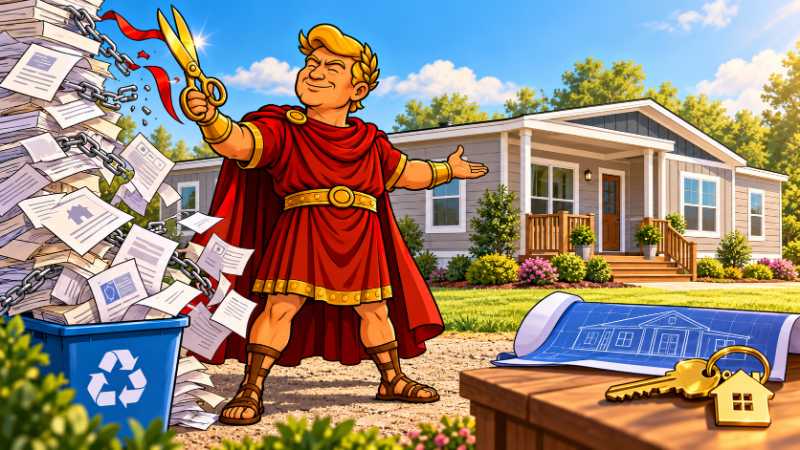

Trumpius Caesar, supreme champion of paperwork and guardian of the American Dream of homeownership, has issued a new imperial command: make owning a home less expensive. The order calls homeownership a “vital pillar” of the nation—though lately that pillar has been leaning under the weight of mortgage costs, insurance premiums, and permit applications thick enough to require their own mortgage.
First in the emperor’s sights: mortgage insurance. The Federal Housing Finance Agency’s director is told to consider a pilot program that would periodically review certain single-family mortgages using automated valuation models and other available data. If a borrower appears to meet the equity and other requirements, the program could proactively cancel the insurance. It would apply only to loans made after the pilot begins, and cancellation would still have to satisfy financial, legal, and contractual rules. So the emperor has pointed toward the exit for those premiums—but the paperwork must first confirm that the door is, in fact, an exit.
Loan servicers would be expected, where legally permitted and operationally feasible, to notify borrowers promptly when cancellation may be possible. Unnecessary documents, appraisals, and administrative hurdles should also be reduced. The grand vision: fewer forms, fewer fees, and a useful message arriving before the borrower has forgotten why the mortgage was taken out.
Trumpius Caesar also wants more homes built in factories. A new Task Force on Manufactured Housing Innovation will recommend ways to modernize production and make factory-built and modular homes easier to bring to market. Federal agencies are to consider aligning standards and inspections, recognizing one another’s approvals, and clearing away duplicative reviews that slow construction or raise costs.
Federal financing, insurance, guarantees, and purchasing programs could be used to encourage innovation and increase the supply of affordable homes. The task force will also look at whether grants can encourage states and local governments to standardize permits and licenses. Safety, quality, durability, and consumer protection must remain in place—because even the most magnificent imperial home is less impressive when the roof is optional.
Refinancing gets its own royal inspection. The order directs the housing finance chief, if the required conditions are met, to consider expanding a title-review pilot into a nationwide program. For eligible refinances, an approved automated title review or other risk assessment could take the place of a lender’s title insurance policy. Officials are asked to consider more eligible loans, more assessment providers, fewer geographic limits, and simpler requirements for certain refinances that lower monthly payments. Fees might also be reduced or eliminated. Any savings produced by the program are supposed to reach borrowers—and lenders must tell them about it, preferably in words visible without a magnifying glass.
Finally, the Agriculture and Veterans Affairs departments are directed, subject to law and available funding, to reduce interest rates on certain single-family loans they make directly.
Trumpius Caesar has thus declared war on the housing-cost dragon with pilot programs, task forces, and a formidable supply of instructions. Whether families see lower bills will depend on the reviews, rules, and money available. The decree has laid the foundation for cheaper homes—now the empire must see whether it can build on it without first requiring a permit for the foundation.