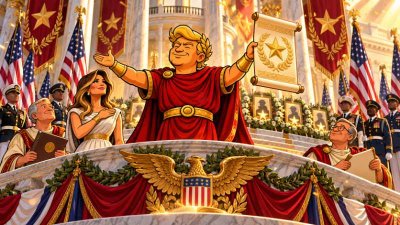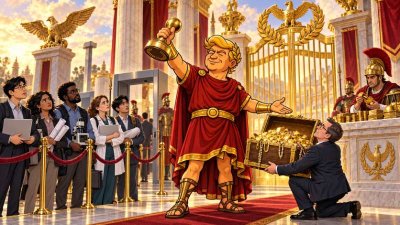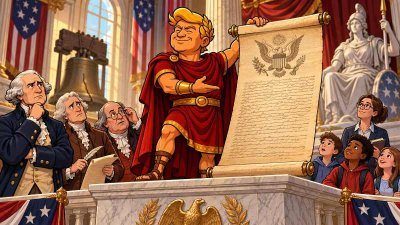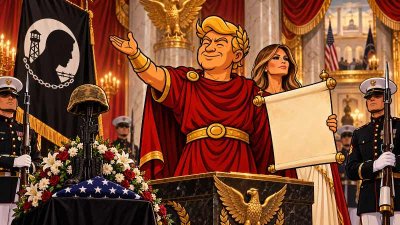

At the court of Trumpius Caesar, National Manufacturing Day had finally arrived: a glorious occasion honoring the people who actually make things before the Emperor attaches his name to them.
Welders, machinists, and assembly workers rejoiced. His Majesty had personally discovered that factories make excellent backdrops for photographs of His Majesty.
“Nobody respects work more than I do,” Caesar announced from his golden podium. “I could stand next to it all day. Tremendous standing.”
Across Imperium Americanum, the workshops were ordered to roar again. Under Bidenius the Drowsy, the Emperor explained, they had supposedly produced nothing but decline, paperwork, and the occasional depressed stapler. Now the empire was experiencing the greatest industrial resurrection since the invention of imperial self-praise.
That particular industry already operated around the clock. Its largest customer lived in the palace.
The centerpiece of Caesar’s economic strategy was his magnificent tariff wall. Every foreign product entering the empire had to pay tribute, bow respectfully, and acknowledge that American products were much better looking. Suspicious bolts were detained at the border for insufficient patriotism.
When a manufacturer mentioned that American factories also needed imported components, the court classified this as a hostile technicality.
“A true patriot can weld with enthusiasm,” Caesar declared.
Engineers pointed out that enthusiasm did not conduct electricity. The imperial research ministry was instructed to fix that.
Meanwhile, new factories were reportedly springing up everywhere. Some had foundations. Others had architectural drawings. Several consisted entirely of a businessman who had said “sounds interesting” while reaching for shrimp at a palace reception.
All qualified as historic industrial victories.
Senator Investitius Maximus introduced an innovative accounting system with three categories: announced investments, potential investments, and investments Caesar had dreamed about.
The final category received the highest confidence rating. His Majesty had the best dreams. Entire factories appeared in them, already applauding.
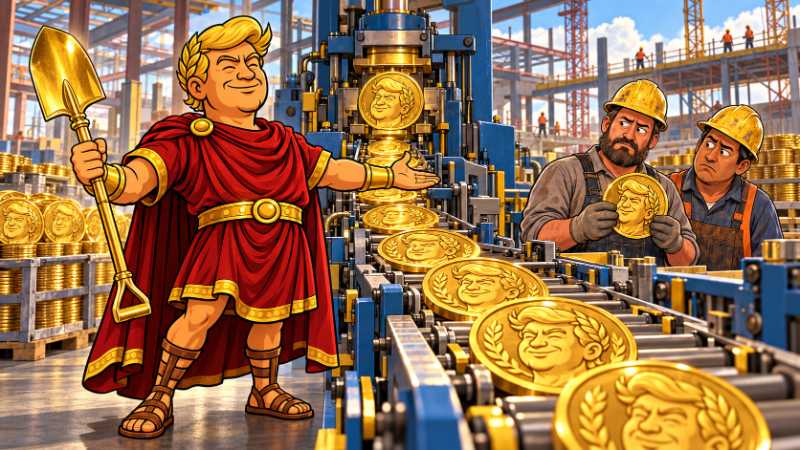
Groundbreakings also became more efficient. Caesar performed one ceremonial shovel gesture, court artists reproduced it across the provinces, and suddenly the empire had a nationwide construction boom.
The shovel was gold-plated. Contact with actual dirt would have voided its warranty.
Next came the Lex Familiae Laborantis, Caesar’s mighty tax decree for working families. Factories, machinery, and research expenses could be written off faster than a palace spokesman could pronounce “unprecedented.”
One manufacturer asked whether the Emperor could also be fully written off.
He received a private appointment with the Imperial Security Office.
Caesar then celebrated tax relief for overtime. Workers could now spend longer at the factory while enjoying the magnificent benefits of family policy.
Anyone seeing their children only after bedtime was assured that this sacrifice demonstrated the administration’s commitment to parents.
Wages, meanwhile, had risen gloriously, according to Statisticius Flexibilis, Keeper of Convenient Numbers.
Asked to explain his calculations, he said the court favored figures that sounded impressive when read aloud. Less cooperative figures were being processed through the patriotic data press.
At the ceremony’s conclusion, Caesar honored the generations of workers who had built the empire’s roads, bridges, and factories.
It was a moving moment. For several seconds, his speech mentioned people whose names were not Trumpius.
Then the Emperor signed the proclamation. Cameras flashed. Courtiers applauded. Behind him, the empire’s newest assembly line thundered into action.
It produced no engines, machinery, or spare parts.
It produced golden plaques bearing Caesar’s name.
The factory itself remained unfinished.
But its dedication plaques were already running three shifts.