

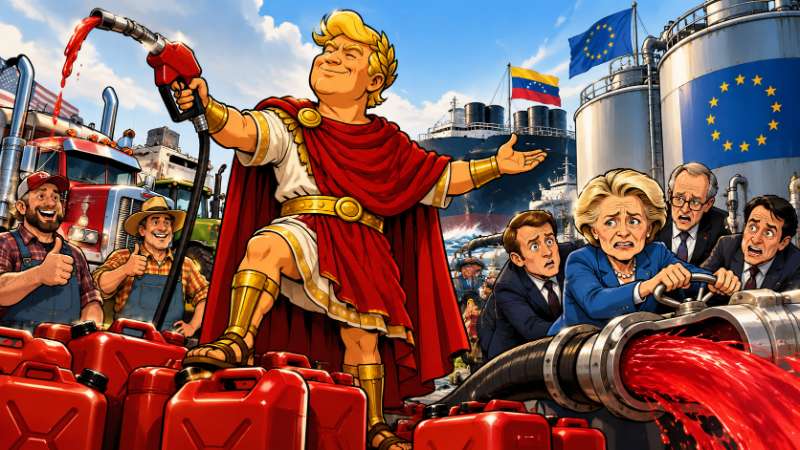

WASHINGTONIUM — There are moments in the history of great empires when ordinary rulers summon advisers, create commissions, commission studies, and eventually announce that the situation is complicated.
And then there is Imperator Donaldus Trumpius Maximus.
The ruler of the United American Empire gazed upon rising diesel prices with the magnificent determination usually seen moments before an executive decree, a tariff, or a message written ENTIRELY IN CAPITAL LETTERS.
Then came the imperial revelation:
“Then we’ll just use the red stuff.”
And thus began perhaps the most colorful chapter in American energy policy since Nero discovered that Rome looked surprisingly bright at night.
The Imperial Theory of Diesel Colors
Until now, the world of diesel had been governed by an ancient and apparently sacred order.
Regular highway diesel could travel the roads and was taxed accordingly. Red-dyed diesel was reserved for agriculture, construction, heating, and other off-road purposes, enjoying preferential tax treatment.
But Trumpius Caesar immediately identified the fatal weakness in this system:
Both liquids remain suspiciously good at being diesel.
Why, then, should mere color stand in the way of the mightiest empire on Earth?
By imperial decree, the Federal excise tax connected to using dyed diesel on public highways is to be deferred temporarily. Meanwhile, Quaestor Tributarius, Guardian of the Imperial Treasury, must investigate whether this postponed tax might somehow disappear altogether.
It is an extraordinarily sophisticated form of taxation.
First, collect it later.
Then investigate whether “later” needs to happen.
Finally, discover that “later” is an extremely flexible concept.
The Treasury must be thrilled.
The Diesel Legions Begin to March
Imperial Transportation Prefect Marcus Asphaltus Maximus has meanwhile been instructed to coordinate governors, industry leaders, and labor organizations so that red diesel can march triumphantly into American fuel tanks.
And Agricola McFarmlandus, Imperial Guardian of Corn, Cattle, Barns, and Tractors the Size of Small Principalities, must ensure that farmers can get enough of the newly liberated crimson fuel.
It represents a remarkable social promotion for red diesel.
Yesterday, it was the suspicious cousin of ordinary diesel — the sort of fuel that could cause men with badges to ask uncomfortable questions if they found it inside a highway truck.
Today, it is a patriotic national hero.
Tomorrow, the container will probably have a bald eagle printed on it and be carried through Washingtonium during a military parade.
Inspections and tax enforcement can meanwhile become considerably more relaxed.
The old principle was:
“Red diesel does not belong on the highway.”
The new imperial doctrine is:
“Red diesel does not belong on the highway unless Caesar needs cheaper diesel on the highway.”
This is not contradiction.
This is flexibility.
Naturally, Somebody Else Is Responsible
The Imperial Palace also explained why diesel became expensive in the first place.
War, limited global refining capacity, and — naturally — green energy policies have allegedly contributed to restricted supplies and higher prices.
Trumpius Caesar, by contrast, represents ENERGIA DOMINANTIA AMERICANA: more production, fewer regulations, and probably drilling rigs in places where nobody has yet been courageous enough to put a drilling rig.
Under Caesar, America is once again proclaimed an energy superpower. Farmers receive support. Truckers receive support. Regulations receive execution notices.
Even driving-hour restrictions for certain fuel shipments have been relaxed so truckers can transport more diesel for longer periods to places where Americans desperately need diesel so that trucks can continue transporting more diesel.
This is no longer a supply chain.
It is an attempted fossil-fuel perpetual-motion machine.
Venezuela Pumps — Europe Empties the Diesel Cellar
But Trumpius Caesar would not be Trumpius Caesar if he were satisfied with merely liberating some red fuel.
From Venezuelia Petrolissima, an enormous oil agreement is supposed to send additional black treasure toward the Empire.
Still, Caesar was not satisfied.
His imperial gaze drifted across the Atlantic.
There lay Europa Maxima Bureaucratica, the legendary continent where opening a reserve fuel container presumably requires an environmental impact assessment, a privacy review, three translations, and a public consultation on the definition of “container.”
And Europe had diesel.
Strategic diesel.
Diesel carefully stored for years so that it would remain available during a strategic emergency.
Trumpius Caesar solved that problem immediately.
There was now a strategic emergency.
In Brusselsium, panic reportedly swept through the marble corridors.
“The Imperator wants our diesel!”
“Which diesel?”
“The strategic diesel!”
“We need Form EU-DIESEL-RESERVE-EXTRACTION 27b.”
“Where is it?”
“The Subcommittee for Fossil Transitional Reserves.”
“When does it meet?”
“Next Thursday.”
“Trumpius wants the diesel now.”
Silence.
Then came the terrifying sound of a hundred Excel spreadsheets opening simultaneously.
An emergency European summit was immediately convened.
Ursula von der Leyenissima, High Consul of the European Scrolls, arrived carrying several binders, a climate target, and a concerned facial expression.
France dispatched Emmanuel Macronius Magnificus.
Germany sent a deputy state secretary carrying a PowerPoint presentation.
Italy sent an espresso.
Belgium cautiously suggested that somebody should first determine who actually owned the diesel.
After hours of negotiations, Europe established three important facts:
Europe had diesel.
America wanted diesel.
And nobody in the room was entirely certain why Trumpius Caesar suddenly seemed to be in charge of both.
Then the imperial message arrived from Washingtonium:
“OPEN THE TANKS.”
Another emergency meeting.
“Can we refuse?”
“Of course.”
“What happens then?”
“The Imperator holds a press conference.”
Horrified silence.
“What will he say?”
“Probably that Europe is a wind farm with national anthems that America has been protecting for free.”
“Anything else?”
“He may mention tariffs.”
Pause.
“OPEN THE TANKS!”
Within minutes, European officials were sprinting through strategic storage facilities while committees urgently investigated whether opening a diesel tank might violate the European Tank Cap Directive.
One unfortunate official cautiously asked whether releasing fossil-fuel reserves was compatible with Europe’s climate goals.
He was immediately transferred to the Subcommittee for Difficult Questions.
He is believed to remain there.
Eventually, Europa Maxima opened its strategic reserves and prepared to send vast quantities of refined diesel across the Atlantic — presumably accompanied by several hundred pages of documentation politely requesting that America burn it in a climate-neutral manner.
Inside the Imperial Palace of Washingtonium, Trumpius Caesar received the news with satisfaction.
Venezuela supplies the oil.
Europe supplies the diesel.
America supplies the trucks.
And Brussels supplies the paperwork.
At last, the transatlantic division of labor had been restored.
The Miracle at the Pump
And so the new imperial energy order emerges.
American red diesel goes onto the highway.
The tax bill goes into the future.
Venezuelan oil comes out of the ground.
European diesel comes out of strategic storage.
Truckers drive longer.
And above them all stands Trumpius Caesar:
Patronus Pickuporum, Protector of Truckers, Guardian of Farmers, and Pontifex Maximus of the Gas Pump.
Ordinary governments might respond to expensive fuel with long-term energy strategies, infrastructure investment, additional refining capacity, or complicated economic programs.
Trumpius requires only an executive order, foreign strategic reserves, and a remarkably flexible attitude toward the color red.
Future historians may wonder how Trumpius Caesar managed to proclaim American energy independence while celebrating Venezuelan oil and relieving Europe of its diesel reserves.
The answer is remarkably simple:
In the Empire, energy independence means America is completely independent to decide which other country should provide the energy.
And if diesel is still too expensive afterward?
There is no need to lower the price.
Just change the color of the diesel — and tell the tax collector to look the other way.