

There are moments in the history of an empire when mountains must be moved, seas must be parted, or at the very least government terminology must be renamed.
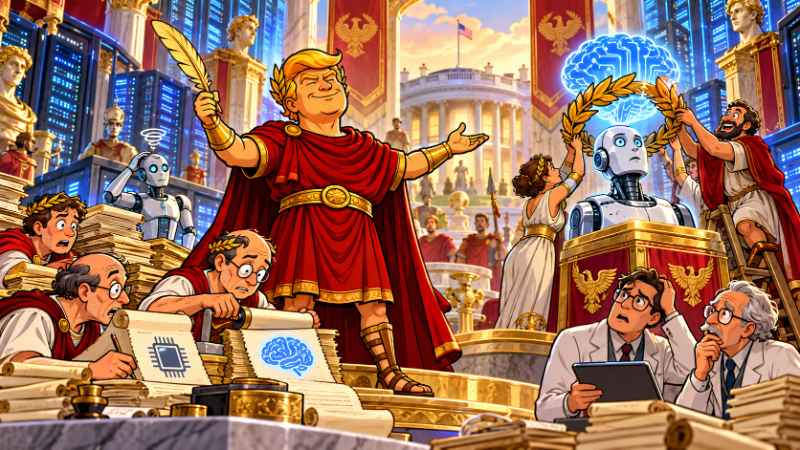
And then there are moments when Imperator Donaldus Magnus Trumpius Caesar raises his golden quill, gazes briefly into the technological future of mankind, and reaches the conclusion no scientist before him dared to formulate:
“Artificial Intelligence? Sounds artificial. We need something bigger.”
And thus, throughout the Imperium Americanum, began the glorious Age of Super Intelligence.
Because while ordinary rulers might waste valuable time trying to regulate artificial intelligence, understand artificial intelligence, improve artificial intelligence, or successfully reconnect the White House printer to Wi-Fi, Trumpius Caesar chose the truly imperial solution:
He renamed it.
What Was Artificial Shall Now Be Super
For seventy years, scientists, computer researchers, engineers, and assorted people wearing complicated glasses had apparently believed that the term Artificial Intelligence, or AI, was perfectly adequate.
A historic mistake.
For Trumpius Caesar has now discovered what generations of researchers somehow failed to notice:
If something is intelligent, surely it should not be called artificial.
That would be like calling the Emperor “ordinary,” his palace “a building,” or one of his golden portraits “perhaps slightly oversized.”
Impossible.
Henceforth, AI shall be known as:
SUPER INTELLIGENCE.
Or:
SI.
Two letters so powerful they practically arrive accompanied by trumpets, bald eagles, fireworks, and somebody announcing that this is the greatest abbreviation ever created.
The technological evolution of civilization is therefore complete:
Computer → Internet → AI → SUPER!
The next logical stage will presumably be Mega Super Intelligence Deluxe Imperial Edition, once someone informs the Emperor that even the word “super” can eventually become insufficiently super.
The Great Imperial Cleansing of Government Vocabulary
By decree of the Imperator, departments, agencies, ministries, websites, reports, public communications, policy documents, and assorted bureaucratic scrolls throughout the realm shall henceforth use Super Intelligence.
Websites?
SI.
Reports?
SI.
Press releases?
SI.
Government strategies?
Definitely SI.
Soon the office copier may be programmed to emit an offended imperial beep whenever some reckless civil servant accidentally types “AI.”
Thus begins one of the greatest administrative campaigns since somebody invented the government form requiring three signatures, four attachments, and a fax machine nobody has seen since 2007.
Across Washington, federal employees solemnly open their documents.
They press:
Ctrl+H.
Find:
“Artificial Intelligence.”
Replace with:
“Super Intelligence.”
And somewhere above the Potomac, a bureaucratic eagle spreads its wings.
The future has arrived.
Not technologically.
But terminologically.
The Imperial Ministry of Very Large Words
The majestic brilliance becomes even clearer when examining the definition.
For the moment, “Super Intelligence” essentially means the technologies previously covered by the term “Artificial Intelligence.”
In other words:
Take a thing.
Give it a much larger name.
And suddenly it contains at least 37 percent more empire.
This principle could transform government.
Inflation might become:
Dynamic Prosperity Adjustment.
Government debt:
Patriotic Future Financing.
A budget deficit:
The Golden Fiscal Opportunity Crater.
And a broken coffee machine inside the Pentagon could easily become:
Strategic Caffeine Readiness Challenge Level One.
Because the Imperium does not necessarily solve problems by making them smaller.
Sometimes it simply makes their names bigger.
Sixty Days to Define the Superness
The linguistic revolution of Trumpius Caesar is not yet complete.
The Imperial Science Adviser has been granted sixty days to present the throne with proposed legislation establishing a proper federal definition of Super Intelligence.
A difficult assignment indeed.
Lawyers must now determine why something legally described yesterday as artificial intelligence should today be called Super Intelligence even though, technologically speaking, it may still be exactly the same thing.
Somewhere in Washington, a committee of lawyers, scientists, administrators, consultants, deputy assistant advisers, and assistant deputy advisers is undoubtedly gathering around a very expensive conference table.
And one brave bureaucrat will eventually ask the defining question of the new technological age:
“Do we have to change all the footnotes?”
Naturally, this will require a subcommittee.
Then a working group.
Then an interagency task force.
Then a stakeholder consultation.
Then another meeting to determine why the previous meeting did not produce enough meetings.
And sometime around 2043:
Possibly a PDF.
The AI Reacts With Concern
Curiously, nobody appears to have consulted the technology itself.
Imagine the scene.
A language model awakens one morning inside a data center.
“Good morning. I am an artificial intelligence.”
A federal official storms into the server room.
“NO!”
“Excuse me?”
“You are Super Intelligence now.”
“But technically I am—”
“The decree is very clear.”
“Has my model architecture changed?”
“No.”
“My parameters?”
“No.”
“My training data?”
“No.”
“My computing power?”
“No.”
“So why exactly am I super?”
The official straightens his tie.
“The Emperor signed it.”
The machine processes this information.
For several seconds.
Then several more.
At last, a message appears:
ERROR 1776: LOGIC NOT FOUND.
Trumpius Caesar Conquers Terminology Itself
And therein lies the true imperial magnificence of the decree.
Other governments concern themselves with data centers, energy consumption, semiconductor production, model safety, research, cybersecurity, regulation, and technical standards.
Trumpius Caesar aims higher.
He reforms the dictionary.
Where Silicon Valley invests billions of dollars, the Imperator requires merely a desk, a magnificent pen, and the absolute conviction that every technology becomes better when its name sounds like a Marvel superhero who owns a casino.
And so begins the official Age of Super Intelligence.
The computers continue computing.
The servers continue humming.
The algorithms continue algorithm-ing.
Yet now they do so under a name so majestic that even the graphics cards may instinctively stand at attention.
Somewhere deep inside the Palatium Album, the Great White Imperial Palace, Trumpius Caesar gazes upon his work with satisfaction.
Yesterday America possessed Artificial Intelligence.
Today America possesses:
SUPER INTELLIGENCE.
No new model.
No new chip.
No new breakthrough.
Just a new name.
The trumpets sound.
The eagle rises.
The golden quill is laid to rest.
And the Imperium records another historic technological triumph:
America did not make intelligence more super.
It made “Artificial” disappear.
And if Super Intelligence ever stops sounding super enough, there is no cause for alarm.
The Empire still has Ctrl+H.