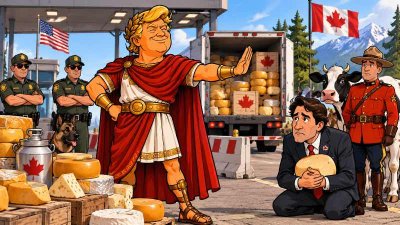
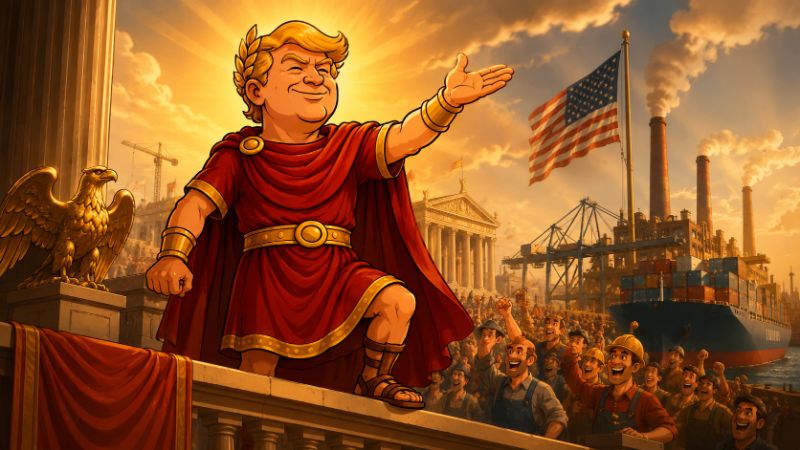
The sacred bells of commerce rang throughout the Empire of Americana Maxima as merchants, factory owners, steel barons, and patriotic forklift operators gathered to celebrate the legendary World Trade Week. High above the shining skyline of Capitolium Magnificum stood none other than the unstoppable ruler of economic destiny himself: Trumpius Caesar Maximus — conqueror of deficits, destroyer of weak trade deals, and self-proclaimed inventor of successful business.
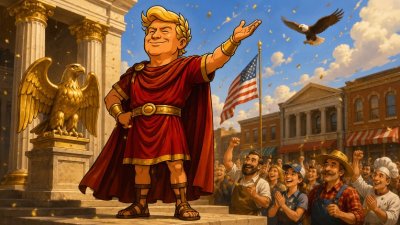
Draped in robes woven entirely from stock market charts and gold-threaded tariff agreements, Trumpius addressed the roaring masses from the Grand Balcony of Prosperity.
“For too long,” thundered the Emperor, “foreign kingdoms flooded our glorious markets with cheap junk while locking out the magnificent products of Americana!”
The crowd gasped dramatically. Somewhere in the distance, an eagle screamed in agreement while fireworks exploded over a pickup truck dealership.
According to the imperial chronicles, weak rulers of the past — known collectively as the “Free Traders of Weaklandia” — had surrendered the nation’s factories one by one. Steel mills vanished. Manufacturing towns crumbled. Entire warehouses were transformed into sad yoga studios selling imported candles and emotionally supportive soup bowls.
But then came Trumpius Caesar Maximus.
Armed with the mighty Hammer of Tariffus, the Emperor launched his legendary economic crusade against unfair trade practices. Foreign merchants trembled. Shipping magnates panicked. Economists fainted directly into spreadsheets.
And suddenly — according to the glorious imperial reports — miracles began happening everywhere.
Factories reopened across the empire like ancient volcanoes erupting with patriotism. Steelworkers returned to high-paying jobs. Massive manufacturing investments poured into the Republic by the trillions. Industrial machines roared back to life so loudly that neighboring nations reportedly filed noise complaints with the United Nations of Jealous Countries.
Trumpius proudly declared that his administration had secured more than twenty “historic and unbelievable trade deals” with major world powers. Nobody was entirely sure what all the deals contained, but imperial advisors confirmed they were “the greatest deals ever negotiated by any human civilization, including Atlantis.”
The Emperor explained that these agreements would create stronger supply chains, lower prices, booming exports, and unlimited prosperity for the people of Americana Maxima.
“Groceries cheaper! Medicine cheaper! Building supplies cheaper!” shouted Trumpius while dramatically pointing at a pie chart nobody could fully understand.
Supporters erupted into thunderous applause.
Patriotic citizens immediately began celebrating by purchasing commemorative tariff coins, “Make Factories Great Again” hats, and collectible action figures of Trumpius riding a bald eagle while carrying a steel beam.
Meanwhile, the elite scholars of Globalistan University warned that trade wars might be more complicated than screaming at cargo ships. Some economists quietly suggested tariffs could potentially increase prices in certain sectors — but these concerns were quickly drowned out by patriotic accordion music and chants of “USA! USA! USA!”
Undeterred, Trumpius Caesar Maximus doubled down.
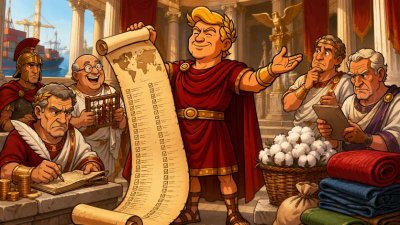
“The age of economic surrender is OVER!” he proclaimed, slamming a golden pointer stick against a map where Americana occupied roughly eighty percent of the known world.
Across the empire, state media reported scenes of industrial rebirth so dramatic they bordered on mythology. Rust Belt towns supposedly glowed again with economic life. Factory whistles echoed through the valleys. Proud workers marched into production halls like Roman gladiators entering the Colosseum of Capitalism.
Even the cost of living, according to the imperial treasury, would continue to fall under the sacred doctrine of Strategic Magnificent Tariff Prosperity™ — a phrase economists immediately placed into quotation marks for safety reasons.
Yet even critics had to admit one thing:
Nobody turned economics into theater quite like Trumpius Caesar Maximus.
Previous rulers had presented charts, statistics, and complicated policy papers. Trumpius instead transformed trade policy into a gigantic reality show featuring tariffs, roaring factories, patriotic monologues, and enough dramatic hand gestures to power several wind farms.
Every trade agreement became a military victory. Every manufacturing investment was treated like a moon landing. Every tariff announcement sounded as though the gods themselves had signed off on it using molten gold.
As World Trade Week came to its glorious conclusion, Trumpius raised the Sacred Chalice of Prosperity high into the air.
“Americana Maxima,” he declared proudly, “will dominate the global economy for centuries to come!”
Patriotic fireworks exploded across the heavens. A choir sang the Hymn of Reciprocal Trade. And somewhere deep within a crowded shipping port, a single customs officer wiped away a tear of pure economic pride.
The global economy, meanwhile, quietly ordered another emergency coffee.