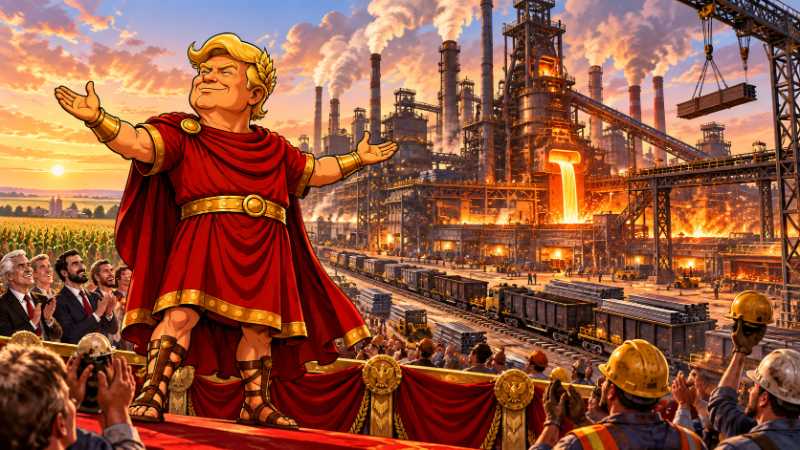

There are days when an emperor builds roads. There are days when an emperor builds walls. And then there are those especially imperial days when Trumpius Maximus Caesar decides to pour half a continent into molten steel.
Thus came the proclamation from the White Palatium of Washingtonia: in the distant province of Iowarium, a colossal new steel complex shall rise.
Not just any steel mill, naturally.
Nothing under Trumpius is ever merely large.
It must be the largest, the greatest, the most historic, the most transformative, and preferably so enormous that ancient Roman aqueducts lower their water pressure out of respect.
The imperial court places the grand project at roughly 15 billion American denarii, with Mesabi Metallicus preparing to build what is being presented as the mightiest steel complex ever forged upon American soil.
And frankly, with a name like Mesabi Metallicus, the company already sounds as though it once manufactured chariot axles for Julius Caesar.
The American Steel Gospel
The message from the throne was simple:
American ore.
American railroads.
American energy.
American workers.
American steel.
Presumably, even the lunchboxes will soon require domestic-content certification.
Trumpius Caesar proclaimed the return of American industrial greatness with all the majesty of a ruler personally reopening Mount Vulcan.
For too long, the imperial narrative declares, factories wandered overseas, jobs disappeared across distant seas, and foreign furnaces glowed while American smokestacks sat sadly contemplating globalization.
But now comes the new doctrine:
No more globalization.
Welcome to Trumpiusization.
Iowarium Enters Mandatory Celebration Mode
No sooner had the imperial steel decree been announced than political Iowarium erupted into a spontaneous festival of industrial praise.
Governatrix Kimberlia Reynoldsia hailed the project as transformational for families, national security, manufacturing, regional prosperity, and seemingly every other noble cause that can fit inside a press release.
Steel would return.
Jobs would return.
Young people would stay.
Communities would flourish.
And somewhere, one assumes, a bald eagle would be issued a ceremonial hard hat.
Attorney General Brenna Birdia praised the coming plant as a historic investment capable of bringing thousands of good-paying jobs and strengthening the entire empire.
Then came the venerable Senator Chuckius Grassleius, delivering a message so densely packed with capital letters, numbers, abbreviations, and patriotic enthusiasm that future digital archaeologists may require a Rosetta Stone.
The essential translation:
GR8 STEEL. GR8 JOBS. GR8 AMERICA.
A full sentence, under the circumstances, might simply have lacked sufficient industrial patriotism.
The Senate Discovers the Blast Furnace
Senatrix Jonia Ernsta, Mariannetta Miller-Meeksia, Ashleya Hinsonia, and Zacharius Nunnus joined the great imperial chorus.
Their conclusion was unanimous:
There is apparently no better place in the known world to manufacture steel than Iowarium.
Other regions of the republic were wisely not consulted.
Every politician suddenly became an expert in furnaces, metallurgy, supply chains, apprenticeships, tax competitiveness, and the philosophical importance of molten iron.
It was a remarkable transformation.
One moment: elected officials.
The next: honorary blacksmiths of the Republic.
From Mine to Mill, From Mill to Myth
Mesabi Metallicus Chairman Rewantus Ruia offered perhaps the purest version of the new industrial creed.
American ore from Minnesota.
American railroads.
An American mill.
American energy.
American workers.
American manufacturing.
All that remained was for someone to add:
“And every blast furnace shall receive the personal blessing of Caesar before ignition.”
Chief Executive Josephus Brokingus explained that the plant would supply American-made steel for national defense, cars, trucks, shipbuilding, appliances, energy, infrastructure, and virtually anything large enough to require both a crane and an insurance policy.
In other words:
If it is heavy, expensive, metallic, or capable of leaving a crater when dropped, Iowarium would very much like to manufacture it.
Washingtonia Suddenly Loves Steel Again
Even the Americanus Ironus et Steelus Institutum welcomed the investment, crediting the imperial tariff walls with helping energize domestic steel production.
The political machinery was therefore operating perfectly.
The emperor imposes tariffs.
The company announces a steel mill.
The politicians issue triumphant declarations.
And somewhere in Washingtonia, a speechwriter receives strict instructions to use the word “historic” no fewer than three times per paragraph.
The proposed project is expected to support thousands of construction jobs and around 1,750 permanent positions, with major long-term economic effects projected for southeastern Iowa.
For the region, such an investment could indeed be enormous.
But naturally, in the Empire of Trumpius, it cannot simply be called:
“A very large industrial investment.”
No.
It must become:
THE GREATEST STEEL MIRACLE SINCE VULCAN PERSONALLY INVENTED THE ANVIL.
The Imperial Final Proclamation
And so ends another glorious day in the chronicles of Trumpius Caesar.
He has not merely announced a steel plant.
He has transformed the blast furnace into a philosophy of government.
Soon, in Iowarium, ore may be melted, steel may be rolled, and entire trains may depart carrying great coils of metal sufficiently patriotic to qualify for ceremonial citizenship.
And should some future historian dare to ask who truly restored American steel, the answer from the White Palatium will likely arrive immediately:
“Steel? Tremendous material. Very strong. I didn’t technically invent it — but before me, frankly, nobody was doing it properly.”