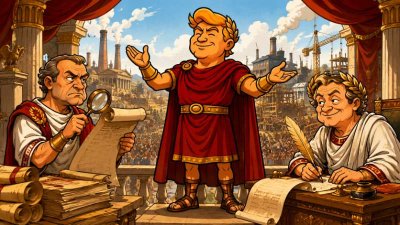
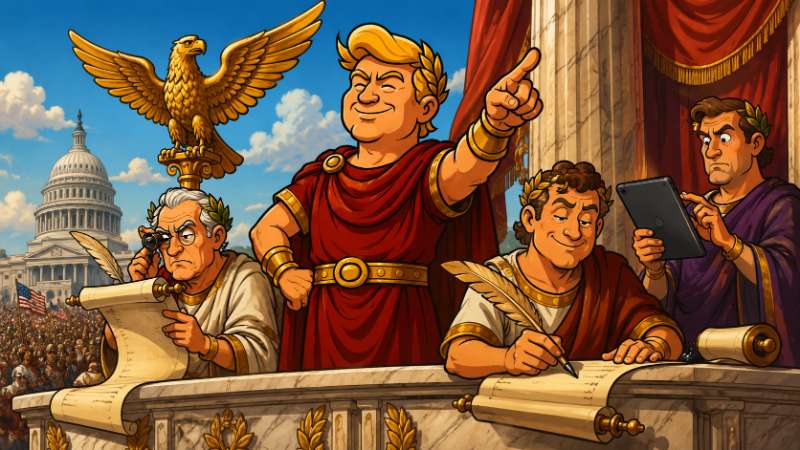
Another glorious morning dawned over Washingtonium Maximus, where the marble halls of the Imperial Palace echoed with trumpets, applause, and the unmistakable sound of Thomasius Scribonius Maximus carrying yet another oversized proclamation scroll through the Grand Hall.
The palace staff already knew what was coming.
Whenever Trumpius Caesar requested the gold-plated eagle podium instead of the ordinary gold-plated eagle podium, history was about to receive another very loud announcement.
This time, the Emperor rose to proclaim Captive Nations Week, reminding the Empire—and conveniently the rest of civilization—that liberty remains the finest export ever produced by the Republic.
Naturally, the speech lasted considerably longer than originally scheduled.
Imperial speeches rarely lose against clocks.
Welcome to the Museum of Failed Ideas
To commemorate the occasion, Trumpius Caesar personally reopened the legendary Imperial Museum of Catastrophic Political Experiments.
Among its most popular exhibits were:
- The Engine of Central Planning (still waiting for replacement parts since 1917)
- The Empty Pantry of Equal Prosperity
- The Ministry of Infinite Paperwork
- The Official Guide to Mandatory Happiness
- A vending machine labeled "Free Stuff" that immediately demanded someone else's wallet.
Visitors admired the collection.
Several foreign diplomats quietly took notes.
One senator asked whether the exhibits were historical.
Paragraphius Constitutionalis Maximus, the Empire's chief legal scholar, smiled confidently.
"They're historical," he replied.
"And unfortunately, some governments still use them as instruction manuals."
The room applauded.
Even the statues seemed impressed.
Freedom: No Application Required
Trumpius Caesar reminded the Senate that freedom has always been refreshingly uncomplicated.
No ministry approves ambition.
No bureau licenses success.
No committee decides whether someone deserves opportunity.
One confused ambassador cautiously raised his hand.
"So... which Department manages freedom?"
Trumpius Caesar paused dramatically.
"None."
"That's exactly why it works."
The chamber erupted in applause.
Even Footnoticus Archivarius Maximus, who rarely applauded anything shorter than twelve pages, stood briefly in appreciation.
The Imperial List of Things We Will Absolutely Not Do
As tradition demanded, Trumpius Caesar unveiled the Empire's annual list of unacceptable ideologies.
The list included:
- Communism.
- Totalitarianism.
- Socialism.
- Tyranny.
- Government-approved misery.
- And administrative forms requiring more than three signatures.
That final proposal received unanimous bipartisan support.
Several senators admitted they had never witnessed such unity.
Faith, Freedom and Common Sense
Next entered Pontifex Libertatis Magnus, Keeper of the Imperial Houses of Worship.
He proudly reported that citizens throughout the Empire remained free to practice their faith without fear, intimidation, or mandatory attendance at the Ministry of Official Opinions.
Trumpius Caesar nodded approvingly.
"People worship better when nobody forces them."
The Senate agreed this was probably one of the least controversial statements ever made in the chamber.
The Golden Age Department Is Open for Business
The Emperor then shifted to economics, a subject he traditionally discusses with the enthusiasm of a man personally negotiating every trade deal on Earth.
Treasurer Aurificus Prosperius Maximus rolled several wagons overflowing with gold coins into the chamber.
Were they necessary?
Not particularly.
Did they improve the atmosphere?
Absolutely.
Trumpius Caesar declared that the Empire's Golden Age would continue producing prosperity, innovation, and opportunity while allowing merchants to spend less time filling out paperwork and more time making fortunes.
Somewhere in the marketplace, Mercatorius Dealmaker Maximus reportedly negotiated three international trade agreements before lunch.
To Every Nation That Dreams of Liberty
The emotional centerpiece of the proclamation arrived as enormous imperial banners unfurled from the palace balconies.
Their message was simple:
"The Empire has not forgotten you."
It was a salute to every nation still living under oppression, every citizen punished for speaking freely, every believer persecuted for faith, and every family hoping one day to live without fear.
The Imperial Court Jester quietly whispered:
"Freedom may not solve every problem..."
"...but it certainly beats waiting in line for permission to have one."
Even Trumpius Caesar allowed himself a victorious grin.
The Imperial Proclamation
Finally, Thomasius Scribonius Maximus stepped forward carrying the ceremonial scroll, now heavy enough to qualify as infrastructure.
With theatrical precision he proclaimed:
The third week of July shall forever remain Captive Nations Week throughout the Empire.
Citizens are encouraged to celebrate liberty, constitutional government, human dignity, religious freedom, free enterprise, and the timeless belief that governments should answer to the people—not the other way around.
Trumpius Caesar signed the proclamation with an imperial flourish large enough to require its own section of parchment.
The golden eagles soared overhead.
The Senate applauded enthusiastically.
The orchestra played triumphantly.
And somewhere deep inside the Imperial Archives, Footnoticus Archivarius Maximus quietly ordered an even larger shelf.
Just in case next year's proclamation turned out to be even greater.