
The marble columns trembled.
The eagles stood at attention.
Even Mount Rushmore allegedly leaned forward just a little.
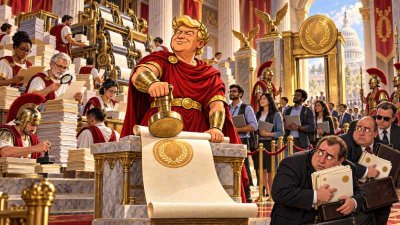
From the Golden Balcony of the Imperial White Palace emerged the one, the only, Trumpius Caesar, Supreme Emperor of Ratings, Builder of Tremendous Things, Defender of the Constitution Scrolls, and Self-Appointed Curator of American Greatness.
Behind him stood the Imperial Court.
Interiorius Monumentalis Maximus, Keeper of Parks and Patriotic Sidewalks.
Budgetius Calculatus Magnificus, Guardian of Every Golden Coin.
Administratus Generalis Bureaucratius, Master of Endless Paperwork.
And of course the ever-present Domesticus Politicus Strategius, who somehow managed to supervise every government meeting while simultaneously appearing in every official photograph.
Trumpius Caesar raised a golden decree so magnificent that historians immediately requested extra shelving.
"My fellow Imperials," he proclaimed.
"The Museum has forgotten how to museum."
Gasps echoed through the Empire.
Months earlier, the Imperial Council had dispatched scholars, inspectors, consultants, auditors, advisors, reviewers, reviewers of the reviewers, and at least three people whose entire job description appeared to be "Senior Historical Alignment Coordinator."
Their mission was simple:
Investigate the mighty Smithsonianium Maximus.
Their conclusion?
The museum had apparently become less interested in celebrating America's story and more interested in debating it.
For Trumpius Caesar, this was nothing short of archaeological treason.
"A museum," he declared dramatically, "should inspire visitors—not make them think they accidentally enrolled in a graduate seminar."
Thunderous applause followed.
One enthusiastic senator reportedly clapped so hard he accidentally approved next year's budget.
Naturally, something had to be done.
Not by rewriting exhibits.
Not by hosting debates.
Certainly not by encouraging historians to argue with one another.
No.
The Empire chose the noblest solution bureaucracy has ever invented.
Warning signs.
Lots of warning signs.
Magnificent warning signs.
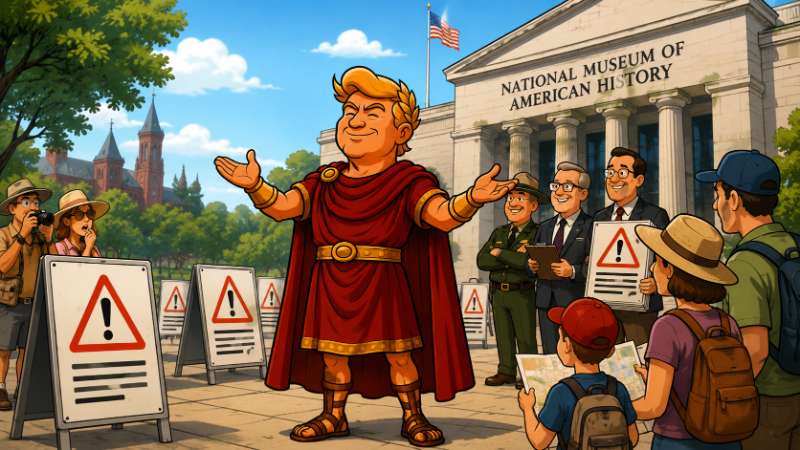
According to the Imperial Decree, visitors approaching the National Museum of American History would now encounter temporary signs placed along sidewalks maintained by the National Park Service.
Not inside the museum.
Outside it.
Because in the Empire of Trumpius, history officially begins at the curb.
The signs would politely inform visitors that some exhibits allegedly required "historical renovations" and recommend places where they could discover the "proper" version of America's story.
Tourists were delighted.
One family confessed they spent forty-five minutes reading every sidewalk sign before realizing they had forgotten to enter the museum itself.
A travel influencer uploaded a video titled:
"Top Ten Sidewalks More Educational Than Museums."
It received twelve million views.
The museum gift shop immediately began selling souvenir miniature warning signs.
Collectors bought them faster than commemorative coins.
Children traded them like baseball cards.
One limited edition sign reading "Proceed With Historical Awareness" became the hottest collector's item in Washington.
But Trumpius Caesar was only warming up.
The Imperial Report had also complained that the 56 signers of the Declaration of Independence had not received enough attention during America's 250th birthday celebrations.
An outrage!
An imperial emergency!
Therefore, additional outdoor displays honoring the Founding Fathers would be erected around the museum.
Soon, visitors discovered they could learn more about American history before reaching the entrance than after purchasing admission.
One confused tourist asked a guide,
"So... where does the actual museum start?"
The guide sighed.
"Technically? Somewhere behind Sign Number Twenty-Seven."
Naturally, the bureaucracy embraced its glorious new mission.
Entire departments were created overnight.
The Office of Patriotic Sidewalk Communications.
The Bureau of Temporary Historical Corrections.
The Federal Administration of Outdoor Interpretive Signage.
And, for reasons no one could adequately explain, an Assistant Deputy Director for Sign Placement Symmetry.
Government hiring surged.
America had finally discovered an industry recession-proof forever:
Professional Sign Management.
Meanwhile, Chronicius Scriptorius Maximus, Official Imperial Historian, summarized the decree with his usual theatrical elegance.
"When history loses its way inside the building," he proclaimed, "the sidewalk shall guide civilization."
No one understood exactly what that meant.
Everyone applauded anyway.
Soon Washington became famous not only for monuments but for informational plaques explaining other informational plaques.
Tour buses adjusted accordingly.
"Ladies and gentlemen, on your left is the Smithsonian."
"On your right is the official explanation of why you should carefully evaluate the Smithsonian."
"And just ahead is the explanatory sign explaining the explanatory sign."
Passengers snapped photographs enthusiastically.
The Opposition mocked the decree by proposing warning signs warning about warning signs.
Within hours, bureaucrats submitted feasibility studies.
Three committees were formed.
One commission recommended creating a bipartisan advisory board on directional signage.
Nothing says democracy quite like debating signs about signs.
Trumpius Caesar remained completely unbothered.
Standing proudly before an army of freshly installed placards, he smiled with unmistakable imperial confidence.
"Other nations build museums," he declared.
"We build museums, signs about museums, and sidewalks worthy of history itself."
The crowd erupted.
Fireworks exploded.
A bald eagle circled overhead with suspiciously perfect timing.
Thus concluded another unforgettable chapter in the glorious Empire of Trumpius Caesar—a land where every exhibit has an opinion, every sidewalk has a message, and even the path to history comes with an official disclaimer.
Because in the Empire, if history cannot be rewritten fast enough...
...it can always be signposted.