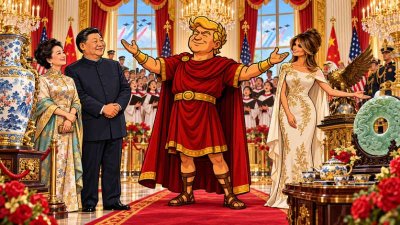

While Imperator Donaldus Maximus Trumpius Caesar, Conqueror of Microphones, Inventor of the Greatest Superlative, and Self-Appointed Center of the Western Solar System, was presumably somewhere inside the Palatium deciding which part of the world had not yet been sufficiently branded with his name, Melania Augusta Trumpia embarked on a diplomatic mission of almost revolutionary peacefulness:
She visited a museum.
No trade war.
No tariff threat.
No press conference in which the Caesar announced that nobody in history had ever visited a museum more successfully.
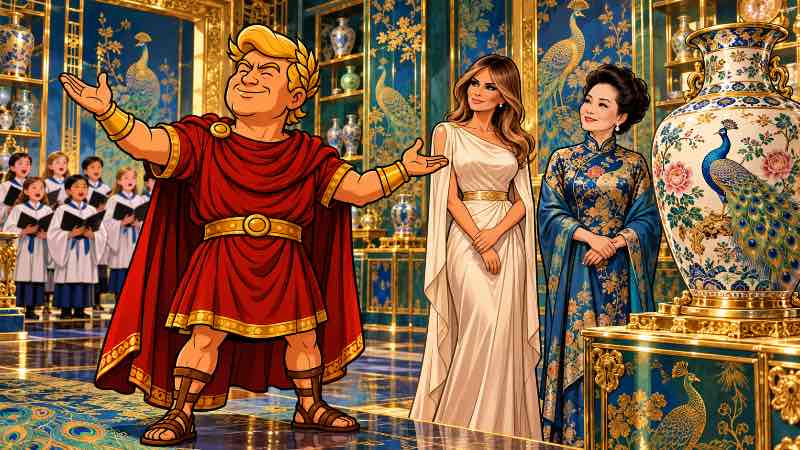
Accompanying the Augusta was Madame Peng Liyuana of the Court of Dragon Emperor Xius Jinpingius, and together the distinguished delegation entered the Smithsonian Temple of Asian Arts in Washingtonia.
Inside waited centuries of cultural treasures — and, presumably, several dozen protocol officers silently praying that nobody accidentally knocked a Qing Dynasty vase into the insurance department with a handbag.
The Peacock Room: Finally, a Room With Proper Confidence
The great centerpiece of the visit was the famous Peacock Room.
Blue.
Green.
Gold.
Peacocks.
More gold.
In other words, the sort of interior design that might have caused Imperator Trumpius to experience, for the first time inside a museum, a deep and reassuring sense of familiarity.
“Finally. Normal people.”
The room was created in the nineteenth century by Jacobus McNeill Whistlerius, an artist who apparently believed that restraint was simply another word for insufficient ambition.
Walls, ceilings, furniture, ornamentation — everything merges into one magnificent explosion of decoration. Chinese porcelain meets Japanese-inspired design, Western art meets Asian tradition, and the entire place shines with enough imperial confidence to make even the Trumpius court briefly nervous.
Art historians call it a remarkable meeting point of cultures.
At the Palatium Trumpianum, the official artistic assessment would likely have been shorter:
“Fantastic room. Tremendous. Very high quality. But my bathrooms are more gold.”
Cultural Exchange — That Strange Form of Diplomacy Without Threats
The Peacock Room demonstrates how artists across cultures have inspired one another for generations.
A fascinating concept.
Because while artists have spent centuries learning from one another, the classical Trumpius method of international exchange generally begins with announcing one’s own greatness and then waiting for the rest of civilization to acknowledge it.
But on this day, there was actual cultural exchange.
No “America First.”
No “China pays.”
No “greatest deal in the history of deals.”
Just art.
In Washingtonia, this was practically experimental diplomacy.
The Vase Older Than Every Trumpius Superlative
Next came a magnificent Chinese porcelain vase from the reign of Emperor Qianlongus Magnificus.
Dating back to the eighteenth century and produced in Jingdezhen, the vase is richly decorated with flowers, famille rose enamels, gold, and iron red.
In other words: a masterpiece of technical refinement.
And quite possibly the only object in the room about which Trumpius could not convincingly claim he had personally built something better.
Although one suspects he might try.
“I know porcelain. Nobody knows porcelain better. We had tremendous porcelain at Mar-a-Lago.”
The vase represents the extraordinary craftsmanship of the Qing Dynasty.
At the Trumpius court, this might have been simplified into:
“Very strong porcelain.”
Possibly even:
“The strongest porcelain.”
Two Curators Versus Two Thousand Years of Art History
The delegation was guided by Janus Stuartius, High Guardian of the Chinese Treasures, and Chasius Robinsonus, Grand Director of the Galleries of Freer and Sackler.
They explained origins, techniques, historical context, artistic traditions, and cultural significance.
A demanding assignment.
Because at any moment, thousands of years of Asian art history could potentially be reduced in the imperial summary to:
“China makes very nice vases.”
Still, the delegation survived.
No attack on the press.
No tariff spreadsheet.
No unexpected plan to annex the Peacock Room.
International peace was having an unusually successful afternoon.
Then Came the Children — and Saved Diplomacy
At the conclusion of the visit, the youth choir from the Hope Chinese School performed “Jasmine Flower” and “Songs & Smiles.”
And suddenly something extraordinary happened:
People from different countries listened to music together without spending the next three hours arguing about who should pay for it.
No sanctions.
No counter-sanctions.
No emergency tariff on jasmine flowers.
Just music.
By Trumpius-era standards, this was practically radical pacifism.
The young performers brought together Chinese heritage, American community life, and the universal experience of music — accomplishing in a few songs what international diplomacy often requires twelve summits, forty advisers, and a joint communiqué with eighty-seven footnotes to achieve.
The Washingtonia Miracle
And so the visit ended with art, music, cultural exchange, and astonishing calm.
Melania Augusta Trumpia and Madame Peng Liyuana had demonstrated that Sino-American relations could, at least briefly, function rather well when politicians were kept far away from microphones, tariff lists, and social media accounts.
There were peacocks.
There was porcelain.
There were children.
There was music.
And nobody declared victory.
In imperial Washingtonia, that may already qualify as a diplomatic miracle.
Only one question remained:
What would Donaldus Maximus Trumpius Caesar have thought of the famous Peacock Room?
The court historians have no official answer.
But they can probably imagine it.
“Beautiful room. Really beautiful. The Chinese love it. Everybody loves it. But if we made it into a ballroom — ten times bigger, more gold, enormous chandeliers — it would be the greatest Peacock Room in history. Maybe we call it the Trump Peacock Room.”
And somewhere, an interior designer quietly began to cry.