

Whenever a man is beatified in the Imperium Trumpianum, one sacred ritual must occur before the trumpets of Heaven are officially permitted to sound:
The Palatium Album must issue a Presidential Message.
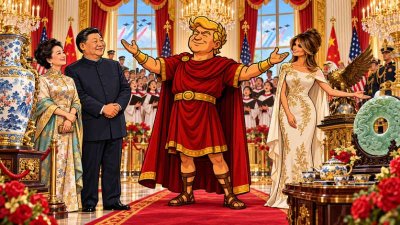
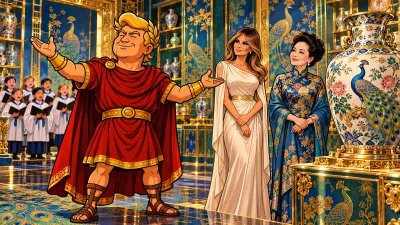
Thus Imperator Donaldus Trumpius Caesar Maximus, accompanied by his eternally immaculate imperial consort Melania Augusta Elegantissima, announced that they were joining the celebration of Archiepiscopus Fultonius J. Sheenius, the legendary Catholic priest, bishop, broadcaster, preacher, author, and — long before the word existed — theological media superstar.
Sheenius had accomplished something almost unimaginable by modern political standards:
He became enormously famous by standing in front of a blackboard and actually having something to say.
No giant LED screen.
No campaign music.
No golden escalator.
No social-media post typed entirely in capital letters.
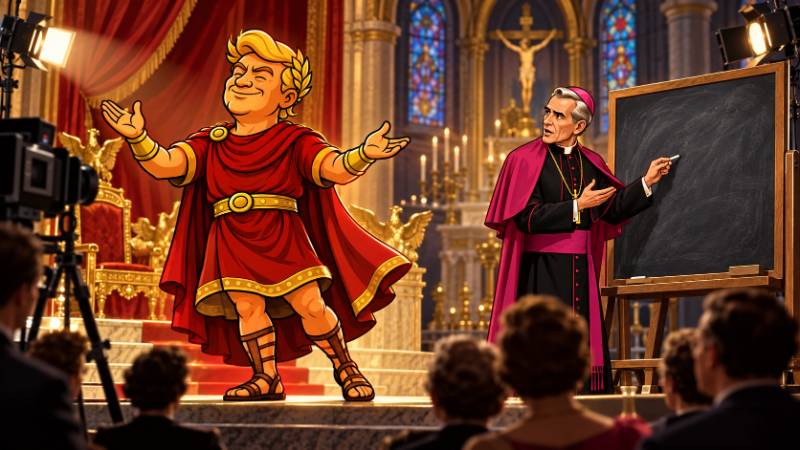
Just a priest, a piece of chalk, a blackboard, and ideas.
Historians remain stunned.
Fultonius Sheenius, Influencer of the Chalk Age
Born upon the vast plains of Illinoia near the end of the nineteenth century, young Fultonius was reportedly blessed with intelligence, humor, eloquence, and extraordinary communication skills.
In other words, he possessed the complete communications department inside one human being.
After becoming a priest, Sheenius spent decades teaching, lecturing, preaching, and broadcasting on radio before eventually becoming Auxiliary Bishop of Nova Eboracum.
Then television arrived.
And television met Fulton Sheen.
Standing before a live audience in magnificent clerical robes, armed with approximately one stick of chalk and absolutely no PowerPoint presentation, Sheenius began explaining theology, philosophy, morality, politics, Christianity, communism, civilization, and the human soul.
And America watched.
Millions watched.
Which may be the last documented occasion when millions of Americans voluntarily listened to a long philosophical argument without someone yelling “BREAKING NEWS” underneath it.
The Bishop Who Defeated Sinatra
Sheenius' program, Life Is Worth Living, became a national phenomenon.
He competed against television legends.
He beat entertainment stars in the ratings.
He won an Emmy.
He appeared on the cover of Time.
This was a bishop.
With chalk.
Talking about God.
In prime time.
Today, approximately seventeen consultants would immediately advise him to shorten the theological sections, add celebrity guests, launch branded coffee mugs, create a podcast, hire a social-media manager, and rename the program:
SHEEN: FAITH. TRUTH. WINNING.
But Sheenius apparently required none of this.
His sharp wit and intellectual confidence carried his broadcasts into American living rooms, where audiences listened to discussions about Christianity, morality, society, and the ideological struggle against communism.
Even politicians and celebrities were drawn to him.
In the vocabulary of the Imperial Communications Office, this means one thing:
TREMENDOUS RATINGS.
And ratings, as every citizen of Trumpianum knows, are among the mysterious measurements by which the universe itself determines historical greatness.
Up! Up! Up!
Years later, Sheenius warned Americans against a culture obsessed with tearing institutions down.
Down with schools.
Down with churches.
Down with teachers.
Down with government.
Down with police.
His question was simple:
What can anyone build by endlessly shouting “down”?
His answer was equally simple:
Up.
Up from violence.
Up from degradation.
Up toward God.
A powerful message.
Although when the phrase “Up! Up! Up!” reached the Palatium Album, several imperial property developers reportedly became extremely excited.
For a brief moment, aides feared that Trumpius Celestial Towers & Basilica Resort had already entered the permitting stage.
Luxury marble.
Divine views.
Penthouse slightly closer to Heaven.
Reservations available to the extremely blessed.
When the Pope Met the Television Bishop
Eventually Sheenius became Bishop of Rochestria and later titular Archbishop.
In 1979, Pontifex Ioannes Paulus Secundus Magnus embraced him at Saint Patrick's Cathedral in New York and praised his service to Christ and the Church. Sheenius died shortly afterward while praying in his private chapel.
His books remained.
His broadcasts remained.
His sermons remained.
And decades later, people continued to watch the man who had once turned a blackboard into prime-time television.
Now comes his beatification.
Thousands gather.
Church bells ring.
Catholics celebrate.
And naturally the Imperial Presidency steps forward to remind everyone that the occasion has now also received the official blessing of presidential communications.
Trumpius Caesar therefore calls upon the nation to rise.
Upward toward faith.
Upward toward virtue.
Upward toward God.
And perhaps — purely coincidentally, naturally — upward toward whichever enormous presidential seal happens to be standing behind the speaker.
For therein lies the magnificent contrast between Fultonius Sheenius and the modern Imperium.
Sheen needed a blackboard.
Trumpianum needs a communications strategy.
Sheen needed chalk.
Trumpianum needs a press release.
Sheen could stand before millions and speak about humility.
And the modern imperial machine can take even a message about humility and somehow make sure the Emperor's name appears at the top.
Somewhere beyond the clouds, one can therefore imagine Archiepiscopus Fultonius slowly approaching the celestial blackboard.
He lifts the chalk.
He considers the Presidential Message.
Then he writes one final sentence:
“Gentlemen, the subject was supposed to be God.”