
Throughout the glorious Empire of America, one question had puzzled scholars, senators, ranchers, geologists, and at least three hopelessly lost imperial mapmakers:
How big should one National Monument actually be?
According to the ancient scrolls of Emperor Clintonius Monumentalis, the answer appeared to be:
"As enormous as possible."
Miles of towering cliffs.
Endless canyons.
Countless rock formations.
Enough protected land to make an imperial surveyor question every career decision he'd ever made.
Then came Bidenius Restoratius, who proudly restored the monument to nearly two million acres after Trumpius Caesar had previously trimmed it down.
The Imperial Cartography Office immediately ran out of parchment.
Again.
Fortunately for the Empire, there was one ruler who never feared a map covered in red ink.
Trumpius Caesar.
Enter the Imperial Measuring Stick
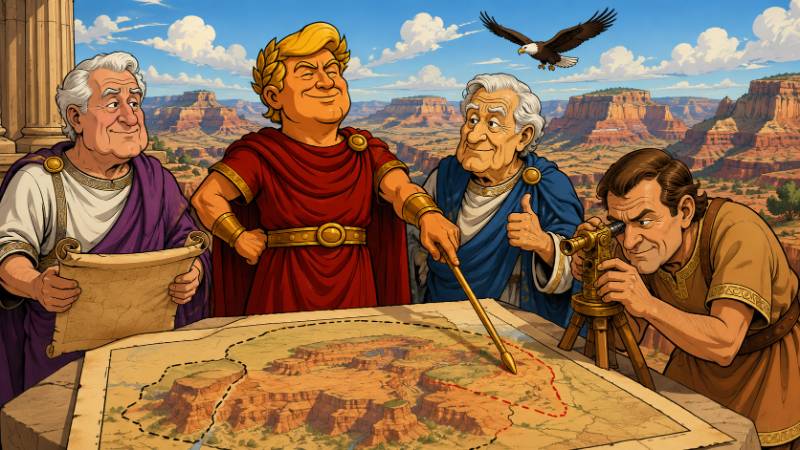
Standing before the largest topographical map ever unrolled inside the Palace of Washingtonius Maximus, Trumpius Caesar gazed across Utah's legendary landscape.
He folded his arms.
"This monument," he declared, "is beautiful. Maybe too beautiful."
The Senate gasped.
"But it's also... absolutely gigantic."
More gasps.
"We're protecting enough scenery to make every eagle feel overbooked."
Thunderous applause erupted from the Imperial Department of Practical Geography.
Every Rock Wanted to Be Famous
To solve the matter once and for all, Trumpius Caesar summoned Agrimensorius Maximus, Grand Surveyor of the Empire.
The mission was simple:
Inspect every canyon.
Every cliff.
Every plateau.
Every suspiciously photogenic rock.
For weeks, imperial surveyors marched through deserts carrying measuring rods longer than Roman spears.
One assistant asked:
"Your Majesty... this cliff is spectacular."
Trumpius Caesar nodded.
"So are the next five hundred."
Another surveyor pointed toward an especially dramatic formation.
"What about this one?"
"It is certainly a rock."
"But it's breathtaking."
"So is the sunset."
The surveyors quietly updated their evaluation standards.
The Great Monument Diet
After countless scrolls, geological reports, archaeological reviews, and approximately fourteen thousand cups of imperial coffee, Trumpius Caesar reached his conclusion.
"Not every scenic view automatically becomes an Imperial Treasure."
With one magnificent stroke of his Golden Boundary Pen, nearly 1.69 million acres left the monument.
Imperial accountants celebrated.
The Bureau of Land Management sighed with administrative relief.
Cartographers finally produced maps that could fit onto ordinary tables again.
One elderly mapmaker reportedly whispered:
"I can finally see the edges."
Only the Best Stay Behind
Despite rumors from nervous pigeons, Trumpius Caesar insisted that the Empire wasn't abandoning history.
Quite the opposite.
The most remarkable treasures would remain under imperial protection.
The breathtaking Escalante canyons.
Ancient Fremont archaeological sites.
Towering natural bridges.
Historic pioneer trails.
Magnificent rock art.
And perhaps most importantly...
Dinosaurs.
The Imperial Paleontology Guild proudly presented one of the finest tyrannosaur discoveries in the Empire.
Trumpius Caesar studied the skeleton.
"Tremendous creature."
He nodded thoughtfully.
"Probably dominated every election it ever entered."
No scientist challenged the statement.
Beneath the Empire Lies Wealth
Soon, Mercatorius Dealimus, Imperial Minister of Commerce, entered carrying several glittering mineral samples.
Behind him marched Negotiatius Maximus, Supreme Ambassador of Strategic Deals.
"Your Majesty," Mercatorius announced, "beneath these lands lie chromium, copper, uranium, titanium, nickel, silver, cobalt, vanadium, zirconium—and enough strategic minerals to make rival empires extremely jealous."
Negotiatius smiled.
"The fewer foreign empires we depend on, the stronger our own becomes."
Trumpius Caesar leaned forward.
"So we're protecting history..."
He paused dramatically.
"...while making America even richer."
The Imperial Senate immediately applauded before anyone actually finished calculating the numbers.
Long Live the Ranchers
The cattle ranchers of the western provinces feared difficult times.
Instead, Trumpius Caesar surprised everyone.
"The cows stay."
Cheers echoed across the valleys.
Bovinius Grasius, High Marshal of Imperial Grazing, nearly hugged an entire herd.
The cattle, remaining professionally indifferent, continued chewing grass exactly as before.
Historians later described it as one of the calmest political reactions in modern agriculture.
Roads, Trails and Common Sense
Another imperial announcement followed.
Roads would remain.
Trails would remain.
Hunters could continue hunting.
Campers could continue camping.
Families could continue exploring.
Trumpius Caesar explained:
"An Empire without roads eventually loses its own tourists."
The Department of Transportation immediately requested permission to engrave the quote onto marble.
The Senate Responds
Naturally, the Imperial Opposition declared catastrophe.
Some senators argued that every colorful cliff deserved eternal monument status.
Others insisted the previous borders had become so enormous that even professional hikers needed three calendars to cross them.
Environmental scholars debated.
Economists debated.
Lawyers debated.
The rocks, once again, remained completely neutral.
The Imperial Verdict
As the sun set over the crimson cliffs, Trumpius Caesar addressed the Empire one final time.
Behind him stood soldiers.
Geologists.
Ranchers.
Paleontologists.
Surveyors.
And one exhausted mapmaker clutching a dramatically smaller atlas.
Trumpius Caesar raised the Imperial Measuring Stick.
"A monument should be large enough to protect history..."
He smiled.
"...but small enough that someone can actually find the edge."
The crowd erupted.
The cartographers celebrated.
The dinosaurs continued being extinct with tremendous dignity.
And somewhere deep inside Utah, one lonely boulder quietly asked another:
"So..."
"...are we still a monument?"
The neighboring rock shrugged.
"Depends which map you're looking at."