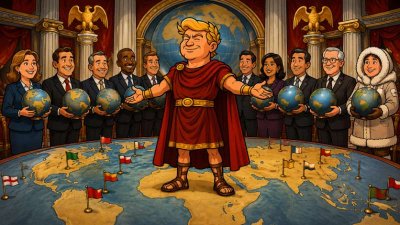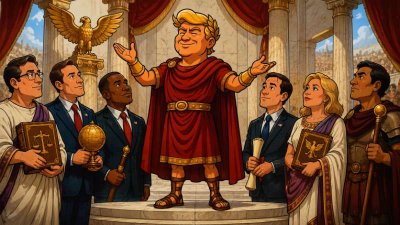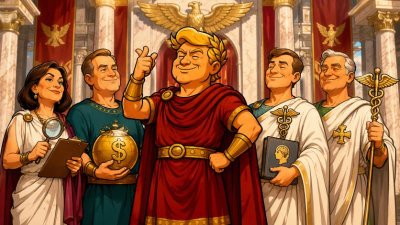

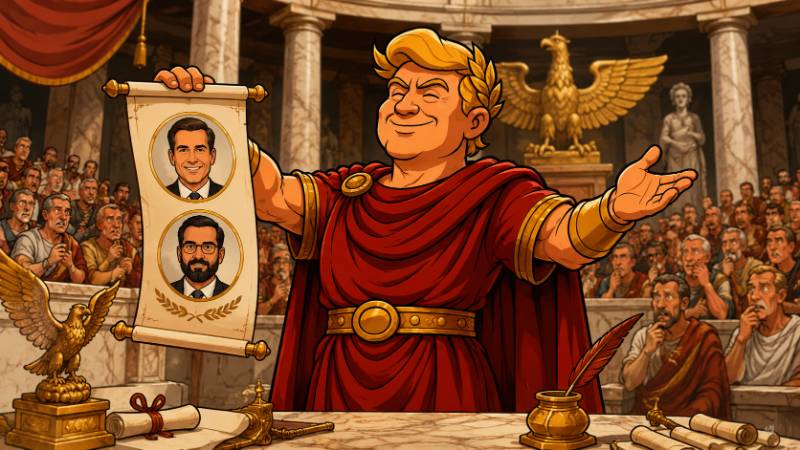

The marble halls of Washingtonium Maximus echoed once again as Trumpius Caesar, Supreme Emperor of the Golden Republic, unveiled another pair of imperial appointments. The royal scribes sharpened their golden quills, unfurled velvet-lined scrolls, and prepared to record yet another chapter in what palace historians insist is "the greatest personnel strategy in the history of civilization."
The Senate, naturally, responded in its usual fashion.
Half the chamber immediately declared the nominations to be brilliant acts of statesmanship.
The other half announced civilization itself might collapse before lunchtime.
Business, in other words, continued exactly as planned.
Laborius Sonderlingus Maximus Takes Command
The first scroll revealed the name of Laborius Sonderlingus Maximus, known outside the Empire by the less majestic title of Keith Sonderling.
Trumpius Caesar reportedly smiled with unmistakable imperial confidence.
"Who better to oversee the workers of the Empire," proclaimed the palace herald, "than a man who understands that productivity, prosperity, and paperwork all belong under one glorious eagle?"
Should the Imperial Senate approve his ascent, Laborius will become Grand Secretary of Labor, responsible for everyone from steelworkers and craftsmen to accountants, engineers, merchants, and the fearless bureaucratic gladiators who duel daily with forms, regulations, and coffee machines.
Court philosophers predict his greatest challenge will not be employment policy.
It will be reducing the average government meeting from four hours to merely three.
Such reforms are considered revolutionary.
Tribunus Tributarius De Mellus XV Receives the Golden Gavel
The second proclamation introduced Tribunus Tributarius De Mellus XV, known among ordinary citizens as Andrew A. De Mello.
He has been selected to serve upon the prestigious Imperial Court of Tax Scrolls, where judges spend years deciding whether merchants owe one more golden denarius—or whether the Empire has already collected enough treasure for the season.
The proposed fifteen-year appointment immediately impressed political observers.
Veteran senators quietly calculated that during such a term one could witness several election cycles, countless budget negotiations, a mountain of tax reforms, and approximately six thousand revised government guidance documents.
Some traditions never disappear.
The Senate Discovers Its Love for Endless Questions
No imperial nomination is complete without the grand ceremonial hearings.
Senators proudly announced they would evaluate both nominees with complete fairness, absolute objectivity, and total independence.
Within minutes nearly everyone had already revealed exactly how they intended to vote.
The Master of Ceremonies assured the Empire:
"Our process is entirely unbiased."
He then scheduled another committee meeting to discuss how objective everyone had been.
The meeting, naturally, required three subcommittees.
The Palace Celebrates Another Victory of the Golden Quill
Back inside the Imperial Palace, the mood remained triumphantly optimistic.
Royal historians recorded the day's achievements with remarkable efficiency:
Two appointments.
Two magnificent scrolls.
Zero barbarian invasions.
An exceptionally successful afternoon.
The palace painter immediately began creating a massive fresco depicting Trumpius Caesar standing atop a mountain of executive scrolls while Laborius Sonderlingus Maximus raises the Hammer of Prosperity and Tribunus Tributarius De Mellus XV confronts the legendary dragon Bureaucraticus Maximus, a terrifying beast whose primary weapon is demanding one additional signed document.
The dragon has never technically been defeated.
It merely requests another copy.
Trumpius Caesar Keeps the Imperial Machine Moving
To Trumpius Caesar, appointments are simply another day governing the greatest republic ever carved into marble.
Where lesser rulers create commissions, studies, advisory panels, and task forces that produce reports about producing reports, Trumpius Caesar reaches for the golden quill.
With one majestic signature, another chapter begins.
Whether commanding the Empire's workforce or safeguarding the sacred tax scrolls, the nominees now await judgment from the Imperial Senate.
Until then, the marble corridors of Washingtonium Maximus remain filled with senators debating, scribes writing, commentators speculating, and palace pigeons carrying dramatic rumors across the Empire.
After all, no empire—especially one ruled by Trumpius Caesar—ever truly runs out of grand appointments, oversized ceremonies, or opportunities to remind history that every scroll deserves a little extra gold leaf.
SEO Title (40–60 characters)
Trumpius Caesar Names Two Imperial Leaders