
It was one of those glorious mornings when the golden eagles perched atop the Imperial White Palace seemed to shine just a little brighter. Why? Because Trumpius Caesar Magnus Transparentius had decided that history should no longer remain hidden inside dusty vaults guarded by bureaucratic librarians with oversized keys.
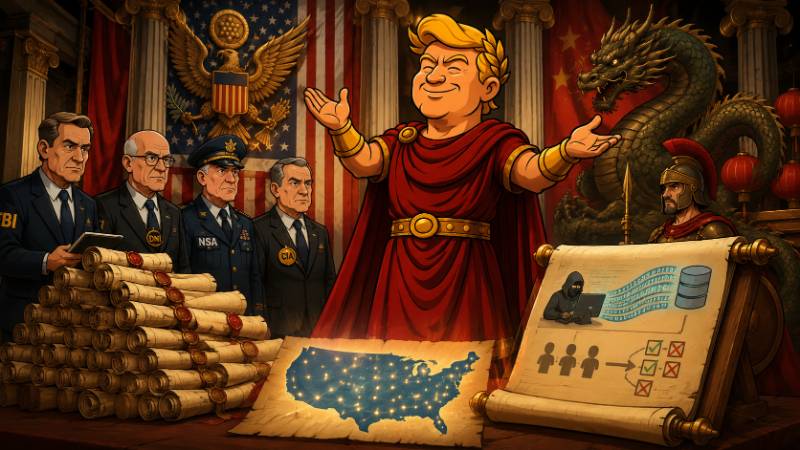
Instead of releasing an ordinary government report—as lesser rulers might do—Trumpius ordered the ceremonial opening of the Imperial Transparency Vault, complete with trumpets, marble columns, patriotic banners, and enough dramatic flair to make Julius Caesar wonder whether he'd been trying too little.
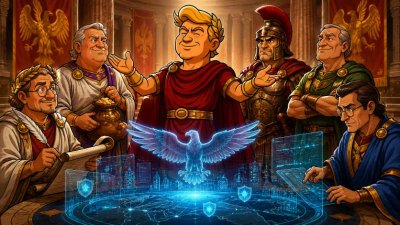
Standing beside him were the Empire's elite guardians of classified wisdom: the mystics of Intelligentius Maximus, the code-breaking priests of NSA Crypticus, the legendary shadow scribes of CIA Occultus, the vigilant defenders of Homelandus Custodius, and the tireless investigators of FBI Investigatus.
Together they unveiled a collection of once-secret imperial scrolls.
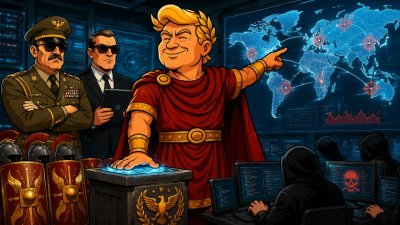
According to the newly revealed documents, the distant Empire of Sinensia Maxima and its cyber legions allegedly gathered voter registration information concerning as many as 220 million citizens of the American Empire.
The Senate immediately fell into complete statistical panic.
"Two hundred twenty million?" asked Senator Calculatus.
"Indeed."
"That's... practically everybody."
"Correct."
The emergency mathematics committee declared the calculation successful and adjourned.
Trumpius Caesar explained with supreme imperial confidence that these weren't merely ordinary lists of names.
No.
These were sacred registration scrolls—the bureaucratic equivalent of finding the recipe for Roman immortality.
According to the archives, the cyber legions allegedly acquired both publicly available information and data that ordinary citizens weren't supposed to see.
Naturally, this inspired endless speculation throughout the Empire.
Some citizens immediately changed every password they had ever created.
Others covered their computers with aluminum shields "just to be safe."
One particularly cautious senator attempted to register to vote under the name "Definitely Not Me."
The paperwork is reportedly still being processed.
The declassified scrolls also contained an official imperial definition of election interference.
Leave it to government scholars to produce a definition so detailed that it required several additional scrolls simply to explain the footnotes.
According to the imperial archivists, ordinary election influence involves attempts to shape opinions, while election interference concerns direct technical attacks on registration systems, voting procedures, ballot counting, or reporting the results.
Even Roman philosophers admitted that the bureaucrats had managed to define something with astonishing precision.
Somewhere, an imperial clerk smiled proudly.
The scrolls further warned that anyone possessing massive voter registration databases could theoretically create confusion by altering records, delaying registrations, or forcing citizens into additional verification procedures.
Hearing this, countless imperial citizens nodded knowingly.
After all, many had already experienced government paperwork.
Some suspected that bureaucracy itself had invented cyber warfare centuries ago.
Others insisted bureaucracy was cyber warfare.
The greatest spectacle, however, wasn't the contents of the documents.
It was the ceremony.
Trumpius Caesar transformed the release of intelligence reports into what historians would later describe as "the most entertaining filing cabinet opening in imperial history."
Gigantic golden banners proclaimed transparency.
Trumpets echoed through the marble halls.
Officials applauded with the enthusiasm usually reserved for tax reductions.
Even the palace librarians received standing ovations simply for remembering where the keys were hidden.
Soon rumors spread throughout the Empire that even more classified scrolls might eventually be revealed.
Optimists hoped for forgotten economic secrets.
Historians wished for ancient strategic maps.
Conspiracy enthusiasts demanded the release of the legendary recipe for the Senate cafeteria's mystery casserole.
The cafeteria firmly denied possessing such documents.
Mostly.
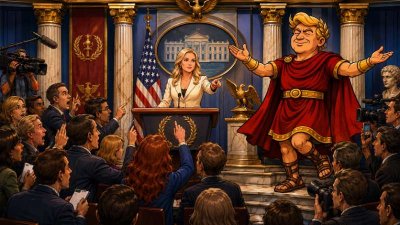
As the celebration reached its magnificent finale, Trumpius Caesar stepped onto the imperial balcony beneath a forest of golden eagles.
Raising his hand toward the cheering crowds, he proclaimed:
"Nothing shall remain hidden in the American Empire... except, naturally, the truly secret things."
Thunderous applause followed.
The imperial bureaucracy breathed a collective sigh of relief.
Transparency had officially triumphed.
And somewhere beneath the White Palace, an elderly archivist carefully unlocked another enormous vault, replaced the faded label, and proudly hung a gleaming golden plaque that read:
"Formerly Top Secret. Now Certified Imperial Transparency."