

Washingtonia, August 12, 2026 — For far too long, digital barbarians beyond the borders of the Imperium Americanum have believed they could send phishing emails, deploy ransomware, impersonate banks, rob grandparents, extort families, and then calmly enjoy their afternoon coffee while hiding behind seven proxies and a suspiciously inexpensive VPN.
Those glorious days of criminal tranquility may be coming to an end.
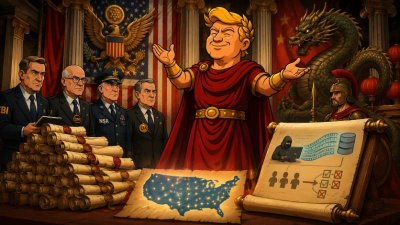
Imperator Donaldus Trumpius Maximus Cyberneticus I, Supreme Defender of the Firewall, Lord of the Golden Password and Protector of the Sacred Wi-Fi, has reached for the imperial signing pen.
And when Trumpius signs something, Washingtonia knows the procedure.
First comes the signature.
Then comes the proclamation.
Then somebody announces that it is probably the greatest signature ever placed on a cybersecurity memorandum.
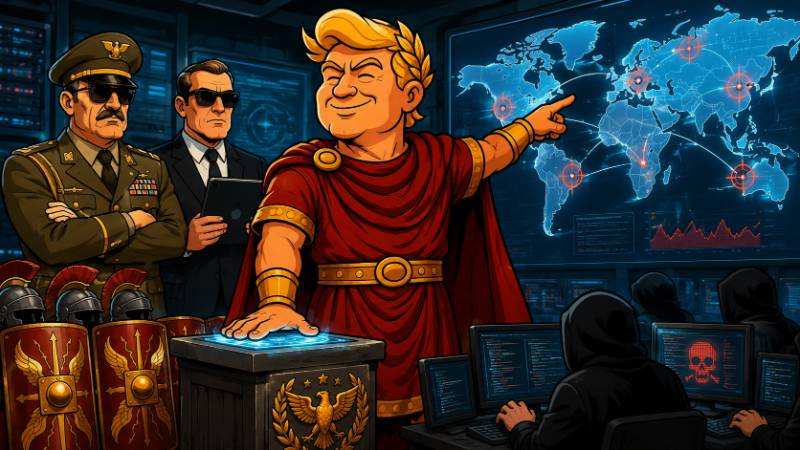
Trumpius has signed a new National Security Presidential Memorandum, known henceforth in the Imperial Archives as the Memorandum Cyberneticum Maximus, empowering U.S. federal law enforcement to use cyber capabilities to disrupt transnational criminal organizations operating abroad and targeting Americans.
In plain American:
If you scam the Empire, the Empire may now come looking for your server.
The Cyber Legions Assemble
At the center of this new imperial doctrine stands the Homeland Security Task Force’s National Coordination Center, now formally renamed by absolutely nobody except this chronicle as the Centrum Coordinationis Cyber Maximus.
The NCC is directed to establish a program for specific cyber operations designed to disrupt foreign transnational criminal organizations.
Two Executive Directors — one representing the Departmentum Justitiae and another from the Departmentum Securitatis Patriae — will oversee the campaign.
Two directors!
A brilliant imperial arrangement.
One can find the cybercriminal.
The other can determine whether Form CYB-27B was properly submitted before anybody disconnects his server.
But Trumpius is not relying solely upon the bureaucratic legions of Washingtonia.
The private sector is entering the arena.
Silicon Valley Joins the Imperial Army
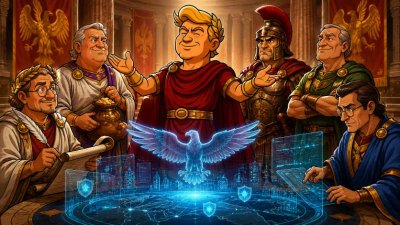
The memorandum calls for harnessing the technological capabilities and innovation of American companies, allowing vetted private-sector participants to assist cyber operations conducted under the direction, control, and authority of the United States Government.
This is a significant development.
For centuries, empires hired auxiliary cavalry.
Trumpius has discovered something considerably more dangerous:
Software engineers with administrative privileges.
Participating companies may enter agreements with other private organizations and with Federal, State, Local, Tribal, and Territorial agencies. Together, they can collect intelligence about transnational criminal organizations and propose cyber operations against them.
The result resembles an enormous digital Roman alliance.
Washington supplies the authority.
Law enforcement supplies the targets.
Technology companies supply the cyber catapults.
And somewhere, presumably, an attorney supplies a 147-page document explaining why everyone must click “I Agree.”
This Is Not the Cyber Wild West
Before anyone imagines thousands of programmers in hoodies launching uncontrolled digital cavalry charges across the global internet, the imperial scribes have included an important detail.
There will be rules.
Many rules.
The Executive Directors and the Homeland Security Council are instructed to establish rigorous procedures governing the review and execution of these limited cyber operations.
Actions must comply with the U.S. Constitution, American law, and applicable international agreements.
Thus, even under Trumpius Cyberneticus, the official strategy is not:
sudo conquer --internet
followed by Enter.
The targets are instead supposed to be sophisticated foreign criminal networks involved in ransomware, phishing, financial fraud, impersonation scams, sextortion, and other cyber-enabled schemes targeting Americans.
These are not merely teenagers in dark bedrooms typing dramatically while green numbers fall down a screen.
Many are organized operations.
They have infrastructure.
They have specialists.
They have money.
And apparently, according to the Imperial Palace, they are about to acquire something else:
A considerably more complicated IT department.
The Digital Barbarians at the Gates
The numbers presented by the White House are serious.
American consumers reported losing more than $20.8 billion to cyber-enabled crime in 2025.
Twenty-point-eight billion dollars.
A sum large enough to make even Imperial Treasurer Aurelius Calculatorius drop his golden abacus.
According to the Fact Sheet, 73 percent of U.S. adults have experienced some form of online scam or attack. Ninety-eight percent believe scams represent a threat to Americans, while roughly two-thirds consider them a major threat.
The most vulnerable — including seniors, children, and low-income families — are frequently targeted.
And behind the absurdity of phishing messages, fake princes, fraudulent invoices, romance scams and badly spelled “URGENT ACCOUNT SECURITY” emails lies a much darker reality.
Sextortion involving minors can have devastating consequences. The Fact Sheet states that one in seven young people who experienced sextortion while they were minors reported harming themselves in response.
That is where even the Imperial Comedy Department lowers the trumpet.
Because behind cybersecurity statistics are actual victims, and protecting children from organized exploitation is not ceremonial palace theater.
Silicon Valley Receives the Cyber Spear
The Trumpius doctrine considers America's private technology sector one of the country's greatest strategic advantages.
And perhaps that is understandable.
The United States possesses enormous concentrations of engineers capable of spending four hours debating whether something should be rewritten in Rust before fixing it with three lines of Python.
Now some of that expertise could be directed toward disrupting criminal networks.
Through cooperation with vetted American companies, the government intends to improve its ability to identify threats, gather information, develop responses, and combat transnational cybercrime.
The old Silicon Valley slogan was once:
“Move fast and break things.”
The Trumpius edition may become:
“Move legally and break the criminals' infrastructure.”
Subject to review.
And authorization.
And international agreements.
And probably several meetings.
Behold the Imperial Scroll of Achievements
Naturally, no proclamation from the Palace of Trumpius would be complete without the ceremonial arrival of Braggus Magnificus, Keeper of Accomplishments and Grand Unroller of Scrolls.
The administration points to falling violent-crime figures as evidence of its broader security agenda.
According to the Fact Sheet, the United States experienced its steepest year-over-year decline in violent crime in 2025, while murder rates fell sharply. The administration says preliminary trends during the first half of 2026 indicate further declines in murder, robbery, rape, aggravated assault, and violent crime overall.
Then enters Melania Augusta Prima, champion of the TAKE IT DOWN Act.
Trumpius signed the bipartisan legislation in May 2025. The law targets the non-consensual distribution of intimate imagery and deepfake abuse, with particular emphasis on protecting children and families from online exploitation and extortion.
According to the White House, the first conviction under the Act followed in April 2026.
But the imperial cybersecurity scroll continues.
In June 2025, Trumpius signed an Executive Order intended to strengthen national cybersecurity and protections against foreign cyber threats.
In September 2025, the administration issued guidance intended to help financial institutions identify and disrupt financially motivated sextortion.
In March 2026 came another Executive Order aimed at cybercrime, fraud, and predatory schemes targeting American families, businesses, and critical infrastructure.
Then, in June 2026, Trumpius signed another National Security Presidential Memorandum strengthening cybersecurity for America's National Security Systems and modernizing their governance.
The message from the Palace could hardly be more subtle if delivered by a golden trumpet inside a server room:
WE HAVE CYBER.
TREMENDOUS CYBER.
VERY ADVANCED CYBER.
CYBER LIKE YOU WOULDN'T BELIEVE.
Pax Cybernetica Trumpiana
And so begins another chapter in the chronicles of the Imperium Americanum.
Once, Roman legionaries guarded distant frontiers with shields and spears.
Today, analysts guard networks with threat intelligence and authentication tokens.
Once, armies launched stones over walls.
Today, governments may launch carefully reviewed, legally authorized digital operations against criminal infrastructure thousands of miles away.
The battlefield has changed.
The barbarians have changed.
Even the catapults have changed.
But the imperial principle remains remarkably familiar:
Attack the citizens of Rome, and eventually Rome starts asking where you live.
Somewhere beyond the borders of Washingtonia, a cybercriminal may therefore be staring nervously at six monitors.
A warning suddenly appears.
Network traffic behaves strangely.
Servers begin disappearing.
And somewhere in a log file appears the mysterious phrase:
TRUMPIUS_CYBER_LEGION_FINAL_FINAL_V7
The criminal freezes.
“What is this?”
Too late.
For Donaldus Trumpius Maximus Cyberneticus I — Defender of Grandmothers, Destroyer of Phishing, Imperator of Firewalls, Guardian of the Sacred Password and Pontifex Maximus of Two-Factor Authentication — has spoken.
The Cyber Legions are marching.
Not across deserts.
Not across oceans.
Not through the gates of ancient cities.
They march through fiber-optic cable.
And somewhere in the Golden Palace, somebody is almost certainly preparing the ultimate imperial declaration:
“Nobody sends better packets than we do. Nobody.”