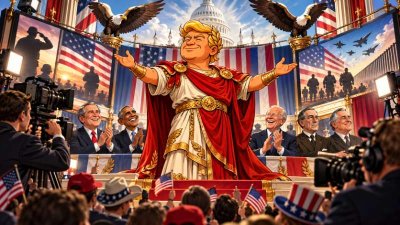
Once again, history was written at the Palatium Album in Washingtonia. Admittedly, it was mostly written inside several PDF documents, but within the Empire of Trumpius, a properly formatted attachment already counts as a geopolitical revolution.
Accompanied by golden curtains, ceremonial trumpets, and the nervous rustling of international tariff schedules, the Imperial Council for Trade, Tremendousness, and Mutual Suspicion announced its newest triumph: the magnificent “Thirty-for-Thirty” framework.
The name alone sounded so powerful that few dared to ask what had actually been decided.
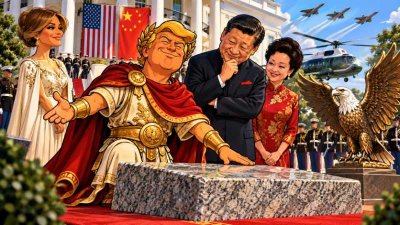
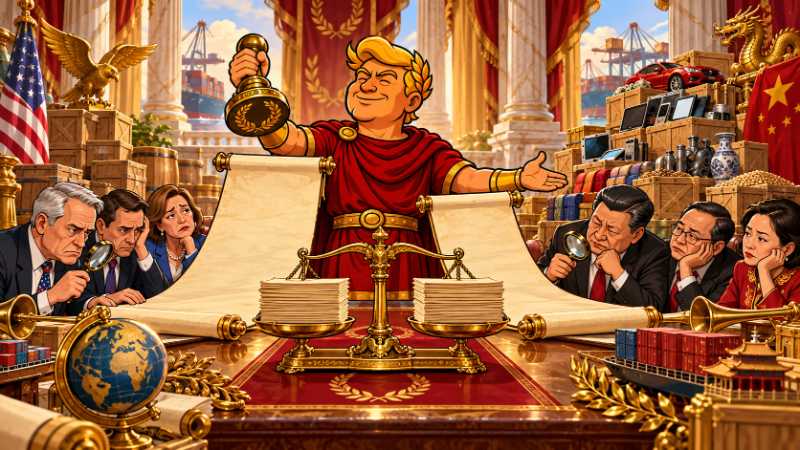
The imperial concept was beautifully simple. The United Provinces of Americusia would present the mighty Sinonian Empire with a list of American products. Sinonia, in return, would present Americusia with a list of Chinese products. Both sides would then study the lists, nod with historic seriousness, and consider whether they might possibly begin thinking about reducing certain tariffs at some later and legally convenient moment.
It was free trade in its most cautious form: nobody opened a door, but both parties solemnly confirmed that doors theoretically existed.
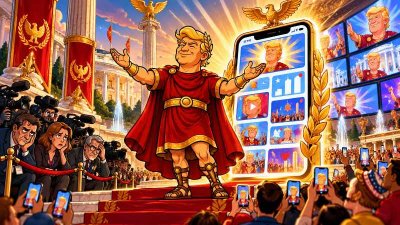
Trumpius Caesar declared it the greatest tariff reduction that had not yet happened. Never before, he explained, had so many goods been recommended for lower tariffs with such majestic determination. Lesser rulers had made the amateur mistake of actually cutting tariffs, thereby destroying all suspense. Trumpius offered something much greater: the glorious possibility of a future review.
The imperial scribe Tariffus Formularius then displayed the sacred “Working Procedures” and the venerable “Terms of Reference.” These scrolls carefully established the rules under which officials would discuss the rules for considering what might eventually be done.
Court observers particularly admired the ingenious principle that a product could appear on a list without receiving anything whatsoever. Under Trumpian commercial law, a recommendation is simply a promise that has been pre-denied.
Even the word “reciprocal” acquired a new and magnificent meaning. Americusia would examine Sinonian goods. Sinonia would examine American goods. Meanwhile, both empires would examine whether the other empire was examining properly. Trust would thus be created through complete and continuous mutual suspicion.
Imperial chroniclers immediately proclaimed the Great Tariff Peace of Washingtonia. Merchants cautiously asked when the lower tariffs would take effect. The Palatium Album responded by pointing toward each nation’s domestic laws and procedures—the legendary bureaucratic labyrinth where entire trade delegations disappear, only to return years later as advisory subcommittees.
Trumpius Caesar nevertheless declared total victory. He had given China a list. China had given him a list. Neither side had immediately torn up the other side’s list. By the standards of imperial diplomacy, this was practically a single market with complimentary valet parking.
The court’s most devoted heralds praised the arrangement as a masterstroke. If tariffs eventually fell, Trumpius would receive full credit. If they did not, foreign bureaucrats, domestic laws, disloyal ink, or insufficiently patriotic paper clips could be blamed. It was the perfect imperial agreement: flexible enough to become a triumph under every possible outcome.
At the closing ceremony, Trumpius raised the Golden Tariff Stamp and declared the dawn of a new era of fair trade. The tariffs themselves remained safely where they were, but the paperwork had moved several feet across a conference table—and within the Empire of Trumpius, that already qualified as an economic earthquake.
Because true greatness does not come from lowering a tariff.
True greatness comes from announcing the possible consideration of a potential reduction with such overwhelming splendor that even the bureaucracy stands, salutes, and quietly asks for another PDF.