
When historians someday chronicle the greatest campaigns of the Empire, they will write of mighty victories over invading armies, fearsome dragons, and impossible economic odds.
But only one ruler could immortalize himself by declaring an imperial crusade against... imported kitchen countertops.
Thus spoke Trumpius Caesar Magnus Maximus, Supreme Builder of Golden Towers, Protector of the Imperial Marketplace, and Eternal Champion of Tremendous Deals.
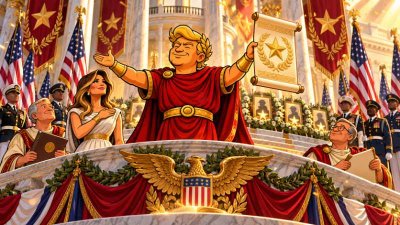
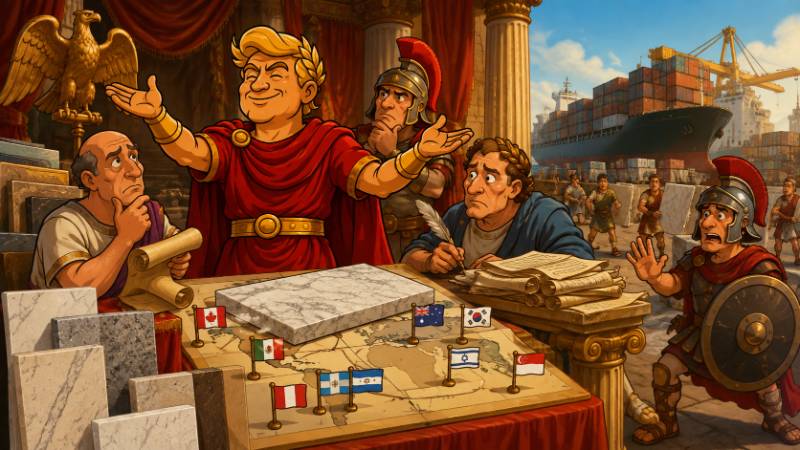
Standing upon the Marble Balcony of the Imperial Capitol, wrapped in robes brighter than polished Carrara stone itself, he raised the Sacred Pen of Executive Destiny.
"My fellow Romans," proclaimed the Emperor, "our kingdom has survived barbarians, recessions, fake prophets, and terrible architects. But today we face our greatest challenge."
The Senate leaned forward.
The eagles stopped flapping.
Even the marble columns appeared nervous.
"Too many foreign quartz slabs!"
A collective gasp echoed through the empire.
For months, the Imperial Trade Oracle had studied the mysterious invasion. Wise scholars carrying scrolls thicker than siege walls determined that magnificent quartz surface products from distant lands had entered the Empire in such enormous quantities that the noble domestic stone carvers were beginning to feel the pressure.
This, declared the Oracle, was no ordinary trade issue.
It was... The Great Countertop Crisis.
Trumpius Caesar immediately summoned his elite council:
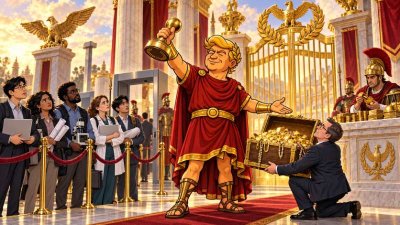
Tariffius Maximus, Master of Customs.
Quotarius the Keeper of Percentages.
And the legendary bureaucratic wizard Annexus Footnotius, whose magical appendices were rumored to be longer than entire libraries.
The Emperor's solution was exactly what every Roman expected.
Not a ban.
Not free trade.
Something gloriously more complicated.
For four imperial years, the Empire would establish a mighty tariff-rate quota.
A certain number of quartz slabs could peacefully enter the realm.
Beyond that?
The Imperial Treasury would greet them with magnificent tariffs large enough to make even accountants salute.
Naturally, no imperial proclamation would be complete without enough exceptions to confuse future archaeologists.
Canada? Welcome.
Mexico? Come right in.
Australia? Excellent people.
Singapore? Very nice.
Peru? Fine.
Panama? Absolutely.
Colombia? No problem.
Israel? Keep coming.
South Korea? Also welcome.
The kingdoms of CAFTA? VIP entrance.
Jordan? An honorary guest.
A senator cautiously raised his hand.
"Your Majesty... if all these kingdoms are exempt..."
Trumpius Caesar smiled with supreme confidence.
"That is exactly why this plan is so brilliant."
The senator immediately applauded.
Nobody wanted a follow-up question.
Across the Empire, the reactions were spectacular.
Domestic manufacturers celebrated as if they had just conquered Gaul.
Importers opened enormous spreadsheets.
Lawyers purchased stronger coffee.
Customs officers quietly requested longer vacations.
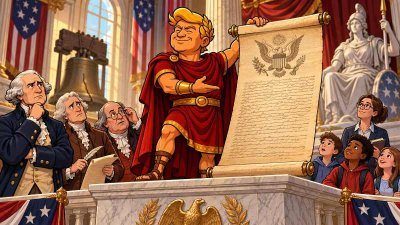
Meanwhile, deep inside the Imperial Ministry of Trade, hundreds of officials attempted to explain the proclamation using maps, arrows, tariff schedules, legal references, exceptions, exceptions to the exceptions, and several annexes that appeared to require annexes of their own.
One unfortunate clerk reportedly asked whether there might be a simpler explanation.
He has not been seen since.
Trumpius Caesar also granted extraordinary powers to his trusted ambassador, Mercator Tariffius Maximus.
Should imports suddenly surge...
He may act.
Should clever merchants attempt to bypass the rules...
He may act.
Should another kingdom become too successful...
He may act.
Should trade agreements prove effective...
He may negotiate.
Should they fail...
He may negotiate again.
By sunset, Mercator Tariffius reportedly possessed enough authority to negotiate with nearly every civilization that had ever discovered polished stone.
Then came the mathematics.
Developing kingdoms remained exempt...
Unless their share exceeded three percent.
Or unless several small kingdoms together exceeded nine percent.
Or unless the Trade Oracle recalculated.
Or unless new numbers appeared.
Or unless another annex replaced the previous annex.
Even the Empire's greatest mathematicians quietly admitted that following the rules required more concentration than calculating planetary motion.
Yet Trumpius Caesar remained magnificently optimistic.
"Our people will enjoy greater economic and social benefits than costs!"
Exactly how one measures the happiness generated by a tariff on luxury countertops was never fully explained, but few dared question imperial optimism.
Citizens gathered in marketplaces throughout the Empire.
"So... are countertops getting more expensive?"
"Possibly."
"Will there be fewer imports?"
"Depends."
"Depends on what?"
"The country."
"What if the country is on the exemption list?"
"Which exemption list?"
"The latest one."
"There are multiple?"
"There are now."
At this point several citizens quietly decided granite suddenly looked just fine.
Yet through it all, Trumpius Caesar stood proudly atop the Imperial Palace, surveying maps, shipping lanes, customs schedules, and towering piles of legal scrolls as though commanding legions marching toward glorious victory.
Not against rival emperors.
Not against invading armies.
Not against mythical beasts.
But against polished quartz countertops.
And perhaps that is the greatest lesson of the Empire of Trumpius:
Only a truly legendary ruler could transform kitchen remodeling into an epic saga worthy of the Roman Empire itself.
Some empires conquered continents.
Trumpius Caesar conquered... the countertop conversation.
And history, naturally, would remember it as the most tremendous stone campaign ever fought.